Gifts

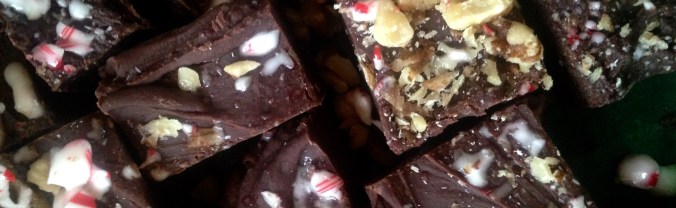
My teenager has been on a fudge-making bender this week, sizing up recipes, sourcing out inexpensive tins, buying ribbon to neaten up her gifts. Last evening, while I was lying gracelessly on the floor in my end-of-long-day stupor, she busily cut peppermint-stick and walnut-studded chocolate fudge and carefully packed the pieces with tissue paper into her bright tins.

She offered up her extras as gifts for me to give away. To the new neighbors, for instance.

Mom, she said, I’m making you look good.

I closed the Shirley Jackson bio I’m reading and looked at her. It’s been a long – perhaps too long a time – since I cared all that much about looking good. Somehow, in the years’ jumble of babies and breastfeeding, sugaring and bills, basketball games and sleepovers, I shifted to “not looking all that bad” as satisfactory enough.

Truth is, the girls do make me look good. Years ago, I would have considered this ancillary boon a trivial notion, hardly worth anything at all. How the world does change. I’m going to walk down the icy road to the neighbors, knock on the door, and offer up that gaily-wrapped fudge in full disclosure of its creator – with great joy.

Here’s a few lines from my library book….

Shirley Jackson saw herself, it seems clear, as a version of a writer…. (whose role) was to draw back the curtain on the darkness within the human psyche…. thousands of unsuspecting readers who opened The New Yorker on June 26, 1948, were confronted by a story (“The Lottery”) unlike anything they had ever read before. They admired it, they raged at it, they were puzzled by it; but no matter their reaction, it illuminated their world.

– Ruth Franklin, Shirley Jackson, A Rather Haunted Life

fullsizerender

Photo by Molly S.

Magical Realm

As the kids and I drove into Barre, Vermont, this afternoon, the little boy in the back seat said,  I really don’t like Barre.

I’m with the kid, I’m reluctant to say, for reasons no doubt wholly different than the boy’s. We were headed to The Nutcracker, in the gracious Barre Opera House. On the way there, I drove behind the county courthouse, repository of windowless hallways and claustrophobic rooms, countless tears of human misery.

But I trusted ballet could rewrite my experience of that city, and the magical dance did not let me down. At the performance’s very end, high up in the balcony, I realized  – in what should be a, well, duh, moment – that ballet was all about the transformative might of imagination.

All the way home – and here’s yet another driving story, yet another journey – we drove on icy roads through the smokey blue-black twilight, and then arrived in our own home town with full darkness ringed all around, velvety and deep, and the village lights twinkling white. The town itself might have been the opera house stage, lit-up and beautifully arrayed for the holidays.

When I was twenty, I worked nights for a summer. I loved driving at night as a young woman; the darkness around my two Volkswagen beetle headlights felt ripe with possibility, and I believed myself invincible with youth. In an odd juxtaposition, nearly thirty years later, possibilities stretch out even more infinitely before me. Although I now know the illusion of invincibility, I think I’ve traded that for something deeper and far more valuable in those sparkling lights.

Unamuno might be describing the artist as well as the Christian as he writes, “Those who believe they believe in God, but without passion in the heart, without anguish of mind, without uncertainty, without doubt, and even at times without despair, believe only in the idea of God, and not in God himself.”

– Madeleine L’Engle, Walking on Water: Reflections on Faith and Art

fullsizerender

Snow!

In our  free range child-rearing realm of West Woodbury, Vermont, sliding off the roof season has officially commenced. Last night, I heard my 11-year-old muttering to herself as she sized up her snow roof-raking endeavor. One more good snowfall should do it. She’s been accumulating a pile of snow to slid into from the low-ish roof.

This morning, we woke up to steadily falling flakes, and by this afternoon she and the neighbor boy were crafting a slide on the sugarhouse roof. While I did chores in the blue haze of winter twilight, I listened to the two kids shouting and laughing, and well beyond dark they were busy with winter’s bounty, bright-cheeked, merry, happy. Rain in the forecast – enjoy, children!

… Around the glistening wonder (of a snowstorm) bent
The blue walls of the firmament,
No cloud above, no earth below, –
A universe of sky and snow!

– John Greenleaf Whittier, from “Snow-Bound”

img_2968

Writing & Money

The other day, my Facebook-loving teenager casually mentioned to me that, on average, writers make $149K per year. “You’re doing something wrong, mom.”

These lines are full disclosure that, in fact, I am not earning $149K per year. The children and I are, however, still afloat. While I know all kinds of writers, many of whom are terrific writers as well as decent people, no one I know has ever undertaken the vocation of writing for money. Writers may be many things, but we’re generally not stupid.

When I taught a one day class at Johnson State College a year ago with Dede Cummings, my most useful piece of advice for aspiring writers was two-pronged: write and keep your expenses low. I really wasn’t kidding on either count.

Money is merely practical. Writing is art. Both are necessary – in my life (and my daughters’ lives, at least). So it was with real pleasure that the day I received a royalty check from my novel, I also met a woman I hadn’t seen for a few years. She had read my book (– and loved it; I write this with real pleasure), because another woman gave her the novel and told her to read it. That woman didn’t know me and didn’t know I had any connection to her friend. She is my ideal reader: someone who loved my book and passed it to another reader, as I do with so many books I love.

What a piece of luck was this chance encounter in the co-op’s coffee aisle, on a subzero and sunny day.

Writing a novel is like driving a car at night. You can only see as far as your headlights, but you can make the whole trip that way.

– E. L. Doctorow

fullsizerender

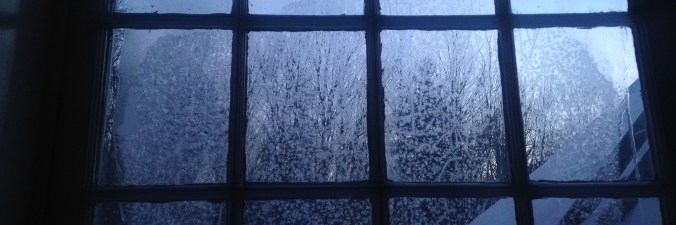
Living Room Windows, Mid-December

Where You Find Yourself

The first job I ever had, when I was fifteen, was a library page in the village library where I read darn near every book in the children’s section. I was so desperate to read, I even read the sic-fi and books about dinosaurs, neither of which were my favorites. One day, I discovered the classics were hidden in a back room off the children’s section. Dickens! Tolstoy! Steinbeck!

This fall, I became the librarian at Woodbury’s even tinier library. While I had to be talked into this position, I should have taken it right away; the library is one of my natural places. Likewise, a welder I sometimes use has a group of guys in his shop, hanging out in lawn chairs, with a hot wood stove crackling in the winter. That’s the place for those guys.

I see love of places in both my children, too. My teenager runs every day along our dirt road, breathing deeply of the woods. The younger girl has a place in her circle of friends where she’s at home. Which brings me to the present I’m knitting for someone’s Christmas gift. Knitting (and creativity) is a portable place, a true winter activity.

Properly practiced, knitting soothes the troubled spirit, and it doesn’t hurt the untroubled spirit either.

– Elizabeth Zimmermann

fullsizerender

Little Song

The December my youngest daughter was two, she and I did a sweet little one-day-a-week Waldorf mother and child program. One song she loved had the line Look at the snow falling down….

By the end of that December, snow had fallen every day, and our kitchen window was majorly obstructed. I took to gazing out the window and murmuring Look at the snow falling UP…. just to crack the monotony and mix things up a bit.

Those eternally long afternoons with a two-year-old. On a walk this afternoon, my now 11-year-old looks slightly down at me, so merrily proud she’s taller than me, and certainly no longer chubby-cheeked. Same lovely girl on our familiar dirt road, with sparkling winter all around, but always, eternally, in motion.

All things are in flux; the flux is subject to a unifying measure or rational principle. This principle (logos, the hidden harmony behind all change) binds opposites together in a unified tension, which is like that of a lyre, where a stable harmonious sound emerges from the tension of the opposing forces that arise from the bow bound together by the string.

– Heraclitus

img_2936