2017

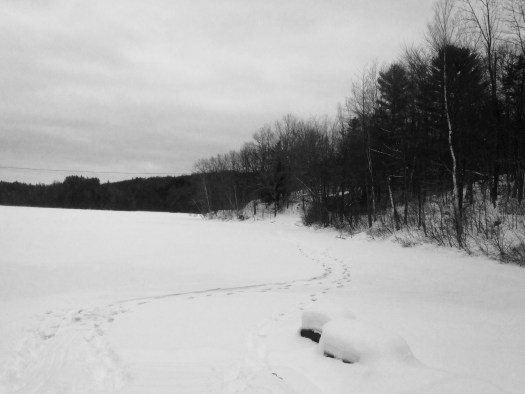
In Vermont, the winter is ubiquitous and possibly unending now. Fresh snow falls frequently, and all day yesterday the children were in and out of the house, hanging snow pants and mittens and hats clotted with snow to dry beside the wood stove.

Last night, driving through the tiny town of Lake Elmore, I pointed to a glowing line of lights on a hillside, and mentioned to my teenager that I wondered who lived there.

She answered, “It’s obviously a merry-go-around.”

This is a terrific thing about having a teenager – despite the crabbing or the exhausting insistence that life should be fair when of course fairness is not a universal principle – teenagers are simply fun. Why shouldn’t there be a merry-go-round in rural Vermont? It’s possible.

So, beginning another year, I’m bending toward brighter possibilities. Maybe that line of lights was nailed up to outdo the neighbors, or maybe the lights were bought by a teenage girl and her sister with money they earned, to illuminate their house, or maybe it is a carousel spinning around, welcoming in 2017 with music.

Bless this my house under the pitch pines
where the cardinal flashes and the kestrels hover…
Please, no foreign wars.
Keep this house from termites and the bane
of quarreling past what can be sweetly healed….
mostly keep us from our sharpening fear
as we skate over the ice of the new year.

Marge Piercy, from “On New Year’s Day”fullsizerender

Stitch by Stitch

When my younger daughter was two, my friend Jessica taught me to knit, which revolutionized my world. A life with little ones underfoot is improved by creativity which may be picked up or put down at any time. Unlike time (say, 2016), yarn can easily be unraveled, and the work improved.

Since my first knit, purl stitches, I’ve knit in numerous houses and meetings, across country on a train, in the ER, the endodontist’s office, at concerts, under trees, in the sugarhouse, in my bed.

With innumerable strangers, I’ve handed my knitting and their knitting back and forth, admiring and discussing. In despair, occasionally, I’ve thrown out knitting gone badly awry. My best knitting was a pair of mittens I knit my daughter for her 15th birthday, blue and white, compass pattern. Now I’m on a pattern a little too difficult, with yarn overs that are trouble to drop, with a pattern I am, stitch by stitch, accomplishing; it’s beautiful.

When my girls and I were talking about wishes for the new year, I thought work hard, but perhaps what I really meant was love well.

The products of science and technology may be new, and some of them are quite horrid, but knitting? In knitting there are ancient possibilities; the earth is enriched with the dust of the millions of knitters who have held wool and needles since the beginning of sheep. Seamless sweaters and one-row buttonholes; knitted hems and phoney seams – it is unthinkable that these have, in mankind’s history, remained undiscovered and unknitted. One likes to believe that there is memory in the fingers; memory undeveloped, but still alive.

Elizabeth Zimmerman (who else?), The Knitter’s Almanac


Snowed In…. and more

My brother borrowed my daughter’s car and returned it with the back door dinged in, which made us laugh. That’s all? 2016 has thrown a lot more at us. But here’s the thing: at the very beginning of my novel’s draft, I have that classic line from Dante: In the middle of the journey of our life I came to myself within a dark wood where the straight way was lost.

In my forties, the straight way is concealed, undoubtedly. But what I’d missed in that line until today is the coming to yourself gem buried within that sentence. Earlier this fall, I had a conversation with someone who described this phase of life as not solved by geography; this is an interior journey of the heart.

So, for a moment here, what better way to end a long year than with laughter? Big and little kids went sliding on the ice today – no sleds required; our kitchen is well-stocked; the snow falls – lovely as I remember from childhood; and my first novel hit the Galaxy Bookshop‘s 2016 bestseller list. Satisfaction.

Do not be afraid; our fate
Cannot be taken from us; it is a gift.

Dante Alighieri, Inferno

FullSizeRender.jpg

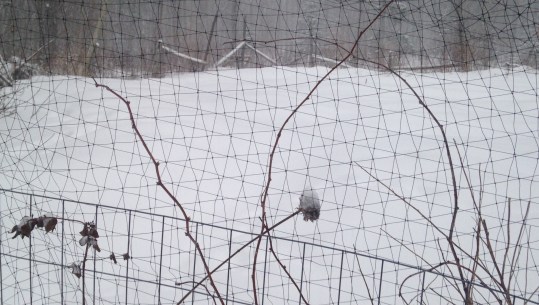
My garden in winter.

My Brother’s Handgun

My 11-year-old daughter wants to be an FBI agent when she grows up. I wish I could say I have no idea where that desire derives from, but a rawer truth is that choice illuminates a great deal about her young life – and equally about mine.

When I was a young mother, I focussed so much on what I could give my children – homegrown organic squash, stacks of library books, sand castle building – that I pretty much entirely discounted all the influences that would equally affect my daughters, unintended or not: in short, the great wide world we live in.

A first-time mother, I just took everything so personally, as if feeding my kid a potato chip would amount to heresy. I had this very naive idea that if I pushed the image of the Earth Mama hard enough, I could hold off from my children the equally real awfulness of this world.

Over and over, one strand emerges in my writing: that our choices and actions determine who we are; that while our heads may be filled with the finest of intentions and profoundest of ideas, only action and how those actions affect others determines, ultimately, the mark of who we are. Which perhaps is why I’ve ragged on that Hallmark card notion of love. In my experience, love is the nursing mother’s arms around her baby, but also the ragged fierceness to step forward when the seas go swirly and the sharks surface to feed.

Whether I like it or not, children grow up, one little bit at a time, not simply with a birthday, or turning eighteen, and, having seen plenty of ignorance (my own and others’), I’d far rather my daughters make their decisions knowingly.

So…. when my brother taught my younger daughter to shoot his Glock, his hands over hers, I let them be.

Here’s a New Yorker parenting article, on resilience.

fullsizerender

Woodbury Library

Clutter

With a gift of fudge, my teenager and I stopped by the new neighbors’ house yesterday. The boys and their father had disappeared outside, while the mother was reading a slender book on feminism she had given her husband for a Christmas present. She had determined the book was required reading for her high school student, while the 10-year-old was given a temporary pass.

Owned by a large Connecticut family, the house has been vacant for years. One night this fall, another friend was sorely in need of acorns for a photo shoot (these are the kinds of friends I have), and the girls and I drove down in the dark and searched under that property’s oak trees with flashlights for what my children once called “oak nuts.”

Now, the house is literally spewing belongings: mismatched ski boots, a basketball stand on its side in the snow, Christmas lights on a hedge so haphazard my older daughter laughingly said the lights appeared to have been tossed out a bedroom window. Family life in all its raging clutter. Coincidentally reading Shirley Jackson’s phenomenally useful and entertaining essays on writing fiction and craft, I realize how interested I am in their half-opened door, the painting already hung in the entry hall, and I wonder how our own messy family appears.

 It seems to me that in our present great drive—fiction-wise—toward the spare, clean, direct kind of story, we are somehow leaving behind the most useful tools of the writer, the small devices that separate fiction from reporting, the work of the imagination from the everyday account.

Shirley Jackson, “Garlic In Fiction”

fullsizerender

These Few Days

Christmas is an apt holiday for this northern time of year, a solstice pause when the light will begin turning around, slowly, before it returns by my daughter’s early February birthday in racingly long days. More than anything, I think of this time of year as intense juxtaposition – utter dark, crystalline snow – of giving and receiving – of domestic warmth and external cold.

As a young child, maybe six or seven, I remember listening to a Christmas story on the radio. My sister and I were confused about this place called Bethlehem, and why were Mary and Joseph wandering around on a donkey just before she had a child? How did this mysterious star appear? The most mesmerizing part of the story were the angels who appeared to the shepherds, camped out with their woolly flocks in night. The angels linked those two worlds – sandal-wearing staff-bearing shepherds, sitting around their nightly fire – with the profoundly unknown heavens, embodying juxtaposition: enchanting beauty and stark fear.

So it seems to me, this year perhaps in particular, that Christmas is a holiday for the pleasures of childhood – of play and eating and a ferocious appetite for life. The immense star that joined a newborn and his wandering parents to anonymous shepherds and wealthy kings alike shines yet over our polluted and ailing, and infinitely precious and beautiful planet; the story is yet alive.

And they came with haste, and found Mary, and Joseph, and the babe lying in a manger.

And when they had seen it, they made known abroad the saying which was told them concerning this child.

And all they that heard it wondered at those things which were told them by the shepherds.

But Mary kept all these things, and pondered them in her heart.

Luke 2, King James Version

img_3015

Elmore, Vermont/Driving home