Coltsfoot Dreams

February 4 always marks the return of light to me, and, from my windows, the skies are clear today. February 4, 18 years ago, was my first day as a mother. My baby had been born in the deep of night, shortly before midnight, and the 4th was filled with radiance.

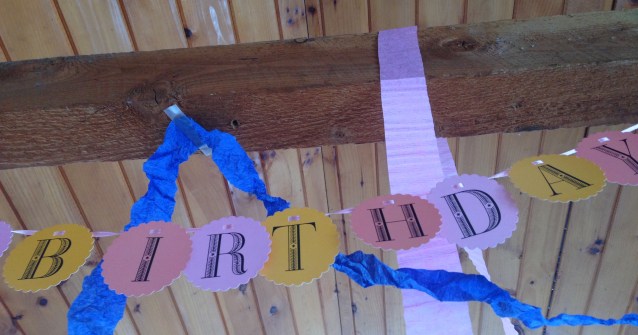
What’s 18 years over the span of millennia? Not even a heartbeat, perhaps, but for us, these years have been mightily full. Her younger sister and friends made tissue paper flowers and decorated the house with balloons and streamers, for this young woman who spent much of her childhood drawing or photographing blossoms.

It seemed fitting, then, that she returned from her birthday dinner with an exquisite bouquet from her boyfriend. The mistakes I’ve made as a parent could fill six novels. Yet here’s my tall beautiful daughter, her hands full of flowers, stepping into a world we’re offering her rife with political chaos, shot through with what should be acknowledged as unbridled vice, on a planet severely ailing.

And yet: flowers. The 11-year-olds and I stayed up late last night in front of the wood stove. Perhaps for no other reason than to delay bedtime, they began knitting with me. Kids and flowers: wily and beautiful.

February means spring isn’t that far in the offing, and spring means coltsfoot, those tiny gold blossoms thrusting up through the hardest and ugliest of roadsides, claiming their territory.

Our life here on earth:
to what shall we compare it?
Is it not like a rowboat
departing at daybreak,
leaving no trace of us in its wake?

 Takaha Shugyo, translated by Michael R. Burch

fullsizerender

Early February, Return of Light

Just about 17 years ago, my daughter had her first birthday, and even the parents ate pasta elbows with our fingers. We were entering the snot-strewn realm of parenting toddlers; standards had literally sunk onto the floor.

One father who was at that birthday party dropped off his daughter today, and we reminisced for a moment in my sunny, snow-covered driveway. His daughter had figured the math of their short drive from home to school, and how many hours that entailed. He had told his daughter that it meant so much more time they had together – all those years, through snow and slush, humid fall days, through happy days and miserable ones – while she grew up.

As a mother, I’ve learned how to bake a decent birthday cake, pull together a kid craft project from a handful of paper, a piece of yarn and a scissors, and listen, listen. Or maybe I just need a nap.

…I have done what you wanted to do, Walt Whitman,
Allen Ginsberg, I have done this thing,
I and the other women this exceptional
act with the exceptional heroic body,
this giving birth, this glistening verb,
and I am putting my proud American boast
right here with the others.

From “The Language of the Brag” by Sharon Olds

fullsizerender

Loon Recovery Project


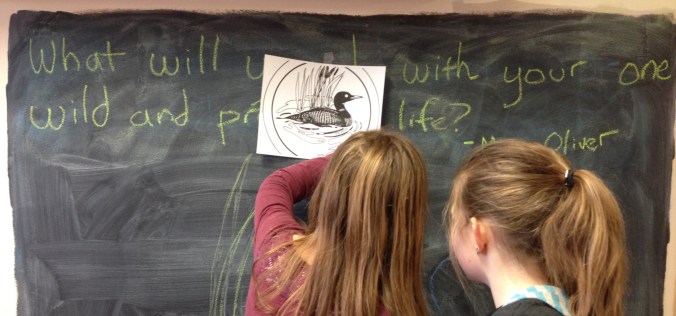
Late last night, while my daughter ate a grilled cheese sandwich before the wood stove, we talked about a slideshow about Vermont loons we’d attended at our library and, with the cold deepening around our house, reminisced about summer nights camping at Ricker Pond in Groton, when we lay awake in our tent and listened to the loons’ wildly beautiful tremolo – a call so bizarre it hovers between our world and the mystery of the unknown.

Remember? she asked. Remember?

Perhaps for no other reason than it’s the last day of January, and winter’s teeth are easing sufficiently I know spring isn’t far in the offing, here’s a Mary Oliver poem.

Lead

Here is a story
to break your heart.
Are you willing?
This winter
the loons came to our harbor
and died, one by one,
of nothing we could see.
A friend told me
of one on the shore
that lifted its head and opened
the elegant beak and cried out
in the long, sweet savoring of its life
which, if you have heard it,
you know is a sacred thing.,
and for which, if you have not heard it,
you had better hurry to where
they still sing.
And, believe me, tell no one
just where that is.
The next morning
this loon, speckled
and iridescent and with a plan
to fly home
to some hidden lake,
was dead on the shore.
I tell you this
to break your heart,
by which I mean only
that it break open and never close again
to the rest of the world.

fullsizerender

Flipping the Question

The summer I had my second daughter in 2005, the term “peak oil” surfaced in my world, first from a neighbor who came to see the baby. The term itself wasn’t so disturbing, but the potential social unrest was mightily so.

I’m sure Vermont has more than its share of the country’s population battening down the root cellar hatches and stocking the ammo cabinet to bursting. While I’ve been joking for years that my garden isn’t merely spiritual succor but also our homeland security project, I sometimes wonder if these hard-core survivalists just might be right, and I should be mapping a route out. What’s my reluctance? Laziness? Immersion in magical thinking?  Lack of ready cash to invest in an underground bunker equipped with a five-year supply of Spam? Or just, where the heck would we go? 

Evan Osnos writes in the recent New Yorker about ultra-rich disaster preppers, then winds up chatting with Stewart Brand, hippie cult creator of the “Whole Earth Catalog.” Osnos writes:

At seventy-seven, living on a tugboat in Sausalito, Brand is less impressed by signs of fragility than by examples of resilience. In the past decade, the world survived, without violence, the worst financial crisis since the Great Depression; Ebola, without cataclysm; and, in Japan, a tsunami and nuclear meltdown, after which the country has persevered. He sees risks in escapism. As Americans withdraw into smaller circles of experience, we jeopardize the “larger circle of empathy,” he said, the search for solutions to shared problems. “The easy question is, How do I protect me and mine? The more interesting question is, What if civilization actually manages continuity as well as it has managed it for the past few centuries? What do we do if it just keeps on chugging?”

fullsizerender

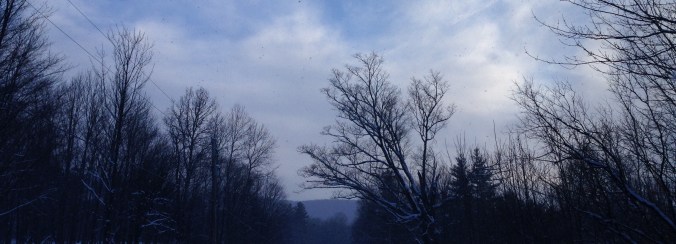
Morning commute, West Woodbury, VT

Young Women

My younger daughter collided with a basketball in practice the other day and returned home with a swollen lip. Her older sister, a tiger by nature, immediately asked if she should provide restitution. (It was an accident.)

Today, in her high school guidance counselor’s office, my teenager is all long legs, a combination of gawky and ravishing in her black parka and dark eyes. Like sparks, she emanates loyalty, desire, heartache, anger, joy. Yes, all this.

I’m reading the new biography of Emma Jung, and I can’t help but wince that this talented woman, like so many others, was under the “vaulting ambition” of her famous husband. As a society, we haven’t made it all that far from those days. How much I want for both my daughters not to bend under their future partners’ ambitions, and to expect with impunity equality in parenting and in creative fulfillment, to know that before we can demand justice anywhere else on the planet, our own relationships must at least be threaded with decency.

My fierce tiger, my mighty one.

If only we lived in a culture that made ambition compatible with motherhood and family life, that presented models of women who were integrated and whole: strong, sexual, ambitious, cued into their own varied appetites and demands, and equipped with the freedom and resources to explore all of them. If only women felt less isolated in their frustration and fatigue, less torn between competing hungers, less compelled to keep nine balls in the air at once, and less prone to blame themselves when those balls come crashing to the floor. If only we exercised our own power, which is considerable but woefully underused; if only we defined desire on our own terms.

– Carolien Knapp, Appetites: Why Women Want (Put this book on the required reading list.)

fullsizerender

Greensboro, Vermont

Winter Travels Near to Home

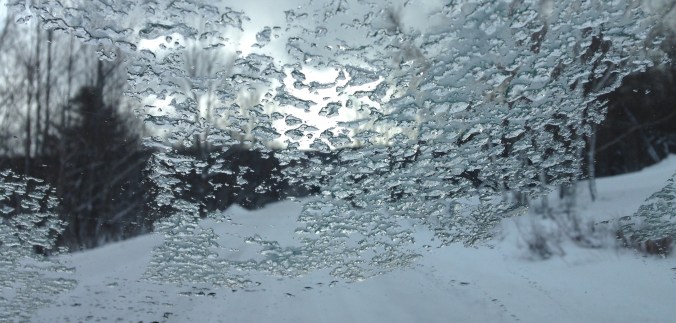
We drove home through falling snow tonight – real snow – not ice, not grapple, not nerve-wracking freezing rain. As my kid and I wound up our steep dirt road, the visibility diminished to just a blue twilight, white flakes and road, and my windshield wipers.

That narrow vision mimicked my day – both parenting and working. In my twenties, I would have raged; now in my forties, I still rage, but at least I’ve figured out the value of endurance.

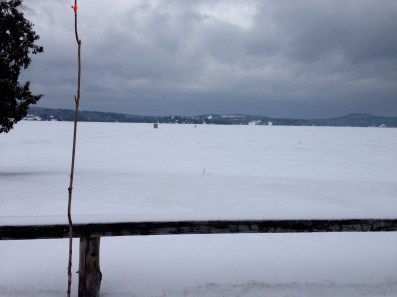
Working in Greensboro today, I stopped by Caspian Lake, scene of so many swims, beach chat, peppermint ice cream cones. On camp stools, three ice fishermen sat in the lake’s middle, beneath the open sky.

Winter solitude —
In a world of one color
the sound of wind.

– Basho

FullSizeRender.jpg