Here.

Here’s where I am, on this day buried deep in gray-and-white January: I’m in a tiny Vermont village — general store with a beer cooler and sandwiches made-to-order, post office open for its afternoon hours, volunteer fire department. It’s early afternoon, and I’m walking back to my library with an armful of mail, and no one’s around, the store empty of customers, no passing cars or granite trucks on Route 14 — no one but me and my library mail and a man on the steps of an unused church. He’s pressing his phone, and he doesn’t look at me.

I stand there, on the pavement, looking at him. I know who he is, as I’m sure he knows who I am, although we’ve never exchanged a single word between us. I know he’s been at my desk, illicitly after hours in the library, sitting with his hands on the worn wood, surrounded by stacks of books, my untidy bins of yarn and crochet hooks, the hastily piled colored scraps of paper. All around are small offerings from children — tiny notes to Miss Brett, a sketch of a piglet, an orange origami box holding a clay snowman. Miniature paper airplanes folded by 7-year-old hands.

On this January day, I keep thinking back to that sunny October afternoon, the leaves turning gold and russet. Had I known that man would be dead within months, I might have stood there a little longer and then walked over to him, said, Come in through the door and not the window.

As a writer, I’ve spent years training myself to look for junctures, to know actions matter far more than thoughts — and yet, that afternoon, I kept walking. Maybe I guessed I had all the time in the world, maybe I judged some things can slide without action and the world will work its own wonders. Maybe it was simply that the day was a fine autumn one, and I believed I had things to do.

I turned left, up the dirt road, and carried on with whatever I was thinking, and that particular day passed in the great finality of the past.

I believe that there is one story in the world, and only one. . . . Humans are caught—in their lives, in their thoughts, in their hungers and ambitions, in their avarice and cruelty, and in their kindness and generosity too—in a net of good and evil… There is no other story. A man, after he has brushed off the dust and chips of his life, will have left only the hard, clean questions: Was it good or was it evil? Have I done well—or ill?

— John Steinbeck, East of Eden
IMG_0917.jpg

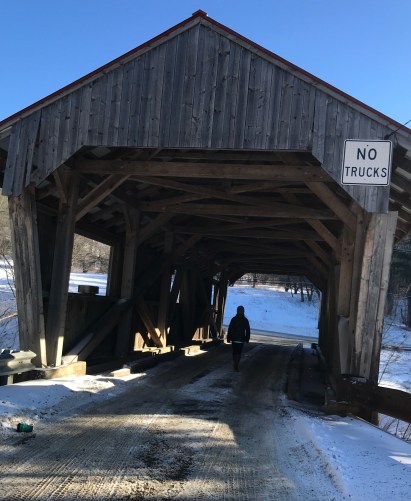
Johnson, Vermont


Winter’s Grass-Is-Greener

Driving down the Woodbury gulf in the twilight, staring at the road — snow-crusted, ice packed, with two curving black lines of asphalt worn through winter — I remember all those years of driving mountainous Route 9 in southern Vermont and wonder, What if I’d stayed in Brattleboro? What if my kids went to school there? I made soup with my publisher and used the Brooks Library with their enormous windows? What if I lived on Elliot Street again?

That’s January thinking.

My gaze lifts from the treacherous road to the gray and white mountains folding around that narrow valley, with the waterfalls and the rocky cliffs high overhead.

Trouble follows you anywhere. I know that. The last time I was in Brattleboro, itinerancy surprised me, the darker threads of our society thickening. I was glad I hadn’t stayed, that I had swapped a larger town for a smaller one. In the end maybe, it’s all Vermont roads, with those mysteriously beautiful mountains always greater than us, rising silently.

The winter wind flings pebbles
at the temple bell

— Buson

IMG_0912.jpg

Store Window Art, Hardwick, Vermont

Mid-Jan

Like a long-ago friend, the cold has settled in. Those summer nights sleeping with the windows wide open, listening to the peepers’ throaty hum, might as well be a memory from a long ago life.

With gusto, the girls ski, their appetites enormous, their cheeks red as cardinal feathers.

Halfway through January, we’re meshed in winter’s routine, with so much of the season ahead. In breaks of thaw, memories of spring will tease us again, reminding us of loosening earth, the rustle of rain on leaves. Robins singing their love songs.

It seems to me that the desire to make art produces an ongoing experience of longing, a restlessness sometimes, but not inevitably, played out romantically, or sexually. Always there seems something ahead, the next poem or story, visible, at least, apprehensible, but unreachable.

— Louise Glück

IMG_0920

Kid note. Sunday afternoon.

Early Hours

In the night, rain thickens to snow. Wind has washed away yesterday’s balmy temperatures.

The cats and I are awake hours before the girls, myself with that eternally running list and dialogue, the cats warm-pawed and hungry. Satiated with their breakfast, one lies on my legs, the other on my feet, while I read The Perfect Nanny, a book brutal and beautiful.

I parse Slimani’s sentences: How has she written this? How has she put this together? and wonder, Who of my library patrons would read this? 

Ice pelts the windows. Our house is blessedly warm, the kitchen filled with light.

She feels alone with the children. Children don’t care about the contours of our world. They can guess at its harshness, its darkness, but they don’t want to know anything more.

— Leila Slimani, The Perfect Nanny

IMG_0906.jpg

Mist and Clouds

Hill Farms

A drawback to easy-access tech is a proliferation of images, everywhere.

And then, this. From the library, I picked up Richard W. Brown’s The Last of the Hill Farms: Echoes of Vermont’s Past, a stunning book published by Godine, with the most amazing black and white photographs of rural farming Vermont.

Check out page 95, with the moon sailing over a barn’s cupola, righteously high with a cow weathervane, intimating great height over farm fields. Broken-paned, paint peeling,

There it is: that elegant, perpetual juxtaposition of human endeavor and the lasting beauty of our landscape.

A neglected landscape silently gathered the patina of the passing years. Weather stained the unpainted barns and farmhouses the color of tarnished silver and gently bowed their rooflines with the weight of one hundred winters’ snow. Seemingly forgotten by the rush of progress, they aged with a poignant grace: spare, worn, yet, to my eye, hauntingly beautiful.

— Richard W. Brown, The Last of the Hill Farms

IMG_0902

Kid Zen

My 12-year-old shoveled a path across our sizable lawn, ending at the cemetery’s fence, putting considerable effort into this project.

My teenager, arriving home from work, asked me, in her trademark language, What the hell?

The next morning, I stood on the porch, watching my girl walk through her path, leap the fence with her backpack, and then plunge through the snow on the cemetery side. She lifted her hand once and waved at me.

The girls are both teetering on the precipices of new ages — one into adolescence, the other leaving adolescence for adulthood. I loved that dogged determination of my daughter, shoveling snow through a field in the bitter cold. A few mornings later, doubtlessly wising up to avoid wet jeans all day at school, she opted to head down the road and take the unshoveled path. At the top of Spring Street, she waits for her friend, holding her sister’s insulated mug with hot chocolate.

This girl reminds me that the journey really is the thing, that parenting isn’t ever about a goal or an ending place. Innately, she knows this, while I’m still standing on the porch step, watching.

A scholar tries to learn something everyday; a student of Buddhism tries to unlearn something daily.

— Alan Watts

IMG_0868.JPG