Four Maples

A friend from my high school years (which, my daughters remind me, were literally in the last century) sends me an email, and I email back from my car, in a gray parking lot beside even grayer Lake Champlain. I remember canoeing from Burton Island to the mainland on a bright, balmy morning last July, and then waiting on a high point on the mainland, watching the ferry traveling across the lake with my 12-year-old daughter and her friend. When the ferry docked, I ran down to meet them, the girls glowing and happy with their adventure.

This friend writes about taking his kids swimming, and I wonder, pond or lake, river or pool? It’s been so long since I’ve seen him I would pass him by on the street, and not recognize him.

Finished, I fold up my laptop. I nod goodbye to this polluted and yet gorgeously beautiful lake and head towards a building where I’ll be blind to the lake all day, but I think for just one more moment of that town where I grew up. Along the square of lawn that my sister and brother and I wore down through endless kickball games stood four giant sugar maples, so tall their lowest branches were high above our heads. I wonder if there’s any chance those maples are still there, haven for songbirds, their leaves lifting up and ruffling over in approaching summer storms.

Once there was a tree….
and she loved a little boy.
And everyday the boy would come
and he would gather her leaves
and make them into crowns
and play king of the forest…

— Shel Silverstein
IMG_1066.JPG

Where we are now

Birth

A young father I know recently described his wife’s incredibly long labor which ended in a caesarean as simply, The baby wouldn’t come. The baby did come, though. The father spoke to me with his tiny son cradled in one arm on his lap.

This time of year, approaching my oldest daughter’s birthday, I always remember the days leading up to her arrival encased in winter’s icy silence. There had been back and forth with a midwife whom we trusted and shouldn’t have, but at the heart of everything was the baby concealed in the warm, wet womb, nearly ready to enter this world. How much I wanted to see her, face-to-face.

That child is a young woman now, full of laughter and silliness — and struggles to determine who she is, where her life will lead. I always think back to the night of her life as a long rowing across stormy seas in a wooden craft, heaving on the waves’ tempest, fiercely determined to reach solid shore with my child.

Her hands are on the oars now, too.

I want death to find me planting my cabbages, not concerned about it or—still less—my unfinished garden.

— Nina Riggs, The Bright Hour: A Memoir of Living and Dying

IMG_1056.jpg

Monday Morning Good Things

This morning, I step out on the back porch to say, Goodbye, have a nice day to my 12-year-old as she walks to school. I lift my voice a little and add, Feels like March and spring!

By way of answering, she raises one hand, watching the ice beneath her boot soles.

Okay, she’s headed to 7th grade (myself and all my friends think been there, done that) but I also see, as the new town kid, halfway through the school year, she’s figuring out how to navigate her own way: who to walk with, and what’s the best snacks for the jaunt home.

I, on the other hand, like many mothers I know, step back in the house and breathe for a moment before the week with all its many pieces rushes at me.

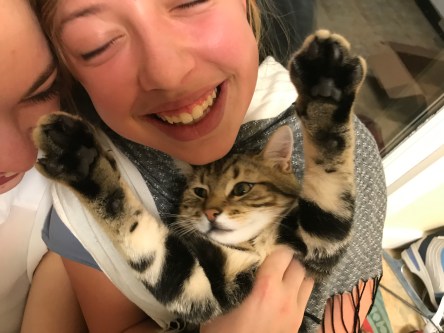
Here’s some good things: an interlibrary loan book I know will be in the post office box today. None of us are sick. The cats are curled in a box, sleeping off their breakfast. The kitchen floor is washed, and there’s all this sunlight, as the planet ever so slowly bends toward spring.

Buying leeks
and walking home
under the bare trees.

— Buson

IMG_1023.jpg

Weighty Reading

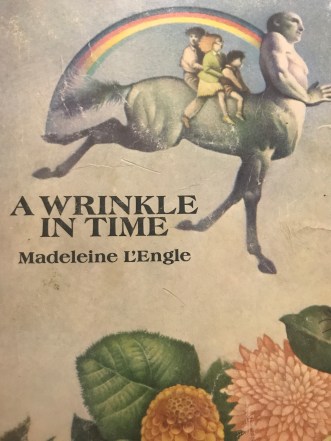
A 8-year-old boy appears in my library and asks for a copy of the wrinkle book. He’s looking for Madeline L’Engle. When I place the book in his hands, he holds it, staring at the cover. It’s an old hardback copy, the dust jacket long since disappeared, so the cover is a plain turquoise, the corners worn down.

This book’s too hard for him to read. I know it, and he knows it, too. I ask if his parents ever read to him at night, and he says, No.

I was a little younger than this boy when my father read this book to my sister and me, and even now, I have to think a little about a tesseract: what is this odd, strange wrinkle in time?

This child isn’t shy, but he stands there, holding this book in two hands. Gently, I suggest he take a second book, too, one I know he can read and will likely love, but he takes the L’Engle, too, pushing the books deep into his backpack without a word.

Life, with its rules, its obligations, and its freedoms, is like a sonnet: You’re given the form, but you have to write the sonnet yourself.

— Madeline L’Engle, A Wrinkle In Time

IMG_1007

The Worth of a Tree

After Obama as a senator had been on NPR’s Wait, Wait, Don’t Tell Me, host Peter Sagal mentioned they had to scrap the charisma off the floor. Last night, my local bookstore, The Galaxy Bookshop, asked Howard Frank Mosher’s brother Terry to read from Mosher’s posthumous collection of stories, and I’m sure the booksellers had to sweep what might be described as just plain Niceness off the floor. What a lovely family. What weeping. What laughter. What a life, Mr. Mosher.

Terry Mosher spoke about a Robert Frost poem their father read to the boys when they young, and mentioned how deeply and tenaciously those lines rooted in his brother’s fiction. He quoted, “The trial by market everything must come to,” and noted that all through Mosher’s writing runs rural people fighting against measuring land in monetary terms, the worth of life in dollars and cents, which sums up one of the deepest conundrums in current Vermont — or stretch that way, way beyond my Green Mountain State borders, far into the terrain of human nature.

The city had withdrawn into itself
And left at last the country to the country…
— From Robert Frost’s “Christmas Trees”
IMG_0986.jpg

Where we are

The Foul-Mouthed

We talk a lot in our house. I mean,  a lot. The mornings I work at home, I always close my laptop when my oldest comes downstairs, generally holding a cat. This daughter works late and stays up later, while I’m awake hours before January’s dawn appears. Even if only for a few minutes — often while I making more coffee or washing a few dishes — we talk, and much of it is simply my own curiosity. What’s up with you? What’s happening in your world?

What she gets from me is possibly not much, but one thing both daughters seem to be absorbing like osmosis is the interconnectedness of everything. This leads to that which prompts this… and so on. That the past is alive and real, and the future holds a myriad of possibilities.

So when my teenager mentions Trump’s denunciation of shithole countries and asked if I could believe it, part of me said God, yes, I believe it, while another part of me is perpetually shocked by such a fatuous fool as commander-in-chief.

I forwarded her this Chris Hedges’s essay my father sent me, in hopes of widening the thinness of a public high school education. Hedges begins, “I covered the war in El Salvador for five years. It was a peasant uprising by the dispossessed against the 14 ruling families and the handful of American corporations that ran El Salvador as if it was a plantation.”

IMG_0984

Sunday, when we’re lucky to live in Vermont.