This Woman, My Daughter

From seemingly out of nowhere, my youngest daughter asks me if Jesus really brought dead people back to life. I pause — there’s been no recent death in our family — before I say that might be possible.

What are miracles, anyway?

My daughters are two of the billions of people who have walked the planet. This morning, I woke thinking of my older daughter, 19 now, and the conversation she and I and my friend had last night, over dinner and knitting and the cats who played with the feathery toys my friend brought. My daughter is grown up now. Always headstrong, she’s plowed into passion and passion’s heartbreak.

The cliché for mothers is to mourn the loss of the tender, little years; this young woman and I share a whole remembered world together — just she and I — like the afternoon in her stroller when she was two and I pushed her through a thousand tedious errands in Montpelier, while she held three buttons in the shape of balloons — pink, yellow, blue — in her tiny fist. I had promised to sew those on her favorite dress. Her younger sister wore that same dress, with those same three balloon buttons.

Or the afternoon in a thunderstorm when she was four, wearing her favorite friend’s t-shirt with a frog on the front, she leaned over the porch and pulled out the neck of the t-shirt so a river of water from the roof poured down her face and body. Laughing: full of radiant joy.

Billions and billions. Over and over. There’s nothing simple about any of this. Not childhood, not growing up, not making a woman or a man’s life. And yet, here we are.

…. it ought to make us feel ashamed when we talk like we know what we’re talking about when we talk about love.

— Raymond Carver, What We Talk About When We Talk About Love
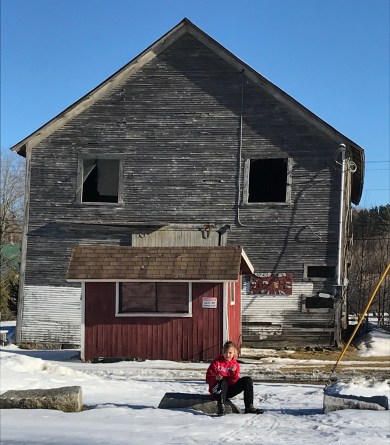
IMG_1311.jpg

Marvelous March Madness

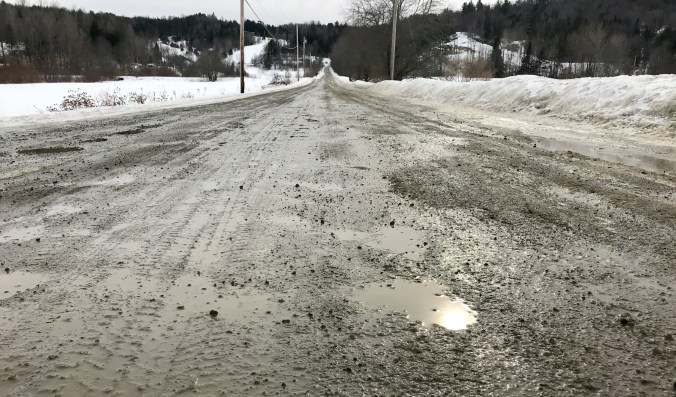
Spring may be fêted with pastel bunnies and pale eggs in the Hallmark and Nestle worlds, but Vermont’s spring must be brutally strong to break winter’s back.

Thaw, and the ice pounds back. Melt, and freeze steals into the night.

The hardest I’ve ever worked in my life is sugaring season. When my younger daughter was two, I remember lying with her under the skylight over our bed, completely spent, reading Louse Gluck’s poem in The New Yorker. I had little time for reading in that season, and this poem always reminds me of this season’s pithiness, the stubborn desire to press on through mud and ice, toward the blossom season.

The sea doesn’t change as the earth changes; it doesn’t lie. You ask the sea, what can you promise me and it speaks the truth; it says erasure

Nothing can be forced to live.The earth is like a drug now, like a voice from far away, a lover or master. In the end, you do what the voice tells you. It says forget, you forget. It says begin again, you begin again.

From March by Louise Gluck

IMG_1295.jpg

Treasures of the Least Likely Kind

Rough-cut diamonds rain on Jupiter: we learn this at a planetarium presentation in St. Johnsbury.

Afterwards, my daughter and our friends walk out of the Fairbanks Museum — one of my favorite places with its collection of local and exotic: freshly picked flowers in season and an ancient clay vessel for wine, Egyptian mummies and Civil War paraphanelia.

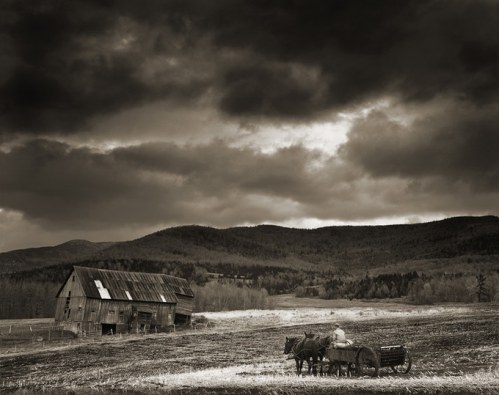
And, a fantastic collection of Richard W. Brown’s photographs temporarily on-display, the real reason we had driven to St. Johnsbury that day.

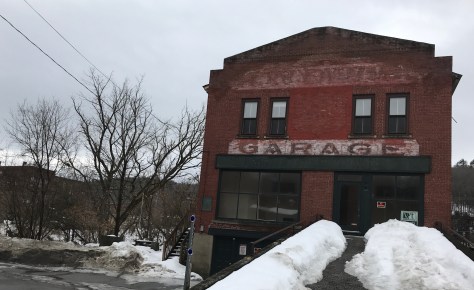
When my younger daughter was three, we had the head rebuilt of a Volvo station wagon we had bought from someone who likely botched the original job and passed the vehicle to us. A mechanic far out on a back road in St. Johnsbury did the work. My three-year-old and I on a beautiful summer day drove along twisting back roads I had never traveled, and ended up at an enormous windowless garage with a single green door at one end. I knocked; no one answered.

Holding my daughter’s tiny hand in mine, I entered and walked through what seemed to be an Alice-in-Wonderland mechanic’s world of room after room of greasy engine parts. I found the mechanic, a man in his sixties, his face and hands permanently hued with that same black used engine oil, in the labyrinth. The inside to my Volvo’s heart he had wrapped in a cloth. He opened the cloth and showed me the shining silver.

I lifted my tiny daughter, in her yellow and red-flowered sundress, a hand-me-down from her sister. He showed my child the work he had done. He and I spoke for a bit, while I wrote a check. As I turned to leave, he noticed my daughter was staring at a tiny plastic horse on a cluttered desk and told me to take the toy for her. He said the horse had been there for a long time and must have been waiting for her.

In a borrowed car, I followed the dirt roads down to the river, then turned left, toward  home. My little daughter sat in the backseat, that horse clenched in one fist, staring through the window at the landscape passing by. In the back was that rebuilt piece of our car, wrapped in clean cloths.

That Volvo has long since passed out of my and daughters’ lives, in the endless way of consuming minerals and money cars claim. My daughter wore that dress for years, until it was far above her round knees. The horse is likely still in our possession, in a treasure box of childhood mementos. And the mechanic? We never saw him again. But I still hold the kindness of a stranger who paused on that July day to wonder what interested a small, unspeaking child.


Scrambled eggs and whiskey
in the false-dawn light. Chicago,
a sweet town, bleak, God knows,
but sweet. Sometimes….

From Hayden’s Carruth’s Scrambled Eggs and Whiskey

39ec7c5d890ce6aca0c29faaef453547_original.jpg

Richard W. Brown


Teaser of Spring

Home early from work, I walked to the post office with my daughter, in what Vermonters know as sugaring weather. Streams ran down hillside streets. Birds sang in bare-branched treetops.

This is the first winter I have lived in town in many years, and I’d forgotten how the melting snow recedes, leaving a pointillistic, 3D mosaic of dirt. With her bare fingers, my daughter picked up little bits of snow and tossed them at my knees, and we made a game of kicking those icy bits ahead of us, walking, as she offered me a few little bits of middle school life.

Passing the elementary school with its mountainous banks plowed to the edges of the parking lot, I remembered my own elementary school, where I walked on those ridge tops in an unbuttoned wool coat, mittens swinging from the knitted cord my mother made, tying the mittens tightly to the coat.

My daughter dug her fingers into a snowbank and threw a handful of ice, soft snow, and dirt over our heads.

Learning to trust the possible and to accept what arises, to welcome surprise and the ways of the Trickster, not to censor too quickly — all are lessons necessary for a writer…..Attentiveness may appear to be nothing at all, yet under its gaze, everything flowers. ‘Awakened,’ Dōgen wrote in a poem, ‘I hear the one true thing —/Black rain on the roof of the Fukakusa temple.’

— Jane Hirshfield, Nine Gates: Entering the Mind of Poetry

IMG_1178.jpg

Montpelier, Vermont

Tales from Library Land

When I was vacuuming tiny gold stars from the library’s rug yesterday, in the hour when the tired after school kids were getting picked up and before the adult readers appeared, I noticed the carpet, hard-worn when I arrived as the sole employee, was even more shabby. A splotch of yellow paint, snips of pink yarn, dog hair that perpetually sloughs off a few small patrons. The carpet has been used by all sizes of feet.

The walls are covered with kid art, colored paper chains hang from the ceiling, donations for the pie breakfast book sale line the walls.

Although I was so tired I considered lying down on the floor before the reading group, the adults arrived with incredible enthusiasm. The kids made popcorn and kicked a soccer ball in the other room, with a strange sound like someone banging her head against a wall I (futilely) tried to ignore.

I heated water for tea. What do goals mean in a lifetime, anyway?

Here’s one of mine: heat water for a thousand cups of tea in this one-room library.

I have always imagined that Paradise will be a kind of library.

— Jorge Luis Borges

IMG_1163.jpg

Craftsbury, Vermont

Parking Lot Humor

A friend once remarked to me that my older daughter has a “very thin scrim” between her and the world. Last night, returning with the girls and their skis, we stopped at a supermarket in Waterbury and wandered through the mostly empty store. When we walked back to my daughter’s car, she stopped and remarked about the car parked very near to hers: What a dick move. She edged around to her driver’s seat and said with absolutely no rancor at all. This is the kind of parking job I would do.

I laughed. I mean — parenting? It’s hard. It’s darn hard. The thinness of that scrim gets to me. So any humor? Send it my way……

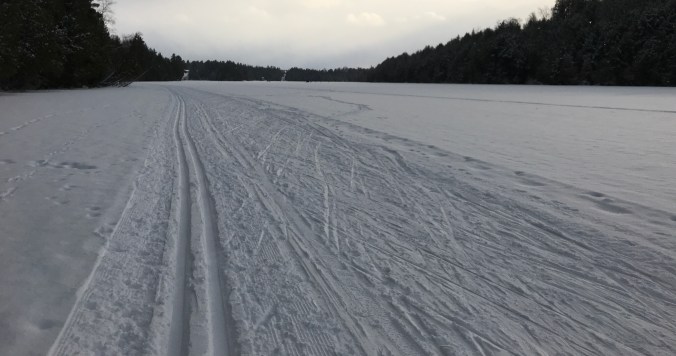
IMG_1159.jpg