Birthday Blessings

This afternoon, I stepped out of my library with a child to look at the sky. He was glad he had returned a stack of library books, a kind of clearing of his child conscience. In my clogs, I leaned against the building, a squall fattening in this valley, tucked up against Woodbury Mountain. What a winter this has been. Snowbanks dominate Hardwick like a pop-up mountain range.

Later, a friend and I leafed through a Vermont guide to wildflowers. Remember spring beauties? Remember trilliums?

Early March is my father’s birthday and, two days later, my mother’s. In their  80s now — old but not very old, not even close to very old — my parents who lived through WWII, the Vietnam War, Nixon’s resignation, and the eternity of the Reagan-Bush regime, through having careers and raising children, teaching and writing books and caring for the infirm and the dying, through decades of friends, through all the everydayness of living — and now through the particularly heartless regime of Trump — here’s Hayden Carruth’s birthday poem for love of a woman and love of living.

“Birthday Cake”

by Hayden Carruth

For breakfast I have eaten the last of your birthday cake that you
had left uneaten for five days
and would have left five more before throwing it away.
It is early March now. The winter of illness
is ending. Across the valley
patches of remaining snow make patterns among the hill farms,
among fields and knolls and woodlots,
like forms in a painting, as sure and significant as forms
in a painting. The cake was stale.
But I like stale cake, I even prefer it, which you don’t
understand, as I don’t understand how you can open
a new box of cereal when the old one is still unfinished.
So many differences. You a woman, I a man,
you still young at forty-two and I growing old at seventy.
Yet how much we love one another.
It seems a miracle. Not mystical, nothing occult,
just the ordinary improbability that occurs
over and over, the stupendousness
of life. Out on the highway on the pavement wet
with snow-melt, cars go whistling past.
And our poetry, yours short-lined and sounding
beautifully vulgar and bluesy
in your woman’s bitterness, and mine almost
anything, unpredictable, though people say
too ready a harkening back
to the useless expressiveness and ardor of another
era. But how lovely it was, that time
in my restless memory.
This is the season of mud and thrash, broken limbs and crushed briers
from the winter storms, wetness and rust,
the season of differences, articulable differences that signify
deeper and inarticulable and almost paleolithic
perplexities in our lives, and still
we love one another. We love this house
and this hillside by the highway in upstate New York.
I am too old to write love songs now. I no longer
assert that I love you, but that you love me,
confident in my amazement. The spring
will come soon. We will have more birthdays
with cakes and wine. This valley
will be full of flowers and birds.
IMG_4848.jpg

Snippets From the Snowy North

Snow falls on my 13-year-old’s hair as we walk through the falling snow. 13-year-old girls are empirically unable to wear hats. Ski helmets, sure. But hats? Get real.

Nonetheless, I ask her to walk with me. Beneath a pine tree, our neighbor’s streetlamp glows day and night at the end of her driveway, weirdly reminding me of the lamppost in Narnia. In this Vermont transformed to the otherworldly by so much snow might a faun appear around a snowbank? Has this neighbor left the lamp lit for someone? Or has she merely closed her curtains and forgotten?

We’re keeping tabs on the neighbor’s progress on his pale blue Honda. Before the storm, he’d removed the hood and laid it on a snowbank. With the recent storm, the car is buried again.

We speculate. Did he return the hood before the recent storm? Oooo, we hope so, thinking of the car engine open to 10 more inches of snow. Implicitly, we’re rooting for him, as if repairing this vehicle is synonymous with spring.

The Chinese junk
not stopping
moving on through the mist

— Buson

IMG_4670

Pre-storm….

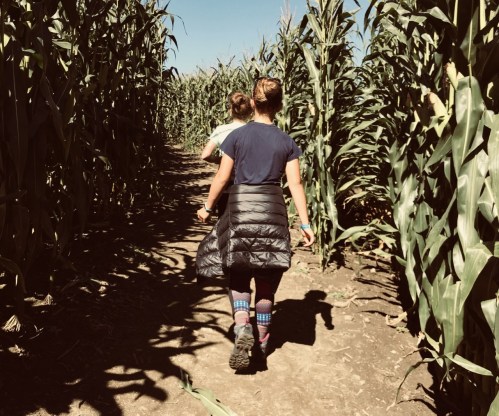
Why I Hate the Corn Maze

Ever read the late David Foster Wallace’s A Supposedly Fun Thing I’ll Never Do Again?

Okay, that was about cruise ships. My supposedly fun thing was a corn maze which began as lots of fun, driving along maple-lined dirt roads, past hayfields, laughing with the kids about the mist we kept entering and exiting, apparently in the middle of rural-Vermont-nowhere.

In this amazing corn maze, hard-packed dirt paths wound between immensely high corn. An hour in, actually beginning to wonder if we might not get out, I dredged up what limited survival skills I might possess, and ordered the kids to follow “the rule of right” and only make right-hand turns — as if that was the key out. Even smarter, perhaps, we tagged behind a cheerful grandparent-ish couple who practically ran through the maze and got us out.

So much for fun mothering experiences, these few hours that seemed, honestly, a little too close to the marrow, a little too near my life — wander around and conjure some savvy to get out.

Much later that Sunday evening, picking up stray socks and library books and putting away laundry — getting ready for a working week — I realized I failed that metaphor for life: enjoy the journey. Take note.

Because here’s something else that’s weird but true: in the day-to day trenches of adult life, there is actually no such thing as atheism. There is no such thing as not worshipping. Everybody worships. The only choice we get is what to worship. And the compelling reason for maybe choosing some sort of god or spiritual-type thing to worship—be it JC or Allah, be it YHWH or the Wiccan Mother Goddess, or the Four Noble Truths, or some inviolable set of ethical principles—is that pretty much anything else you worship will eat you alive.

— David Foster Wallace

thumbnail_IMG_3461

Snippet

For dinner last night, my daughter fried beef for enchiladas. From the garden, I brought in a basket and began washing vegetables. Here, throw in slender leeks, sweet red peppers, onions with their fat greens. I filled a salad bowl with mesclun, radishes, sun gold tomatoes.

Do people talk about the weather as much as Vermonters do? What a summer, we say.

Yesterday: muggy heat, steady rain, a perfect evening. We swam in the nearby pond again, a little chillier after the rain. Then we gathered up our towels and went home.

More from that stack of donated books:

Our story is never written in isolation. We do not act in a one-man play. We can do nothing that does not affect other people, no matter how loudly we say, “It’s my own business.

— Madeleine L’Engle, Walking on Water: Reflections on Faith and Art

IMG_2658.jpg

Girls camping, Lake Champlain: water, rocks, sky, and s’mores

Train Trip

Four summers ago, my family planned an Amtrak journey from Vermont to Santa Fe, New Mexico, in what would be the longest family trip of our girls’ childhood. That summer trip evolved into an illustration of that Robert Burns’ line about the best laid schemes not following the script.

We set out with a curveball detour to Charlottesville, then to New Mexico via Chicago. Somewhere in the month of  August, driving my dad’s old Subaru through the Navajo reservation, I wondered what if the hydrangea outside our back door was blooming, and if we would ever return home.

We did, of course.

In Travels with Charley, Steinbeck writes about how trips take over — true, true….

Yesterday, for a writing assignment, I took my 13-year-old and her friend to the southern end of Vermont on Amtrak  — just enough of riding the rails, of licking ice cream and browsing bookstores, walking across the bridge spanning the Connecticut River so we stepped into New Hampshire.

Back the Montpelier station, we drove home through the breathtaking July dusk, along dirt roads flanked brightly with David Budbill’s ubiquitous day lilies. My daughter went to sleep last night with her cat curled at the foot of her bed.

I saw in their eyes something I was to see over and over in every part of the nation — a burning desire to go, to move, to get under way, anyplace, away from any Here. They spoke quietly of how they wanted to go someday, to move about, free and unanchored, not toward something but away from something. I saw this look and heard this yearning everywhere in every states I visited. Nearly every American hungers to move.

— John Steinbeck, Travels With Charley: In Search of America

IMG_2690.jpg

Brattleboro Museum of Art, Vermont

Age 19

Oh, ode to June in all her lovely greenery.

Remember being 19-years-old? Remember desire, desire, desire?

The summer river.
It’s happy to walk across it.
My hands with zori sandal.

—Buson

IMG_2215

Dog River, Berlin, Vermont