Construction Paper

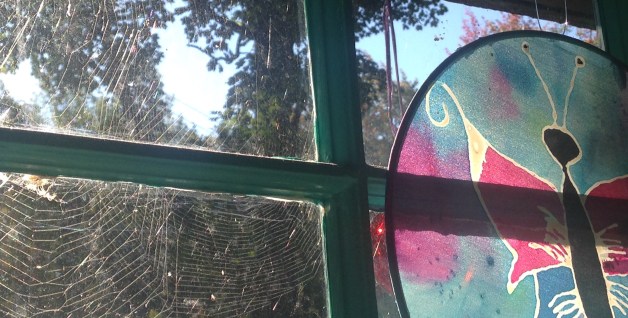
This morning, colored paper leaves spruced up our kitchen windows. My teenager had spent some late hours busy with arts and crafts and Netflix. Our house is the better off for this.

Which got me to thinking… what are the things a kid needs? The obvious ones, of course: steady meals and sturdy shoes and an arc of adult arms. But beyond survival, I see how my own children thrive into their imaginative spaces, busily not finding but creating their own niche.

As babies, their whole lives commenced literally turned into my heart to suckle, but now I see my kids intentionally widening their worlds, painting their bedrooms but also expanding their realms through deepening friendships and giggling nights, or their own journeys on foot or bicycle or down the highway.

What does a kid need? Perhaps what as an adult I need, too: freedom to spread out and explore, and a home to hold your artwork.

Here’s a few lines from what I’m reading now:

There was a period… with every painting or project when the life of that painting became more real to you than your everyday life, when you sat wherever you were and thought only of returning to the studio, when you were barely conscious that you had tapped out a hill of salt onto the dinner table and in it were drawing your plots and patterns and plans, the white grains moving under your fingertip like silt.

– Hanya Yanagihara, A Little Life

fullsizerender


What makes us who we are?


Autumn Commences

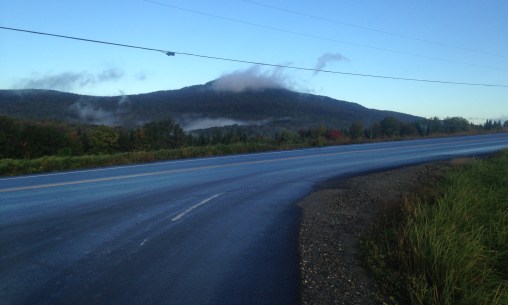
I took an unusual route to work this morning, in an attempt to avoid construction, and was rewarded with fog so rich along the valleys my little car crept along, the headlights no doubt mere smears in the white layers.

As I passed through one rise of mountains, my children traveled the other, each of us parting in the early morning, surrounded by infinite layers of pure, wet white. How I would love to jettison a day’s obligations and disappear into those high rocky peaks, the mist melting in the rising sun, the woods whispering their own particular language in my ears.

At my desk, I think of my daughter with her black and silver-keyed clarinet, an instrument new to her, her brown eyes merry with happiness this morning, anticipating music.

First autumn morning
the mirror I stare into
shows my father’s face.

– Murakami Kijo

fullsizerender

Elmore Mountain, Vermont

David Budbill, Poet

A few years back, I packed up my manuscript and mailed it across the river to a poet I’d read for years but didn’t know. The poet read my manuscript, emailed me, drove up my icy back road, and had tea with me. My house has many doors, and he came in the back door – the practical one, where I carry in firewood and store cardboard boxes of canning jars. The poet, David Budbill, was not perturbed at all by stepping over domestic clutter.

I am but one among many, many, many who received David’s largesse of heart and generosity. The true midwife of my book, he wrote me that it was “very important” not to let any of my grit be watered down now. Do not cave in, he insisted, to any demands to ameloriate what is hardest, rawest, most true, and beautiful in my writing. He, himself, exemplified this advice in his work.

I’ve cherished his wisdom, as a writer and a woman, like an amulet. May I someday return the favor to another, in gratitude to David.

David Budbill, poet of lust and life. Travel well, crossing over into the next realm.

…The sky is empty. The birds are gone.
Dark. Darker still. And winter coming on.

The sky steals light from both ends of the day.

Four o’clock. Almost dark.

Roy McInnes closes the doors of doors
and stands for a moment in the evening
watching streams of commuters going home,
then he turns and goes home….

And winter coming on.

Providential Kindness, bless us.
Bless all souls alive in Judevine,
and bless the ghosts.

Give us Benediction.

– David Budbill, Judevine

fullsizerender


Emerald Heart

Hard, cold rain woke us this morning. In her pajamas, my younger daughter knelt dreamily at the window and murmured, I love the sound of rain, while my teenager rolled over with news it was a bad idea to get up.

Vermont has officially tipped into autumn. I can’t even desire a last swim. Before long, heat will derive from our woodpile and not the sun. Listening to the rain in the lightless, early morning, I woke from a dream where my pole beans, whose bounty is toughening inedibly, threaded through a late-night conversation with my teenager. Her steps into the adult world are just beginning. Worried, she frets this particular door or that has already shut for her.

I counsel her in my own blunt way: all our lives, doors bang closed; a shut door is nothing personal; be persistent, find another door or window sash that yields to your knock, and enter. One of the best pieces of advice a school board colleague gave me was to value curiosity, to regard insatiable inquiry as a fundamental skill, and follow – fearlessly or with fear jackhammering in your pulse – but pursue.

Perhaps naturally, my daughter sees happiness as a pearl she must descend through uncharted waters to obtain, a glowing prize at the end of a journey, a rare gem she might secret in her pocket.

Where I live on this planet bends presently toward gold and scarlet, soon to fade and fall into brown crumbles. Bare branches are not long in the offing. Yet, this week, the riverbank farm fields along my road sprouted slender shoots of winter rye: vibrant growth in the midst of a world that might appear only fading, solely headed toward hibernation. Illusion.

Here’s a few lines from what I’m reading now:

There’s a mythical element to our childhood, it seems, that stays with us always. When we are young, we consume the world in great gulps, and it consumes us, and everything is mysterious and alive and fills us with desire and wonder, fear, and guilt. With the passing of the years, however, those memories become distant and malleable, and we shape them into the stories of who we are. We are brave, or we are cowardly. We are loving, or we are cruel.

Eowyn Ivey, To The Bright Edge of the World

fullsizerender

Hardwick, Vermont


Revision, Again and Again – Or, Happiness

One of my first introductions to my daughter’s elementary school was the all-school hike, all 51 kids on an extended walk through the woods behind the 100-year-old schoolhouse. Of all the school activities, this is one of my very favorite, a relaxed easy hike through a lovely woods. On the way, I had a conversation with another adult about that same theme I keep circling back to, over and over: happiness. Even so many years ago, as an undergraduate, that theme of pleasure versus happiness wound all through my philosophy classes, my writing, and my own life. Here again: present as a handful of soil in my hand.

Pleasure may lie in a well-brewed cup of espresso. But happiness…. what holds the whole of a contented life? All my life I’ve had a dislike of stasis, of suburban dullness, of a two-dimensional life, and I’ve never lived that kind of life. Deep into motherhood, though, I seesaw between feeding the wild dragon of creativity and struggling to keep an even modicum of domesticity. Here’s one line from that conversation: Allow yourself to think differently. Or, as a former grad school teacher insisted, You must revise your life.

When I was an elementary school student like my own daughter now, I believed revise was a punishment, a word written in red pen across my book report. Now, revision in my own work is a near-daily activity. Revise, re-envision, recreate: weave writing practices into life, spread the domestic cloth wider.

The desire to go home that is a desire to be whole, to know where you are, to be the point of intersection of all the lines drawn through all the stars, to be the constellation-maker and the center of the world, that center called love. To awaken from sleep, to rest from awakening, to tame the animal, to let the soul go wild, to shelter in darkness and blaze with light, to cease to speak and be perfectly understood.

– Rebecca Solnit

fullsizerender

my kitchen window, September


View from a Childhood Room Window

My 11-year-old daughter G. sleeps with the window open just inches from her head. From her bed, she sees leafy branches of an ash tree and watched since April buds unfurling into the green that’s now turning to a canary yellow. In one of the few pounding thunderstorms this summer, I slipped into her room in the middle of the night. She lay awake. Her side of the house was mostly sheltered from the storm, and she wanted the window left open, with a smattering of cool drops blowing through the screen on her cheeks. “I like it,” she said.

The room of her childhood.

Late summer, I stacked a portion of our firewood between three straight-trunked ash trees beside her window, in an isosceles triangle. One side I left open, for a entryway. A younger child would have delighted in the three-cornered playhouse, but this child slept with her soccer jersey – number 21 – on the floor beside her last night.

Nonetheless, what composes her childhood room view – leaves on slender branches, woodpile with a beckoning in, and, further beyond, wild elderberry bushes and the old woods road where one afternoon we saw a shaggy-furred bear noiselessly passing by  – are the gateway near her head to the wider world, imprinting on her memory as she sleeps.

O it’s I that am the captain of a tiny little ship,
Of a ship that goes a sailing on the pond;
And my ship it keeps a-turning all around and all about;
But when I’m a little older, I shall find the secret out
How to send my vessel sailing on beyond….

– Robert Louis Stevenson, “My Ship and I” in A Child’s Garden of Verses

fullsizerender

September, Vermont