Two Bald Eagles.

After losing Yahtzee twice and then again to make a third, I’m in the passenger seat, heaing north for no particular reason at all. I’ve forgotten the library books I meant to return, and my bend of mind is that it makes no real difference at all.

Just out of town, I spy two bald eagles on the reservoir, hunched on the beginnings of winter’s ice, unmistakable with their dark bodies, the white of their heads. We drive around a bend, disappearing up the road that’s so narrow and tight there’s no good place to stop. By the time the road widens, I know the way back is impassable through thickets. And so we go on. Talking, talking.

The eagles are perhaps the best of holiday metaphors, utterly outside the realm of any camera lens. (Please, my family might beg, could you lay off the insistence of seeing the world in metaphors?)

This, then: two mighty raptors, the season’s early ice, the rising moon. The evening now is cold enough that the moon sprinkles frostily. I dump the compost in the bin and crunch back over the scattered snow, hungry for the embers in my stove.

Yet once being born there is no turning back.

— Hayao Miyazaki

Thanksgiving Poem.

Don’t Hesitate

If you suddenly and unexpectedly feel joy,
don’t hesitate. Give in to it. There are plenty
of lives and whole towns destroyed or about
to be. We are not wise, and not very often
kind. And much can never be redeemed.
Still, life has some possibility left. Perhaps this
is its way of fighting back, that sometimes
something happens better than all the riches
or power in the world. It could be anything,
but very likely you notice it in the instant
when love begins. Anyway, that’s often the case.
Anyway, whatever it is, don’t be afraid
of its plenty. Joy is not made to be a crumb.

— Mary Oliver

On Not Speaking the Language of Cat.

My cat Acer, above, exemplifies not only feline beauty but a steady reminder that I do not speak Cat, that I live in a world rich with beings going above their own wise lives, despite the lack of an opposable thumb.

For anyone who’s never lived where the days constrict in November and December, here’s a snapshot: I’m home at four and our house is satisfyingly warm as my daughter, home on college break, fed the fire. In the dusk that drifts down, my neighbor and I walk to the town library, which seems a natural destination. When we return, we stand in the light from the windows of her house, remarking about the dark.

We talk about little things that seem irrelevant — our children and Thanksgiving and my asparagus bed gone to weed — these things that stitch our lives whole. The air holds just the right amount of cold, nothing too fierce but sharp enough to whet desire for my warm house, the wood smoke trailing from my chimney. In its wordless language, the half-moon rises through the pines around my neighbor’s house, luminous in the black sky where the stars appear one by one, and then suddenly the Big Dipper glows. The horizon is a thin crimson line, and then that, too, winks down into the night.

“Muddy water is best cleared by leaving it alone.”
― Alan Watts

What’s in the News, What’s Not.

No fooling here — no glossing over — in the past month there’s been two homicide/suicides, neither a domestic, all gunshot wounds, (that’s a total of four souls), right around where I live, then an early morning drug raid a few minutes’ walk from my house. I live in a middle class town, shabby around the edges, a little more spiffed up on some streets. In the evenings, I sometimes walk by the house my daughter’s friend bought. In the dark, he’s often on the roof, hammering or sometimes lying on his back, staring up at the stars. We talk for a bit, and I urge him, be careful.

I write this not out of salaciousness, but more to mark where I am, what’s happening in my state. Malcolm Gladwell wrote that planes never crash because of one reason. Likewise, there’s not one word, one single reason, one sole cause for any of this. These deaths and this raid isn’t my story, but it’s a piece of my story as our lives are all interconnected, the net that holds us together only as reliable as the weakest knots. Yet, as a whole — as a town, a state, a country, as the human story — we keep on.

On this balmy November afternoon, the elementary school kids run on the grass in their t-shirts. Magical insects hover — what my daughters called blue-glass bugs. Later, I stand talking with a friend in the grocery store. I’ve run out of the house, sockless in my Danskos, to replenish the coffee I finished that morning. I met this woman when I was writing Unstitched, so whenever I run into her, we keep talking and talking. What a joy it is to see her glowing and alive, this woman who had a life harder than anyone should ever endure. When I come out, darkness has fallen. The crescent moon hangs over the town, luminous.

Duskier and Duskier.

Chickering Bog

My brother and I have this odd (and likely annoying) habit of repeating the same word or phrase back to each other. In a November weekend interlude, he says duskier, which sums up these November days. I toss it back to him — duskier — then add gloaming.

To break the gloom, we walk through woods not far from my house. Little streams run. Somone has built enchanting steps of fieldstones. At the path’s end, a bog stretches out, the tamarcks’ gold faded pale. Spring, summer, the birds sing wildly happy here. Now, the flutter of wings, nothing more.

There’s a place for all of this: silence and settling down, the drawing in for winter.

Come, for the dusk is our own….

— Lucy Maude Montgomery

The Pleasures of Creation.

An old friend and I walk through the hilly town forest, sharing the tenor of stories that are manna for my soul: which ways our lives have turned and bent, what are the elements that shape us and our families. A little sleet or maybe rain patters down on what remains of the leaves.

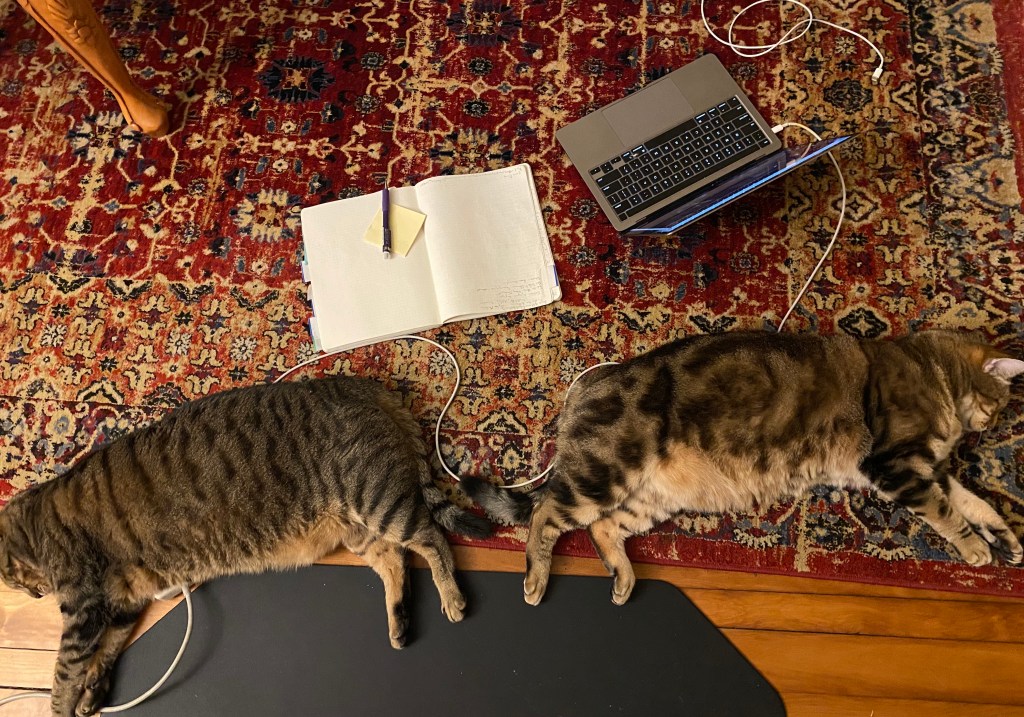
On my way home, I stop at the coffee shop and drink espresso in my damp sweater smelling of sheep — a lovely barnyard smell or a repulsive one, depending on the person I suppose. I carry my laptop and my notebook back home to my wood stove and my cats who remind me their needs are few and the most reasonable constant in this house.

By five, it’s dark as the inside of a pocket. Public radio spins in the greater world. In my tiny dining room, I pull a book from shelf and set it on the table, then another and another. In an hour or so, by then listening to This American Life about rats, I’m in the basement searching for the half-full can of Sunshine paint I used in the bathroom last winter.

Three more walls await me. I’m out of paint and decide a lime-lemon will suffice. I’ll need to drive that half-mile to the hardware store, which annoys me as I have brand-new studs on my snow tires, and why waste those on dry pavement?

All this: it’s that old familiar question, that rub between creation and destruction. Espresso and sunshine-yellow paint have never cured the world’s ills, but a slice of pleasure can’t harm.

In my bookshelves, I find a poem I printed out shortly before the pandemic nailed shut Vermont, still utterly relevant today:

Blackbirds
by Julie Cadwallader Staub

I am 52 years old, and have spent
truly the better part
of my life out-of-doors
but yesterday I heard a new sound above my head
a rustling, ruffling quietness in the spring air

and when I turned my face upward
I saw a flock of blackbirds
rounding a curve I didn’t know was there
and the sound was simply all those wings,
all those feathers against air, against gravity
and such a beautiful winning:
the whole flock taking a long, wide turn
as if of one body and one mind.

How do they do that?

If we lived only in human society
what a puny existence that would be

but instead we live and move and have our being
here, in this curving and soaring world
that is not our own
so when mercy and tenderness triumph in our lives
and when, even more rarely, we unite and move together
toward a common good,

we can think to ourselves:

ah yes, this is how it’s meant to be.