In these days of long light, my daughter and I are drinking tea and talking on our glassed-in porch when she spies a fox walking along the lilacs that fence us from the road. The red fox, a real beauty, turns and looks at us.
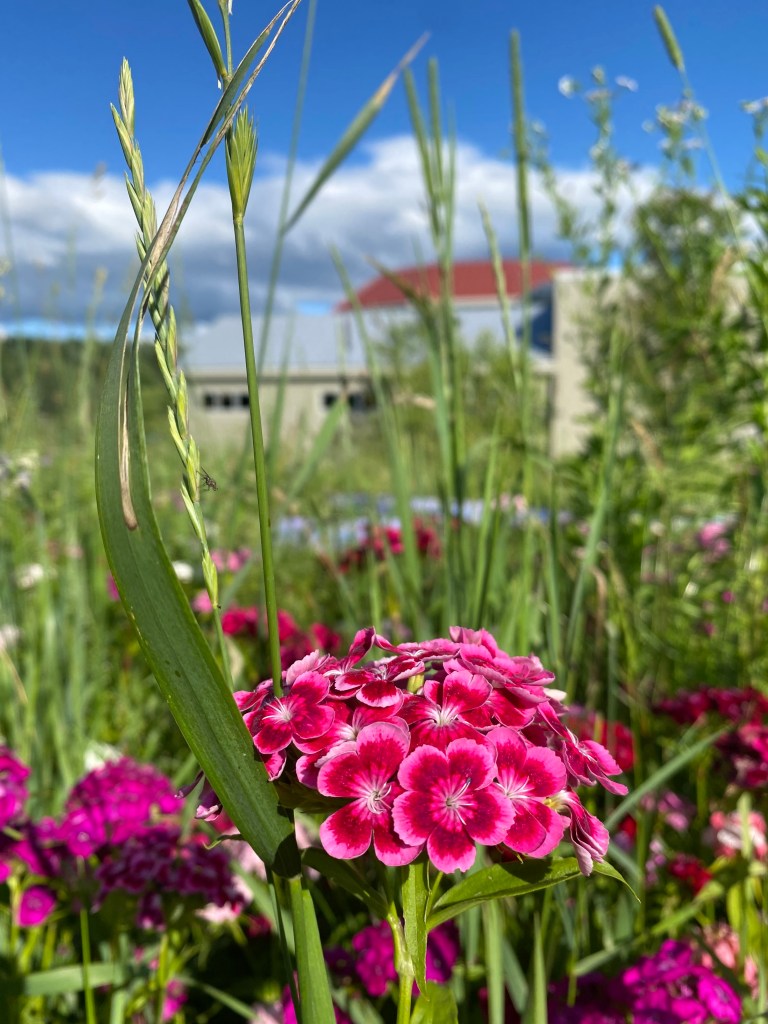
June has been a season of the wild pushing in — the prolific groundhogs (and my thoughts will come to naught about this, but I’m wishing for a more even ratio of groundhog to fox, for my garden’s sake), the multiplicity of birds, raccoon and possum, the circling turkey vultures. This year, too, my garden grows half-wild, the amaranth reseeding around the Brussels sprouts, coreopsis sailing over the fence. One morning, I straighten and pause, brushing dirt from my fingers, when I spy a fox staring at me through the layers of hydrangea and pin cherry trees. For a time without borders, we hold each other’s gaze. What passes between us is a wordless language, with no clear question or agreement. Maybe simply curiosity.
There’s plenty of the human chatter around me these days, much of it rippling up in chaotic waves. But then, this, too. Last night, poetry at a rural arts center, with all the best things of Vermont June: wildflowers and the pleasure of company, the beauty of words stitched finely together.
…. Last, never least, here’s some words about the unsurpassable Vermont novelist Jeffrey Lent, in need of a little lift…
Friday night, driving home along a familiar road from visiting friends, I stop by the elementary school. Solstice, the Strawberry Moon, the daylight lingers, and the dusk is long, multiple hues of blue. No one’s there, of course. I follow the path along the wetlands. Shimmering with lilypads and twilight, the water chirrups, sings, buzzes. Fish leap and splash. I loiter, and the dusk closes in. Still, I keep walking, following the path through the brushy woods up a slight hill, so I can get to the other side.
In my twenties, I had a tendency to get lost in the night woods, stumbling off the path. Years before cell phones, we were always searching for flashlights with working batteries, to visit somebody in a remote cabin. But I’m in familiar territory, and I take my time, in this bowl of evening, letting the cacophony of the wild chorus diminish my stringy thoughts.
I haven’t been back here for a good long while, but this school and the town and the library where I worked was a warm place, with its own complicated stories, sure. Those were the years when my life fell apart. I pause, hoping to see the quicksilver flash of a fish. Across the wetlands, a single vehicle rolls along the road. Maybe it’s the passage of time, or the evening’s mellifuous beauty, but I see suddenly that I was following two strands of my story in those years. I was leaving my husband (and for months, I wasn’t at all certain how to do that), and I was also recreating my life (and how exhilarating and hard that was, too.) I’ve written about my struggle with addiction; when I began to lift that veil, my fierce hunger quickened for what I had wanted all along — to pursue my own creative and often dicey life. In this throbbing evening, I sense the limits of language, that words fail here, that to divide creation and destruction into two words, held in two hands, is illusory.
The fish I didn’t see smacked through the water. Fireflies winked around me as I threaded my way back to civilization in the dark.
“Train Ride”
All things come to an end; small calves in Arkansas, the bend of the muddy river. Do all things come to an end? No, they go on forever. They go on forever, the swamp, the vine-choked cypress, the oaks rattling last year’s leaves, the thump of the rails, the kite, the still white stilted heron. All things come to an end. The red clay bank, the spread hawk, the bodies riding this train, the stalled truck, pale sunlight, the talk; the talk goes on forever, the wide dry field of geese, a man stopped near his porch to watch. Release, release; between cold death and a fever, send what you will, I will listen. All things come to an end. No, they go on forever.
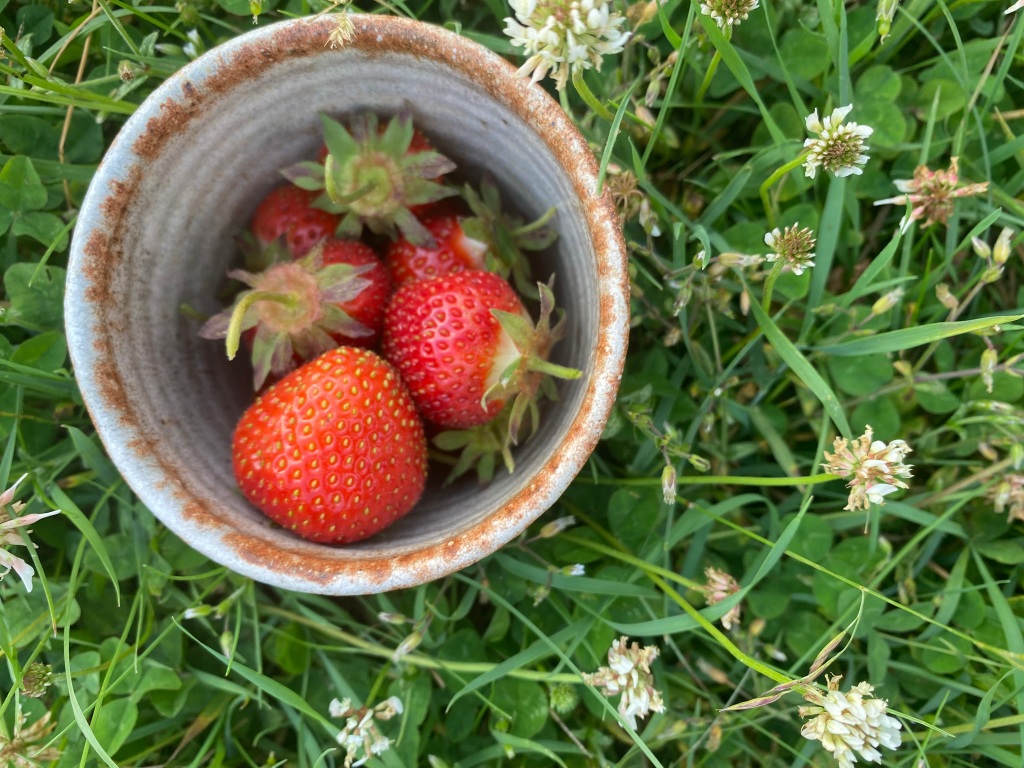
In the sultry dawn, I’m wandering barefoot in the garden, snatching the lingering strawberries before birds have nabbed the remainder. By late afternoon, thunderstorms have settled in. I’ve left a wooden chair on the porch, a throw rug over the railings, both sodden now. Book in my hand, I lean against our house’s dusty and pollen-layer clapboards, reading in the coolness that’s washed in. Our porch looks out over a bed of bleeding hearts, false Solomon’s seal, hostas. Beyond that, the cemetery, the river valley below. Behind our house, the wild presses in. Ferns tall as my shoulders, goldenseal, the groundhogs, thrush, chittering sparrows, the cut of ravine and the great life there.
Equinox; the lushness burgeons. Bring it on. The rain blows through the bedroom screens whose windows we left open all day. The box elder shoves between the porch railings. The grapes rise hungrily against the barn. All night our rooms are filled with moonbeams, the blowing dew, the mixture of milk trucks rattling down the road and the calling frogs.
Seven years ago, my daughters and I moved from a rural hillside down to a village, about five miles away. I’d closed midweek, with plans to rally help for a Sunday move. The evening that I closed, two friends who had followed the jagged path of my divorce loaded up my car and their cars, and we carried in the first load of my family’s belongings.
It was heavenly June, warm without undue heat. I had no furniture. A friend had brought dinner, and we sat on the back deck, eating and talking. I wondered, which way would my story go? Last night, I remembered this first meal here, when a neighbor stopped by with cake and rhubarb sauce: how complicated life is and, sometimes, how very simple.
Now, in this beginning to a lush summer, I water my seedlings in these early mornings, listening to the birds and spring crickets, the drenching dew over my bare toes. The spinach is already wilting. The tithonia drooped dramatically, beginning for extra water. The blueberries have hard knots nestled among their leaves.
So much of life seems impossible — birth a baby, endure a divorce, survive a death, write a book, write another, pack up a house and move (bring the beloved tricycle, too) — and yet we do these things. We all do these things.
Seven years ago, would I have seen myself watering the sprouting green beans and listening to a woman on my neighbors’ porch sing the blues, the sky streaked with turquoise and crimson? I gathered a bowl of strawberries from plants I’ve let run rampart all through my garden beds. Messy, weedy. My youngest was given these plants when she weeded as an odd job in middle school. This year, the plants have given us so much sweetness.
Record temps are moving into Vermont, the world shifting rapidly. Around the globe and in my town, people are on the move. Which way will this story go? For a moment, I gather berries in the dewy morning. So much more day to come. But a steady start, my soles on the damp soil.
When I was a kid, in moments of stress or elevated high jinks, my dad’s sense of humor rose. He was prone to things like putting grapes up his nose while my mother wasn’t looking to make us kids laugh. This was the camping trip to the Grand Canyon, when the clutch went on our old Jeep, and my dad was fixing it whatever he might have had at hand — a pliers and a fishing hook , maybe two rocks rubbed together in prayer, for all I know.
That same trip, someone was on the lam who had once also been a Navy Seal. We hiked into the canyon, passing sharp shooters at the rim. Don’t look, my mother said. Sometimes I wonder, Whatever happened to him? Did he have kids?
My parents never hesitated to get out our atlas, the essential road tripping gear. Looking at the map with my youngest recently, I chanced on Medicine Bow, Wyoming. We camped beside a man who lived in his canvas tent. While we were hiking, a lightening storm blew up, and my father hustled us down. As a kid, our sometimes peripatetic life was status quo, all kinds of living mixed in. I could list a 100 things without stopping that my dad taught us, all darn useful — like read Plato and follow water when you’re lost in the wilderness — but the one I keep returning to these days, now that I’m along in my life, is his utter persistence. A parent now myself, I think of him in the Grand Canyon with three young kids and a skeptical wife, with hardly any money and a broken-down Jeep. He patched it together. We kept on with that journey, thousands of miles, all those nights in the desert under the stars. At the wheel, he drove that Jeep for many more years.
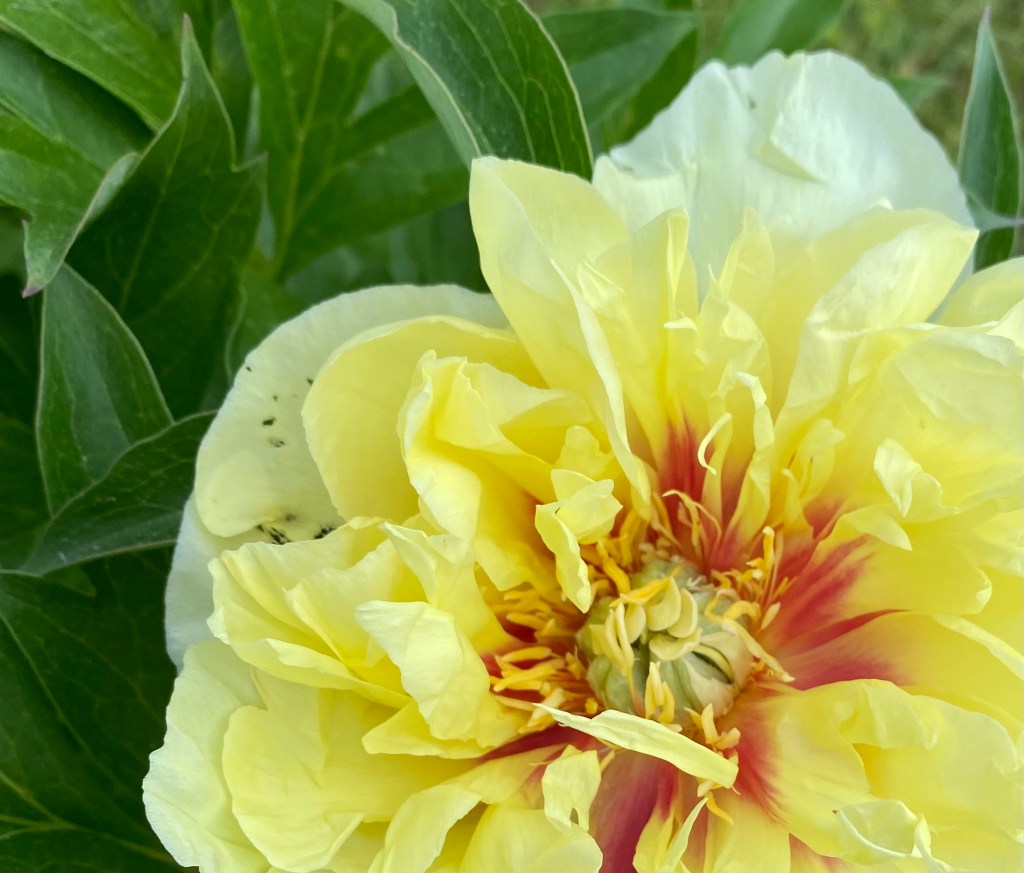
The girls come find me where I’m swimming, the water brackish, strewn with pollen. A blackbird keeps me company. The girls have snagged out-of-date cheese that’s perfectly fine and a tomato that’s sweetly ripe. At home, I dice last year’s garlic. I insist the girls admire the Bartzilla peony that’s blooming now, two blossoms and more fat buds of blossoms. The Bartzilla was a gift a number of autumns ago. My youngest planted the hairy root with me, skeptical. Now, for these few days, this peony’s a marvel.
All day, I’ve been thinking of this Mary Oliver poem. Well worth a share.
Peonies by Mary Oliver
This morning the green fists of the peonies are getting ready to break my heart as the sun rises, as the sun strokes them with his old, buttery fingers
and they open — pools of lace, white and pink — and all day the black ants climb over them,
boring their deep and mysterious holes into the curls, craving the sweet sap, taking it away
to their dark, underground cities — and all day under the shifty wind, as in a dance to the great wedding,
the flowers bend their bright bodies, and tip their fragrance to the air, and rise, their red stems holding
all that dampness and recklessness gladly and lightly, and there it is again — beauty the brave, the exemplary,
blazing open. Do you love this world? Do you cherish your humble and silky life? Do you adore the green grass, with its terror beneath?
Do you also hurry, half-dressed and barefoot, into the garden, and softly, and exclaiming of their dearness, fill your arms with the white and pink flowers,
with their honeyed heaviness, their lush trembling, their eagerness to be wild and perfect for a moment, before they are nothing, forever?