The 10,000 Things Bloom

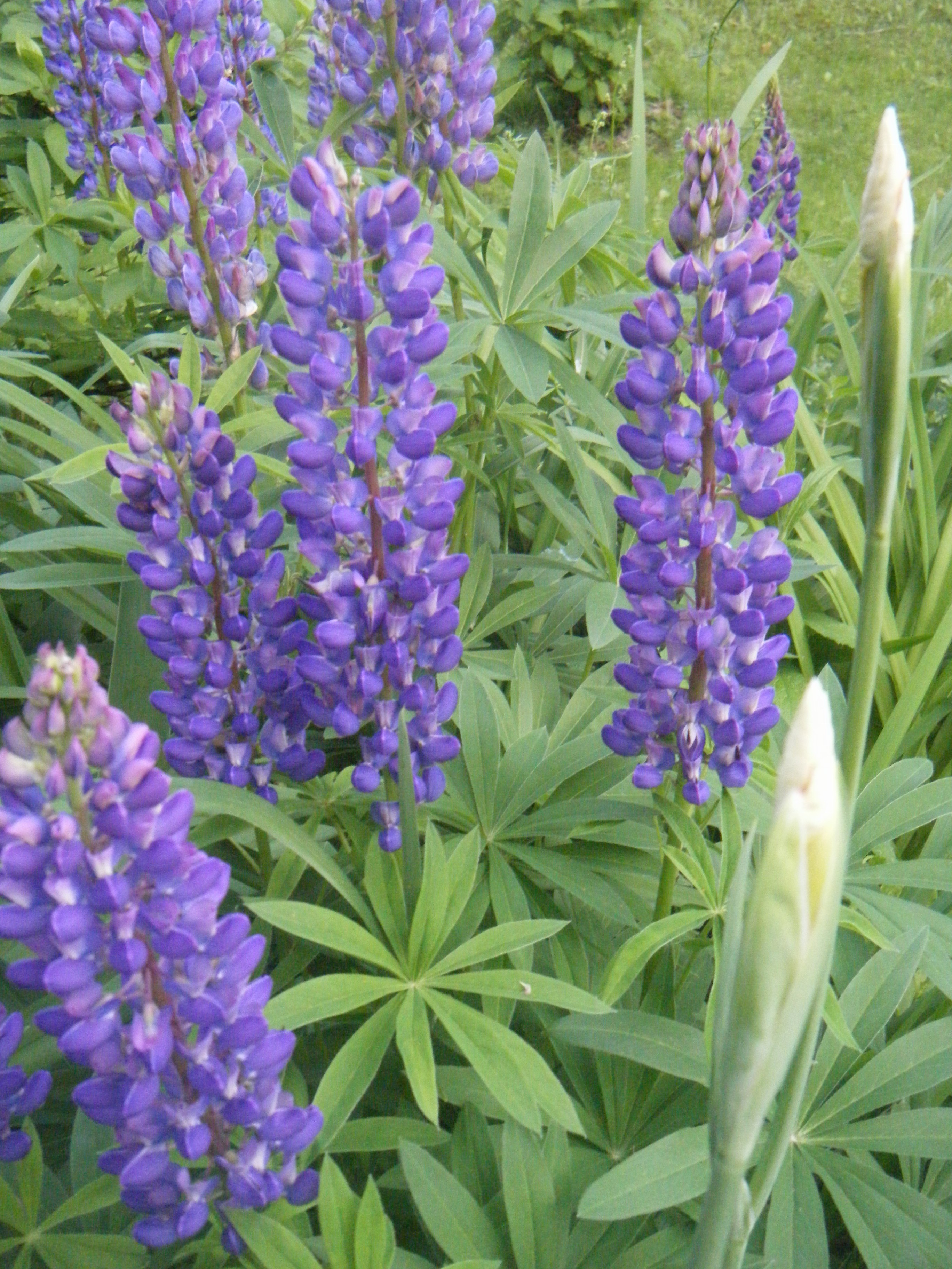
Vermont’s June surges in a melody of the ten thousand things madly growing .  In this fine evening, walking along my dirt road, the landscape hums with life.  On this road, I’ve also been sleeted and hailed upon.  Rain in every imaginable form — from the merest brush of mist to buckshot — has fallen on me.  Snow, of course, snow, snow, snow, in all its myriad Vermont shapes, has graced my shoulders.  But today, this very evening, right now, the air is redolent with wild roses blooming.  This is the season of lupines and iris, of daisies and forget-me-nots, and I intend to savor June in its moist and delectable sweetness.

With another Vermont novelist today, Sheila Post, we discussed landscape in Vermont writing, and this evening I am suffused with landscape, the sheer loveliness of this summer evening, this place and this time, already fleeting.

QUESTION AND ANSWER
after Li Po

You ask me
why I live on
this green mountain.

I smile: no answer.

Come.
Live here
forty years.

You’ll see.

– David Budbill


DSCF9994


Rosebush

This afternoon, between the end of school and the beginning of work, I went running, my little girl ahead on her bike.  Down the dirt road we went, and then she circled back to me as we approached a small camp where a man stood in the road.  My child was afraid of the dog there, and she rode closely beside me.

I stopped running and said I was sorry to hear about his wife.

He told me they had celebrated their nineteenth wedding anniversary on the first, and then last week, they ate dinner together and fell asleep.  He told me he woke in the morning and washed dishes, and when he checked on her, still in her recliner, she had passed.

The couple hasn’t lived in that camp for years.  They moved down to the bottom of our road, in an old farmhouse wrapped with plastic to the keep the wind out, painted pink in one section, green in another.  The acres have substantial mounds of cowshit, junked vehicles in piles, all manner of debris with all kinds of people coming and going.  He considered his occupation “junking,” and had told me in 2008 his occupation had gone all to hell.  In the spring, their pasture is verdant long before anywhere else.

The camp, on its footprint of property, has had a revolving door for years with a series of single men and one winter a woman with two young children.  With no water or plumbing, the cabin is surrounded by piles of exactly what we’re never sure.  Large things like soiled mattresses and campers, a shower stall, salvage windows, and piles and piles of human food garbage.  Built in a dank hollow, the camp has always exuded to me the desperateness of hard-up and hardscrabble people, on the fringe, looking to stay away from the law.  Who in this extended family owns what property, or if it’s even owned or rented, has always been unclear to me.

This neighbor and I have never been on poor terms.  He recalled, today, talking to me years ago, when the road often held only myself and my daughter in her stroller.  When she was three or so, she asked me how he could eat corn-on-the-cob, as he had only one front tooth.

Today, he watched his grandson mow a patch of tangled weeds, telling his story, his eyes tearing.  Tomorrow, he’ll plant a rosebush and bury her ashes.

I said what little I could, that she hadn’t suffered at least.

He shook his head just once and said, I don’t  know.  It was in the night, you know, and no one thought that was going to happen, you see.

The little girl and I continued down the road.  When I returned, I lifted my hand and waved, running, and he hollered to me, These weeds can some grow!

O my neighbor, may your rosebush bloom beautifully.

And did you get what
you wanted from this life, even so?
I did.
And what did you want?
To call myself beloved, to feel myself
beloved on the earth.

– Raymond Carver

DSCF9978

Goldfinch

This afternoon, driving too fast on a dirt road, I spun around a corner and heard rocks spitting from the truck tires.  I was in too much of a rush, after too jumbled a day, and I didn’t slow down.  A goldfinch burst before the windshield, then flew up into the maples. Peering over the steering wheel, suddenly slowing, I saw the bird’s underbelly, so yellow it was iridescent, glowing like Rumpelstiltskin’s freshly spun gold.

A flash, nothing more.

That flickering goldfinch, that gleam of beauty, so startlingly unexpected, tore before my vision as a feathered  shrapnel of truth.

At the school’s sixth grade graduation tonight, the speaker handed each child a shiny 2015 penny.  Be truthful, she counseled wisely, like Honest Abe.  Myself, so long past the years of sixth grade, feel my own truth dispersed and muddied among so many humusy layers of living.  And then this goldfinch before my eyes, harbinger of unadulterated truth, pure beauty.  It might have been my heart leaping from chest.

There is only one heart in my body, have mercy
on me.

The brown leaves buried all winter creatureless feet
running over dead grass beginning to green, the first scent-
less violet here and there, returned, the first star noticed all
at once as one stands staring into the black water.

– Franz Wright

IMG_6270

Photo of Pepper by Molly S.

Wild Strawberries

I received a book of poems in the mail today, and the little girls asked me to read one to them.  Sure, I said, glancing through.  But these are not children’s poems; these poems are smeared with blistering rage, with grief and bloody childbirth.  Feminist poetry?  Or women’s writing?  In what way or what domain is that limited to the female gender?

This evening, the children and I – two girls and a boy all ten and under – walked down the neighbors’ field, a great long stretch of it, the children running ahead of me.  At the bottom, the children knelt and picked wild strawberries, the largest the size of my thumbnail.  Crimson and sharply sweet.  I lay back in a fold of the earth under the blue sky swirled with curled bits of cloud.  All around us, Indian paintbrush was knotted in buds, so I watched the children through waving green stems topped with bits of gold.  My daughter gathered a whole handful of this tiny fruit and offered me the largest.  Mama, try.

Biting a minuscule seed between my teeth, I thought of those poems, my secret stash of nighttime reading.  More than anything else, bearing and raising my children has shaped my life, and so, perhaps, those poems, with their raw grit and embrace of the female body, are women’s writing.  Perhaps the limitation is my fixation, when, instead, the word should be possibility.

female

there is an amazon in us.
she is the secret we do not
have to learn.
the strength that opens us
beyond ourselves.
birth is our birthright.
we smile our mysterious smile.

– Lucille Clifton

DSCF9945

Of Tacos and the Inner Life

The after school kid topic today was how many tacos were eaten at lunch.  The girls each ate two.  The younger brother ate three.  Another child at the table quit after four. Teacher?  Four, apparently.  A fifth grade boy claimed the prize with eight.  Pondering this impossibility, the girls drew a diagram of how large his stomach might be and sandwiched in eight hand-drawn tacos.  A variation of anatomy, in the elementary school world, complete with graphic illustrations.

Don’t days sometimes seem a collage of pieces, one funkily shaped thing pressed in against another?  In my realm today of concrete things — washing dishes and writing tech bits, things I could hold in my hand — I had a conversation with one person about some of the deepest things in my life, a literal spading up of soul debris.

Aren’t the best novels that way, too, filled with the physicality of action and the deeper layers that turn our lives one way or another?  Surely, we’re shaped by the trees in our yards, maybe the nubs of apples fattening up that we finger every afternoon, or the roads we drive along particular rivers, watching their levels rise and ebb, or the patchwork quilt we smooth over a bed, every morning.  But within this, too, are the murkier regions of desire and raw longing, of resentment’s ice and anger’s torrents, and even when our surface belies a calmness, our inner workings foment.

Writing sifts down through those unclear, swirling layers, and tries to make sense of the impossible, accordions us out so we may see less of a mosh and something resembling sense. Know thyself, Socrates advised.  Writing arrows toward that knowing.

How would eight tacos fit into one boy?  We stretch, children.

THE LAYERS
Stanley Kunitz

…In my darkest night,
when the moon was covered
and I roamed through wreckage,
a nimbus-clouded voice
directed me:
“Live in the layers,
not on the litter.”
Though I lack the art
to decipher it,
no doubt the next chapter
in my book of transformations
is already written.
I am not done with my changes.

Photo by Molly S.

Photo by Molly S.

What Do Women Really Want (besides blueberry pie)?

A houseful of children tonight.  Much swinging in the living room hammock (it’s raining, yes), a discussion at dinner about the two ten-year-old girls running as a joint ticket for president, a revealing of whom everyone’s parents voted for in the last presidential election.

One of the girls asks what I’m writing about, and I hold up a book and say, There’s a folktale in here about what women really want.  So, I ask the girls, What do women want?

They think.   This question is a stumper, no doubt about it.  One of the girls offers, Freedom.  I can see the glint in this child’s eye, the allure of this ten-year-old vision of freedom, not the Janis Joplin version, not anything at all but a clear sunshiny day and an ample bowl of ice cream.  I also see blueberry pie in her gaze, which I know this child adores.

At the end of this strange folktale, the Lady Ragnell is transformed from a hag into a beauty when Sir Gawain grants her the freedom of her own autonomy.

Pose this as a koan:  as women, we can’t obtain what we most desire, without the blessing of our spouse?  Is that a backhanded way of getting exactly what you need, when it’s already in your hand?  Is the story far more complicated, laced through Western centuries of female subjugation and denial, the banishment of childrearing to lowly status or else so sanctified mothering is glorified into absurd heights, a challenge we inevitably will fail?  Why do women so often cling to this notion of Prince Charming in all his glory, bending down on one knee to kiss our hand, as if that magical kiss will shatter our haggardness, transforming our ugly selves into princesses?  Why not demand the prince meet us in the kitchen garden, with everyone’s feet firmly on the ground and hands offered equally over the seeded beds?

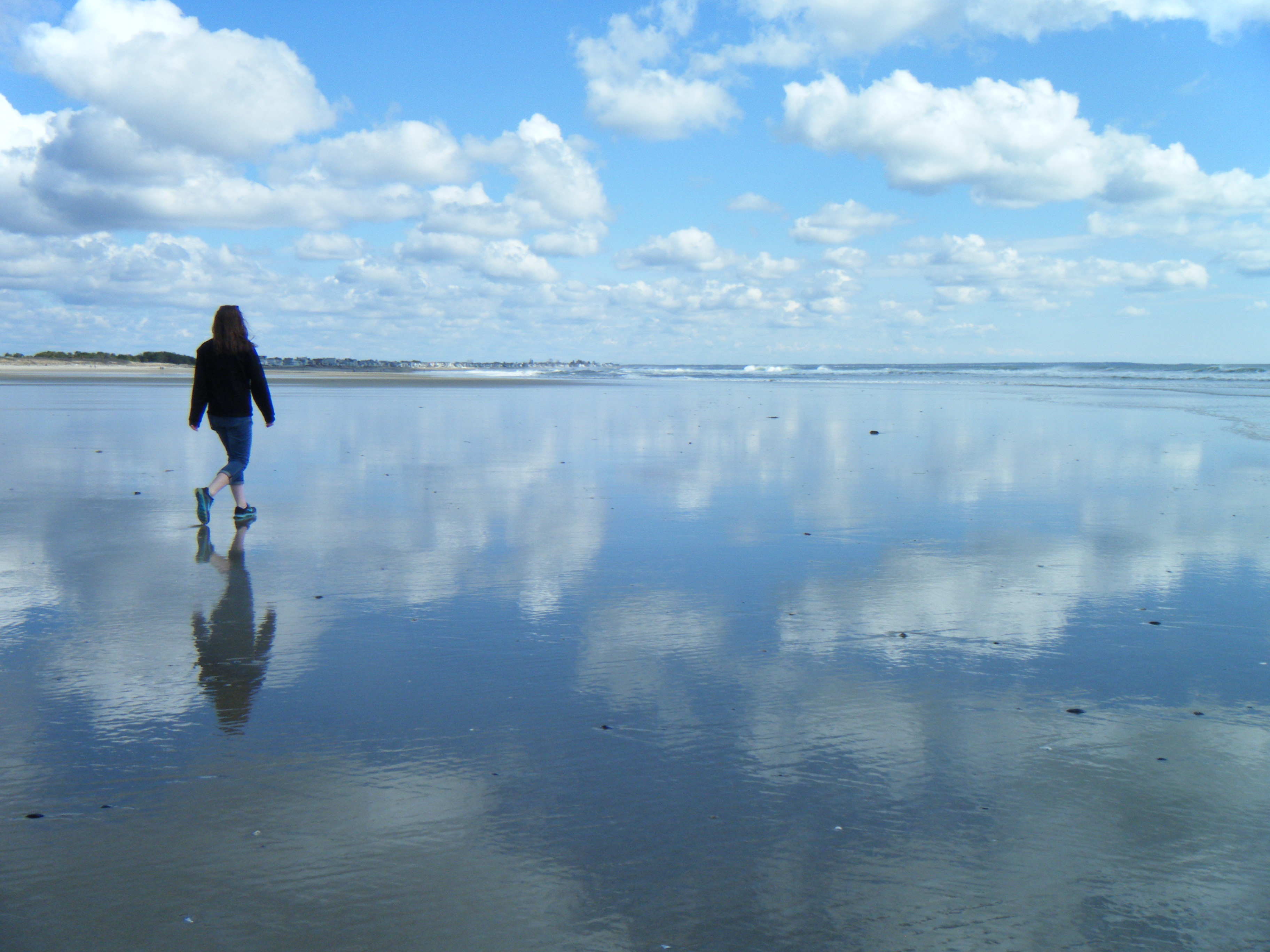
Or is the story, instead, far simpler?  Put another way, perhaps what women desire is the depth of work and love, and the tranquility to lie down on the earth and gaze up at clouds scudding along an azure sky.

DSCF9779