Better Perspective

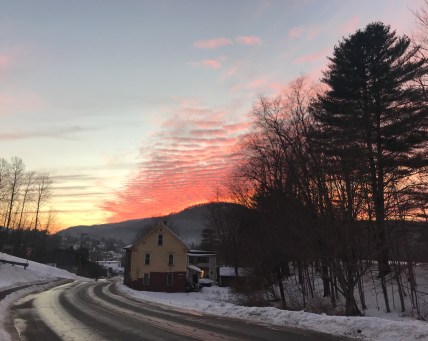
A milk truck rolling slowly up Bridgeman Hill catches the sunset on its long, silvery side. The mud-splattered Booth Bros.’s truck reflects that sky behind and above me — ruby clouds — and that movable art mural is so wonderfully awesome I’m taken out of time, snapped back into the world only as the truck has nearly passed and I realize the driver has lifted one hand, waving a greeting.

I watch the truck continue its gradual roll up the hill, where pavement gives way to dirt road. As I descend down the hill, the village glows beneath that magnificent sunset — the granite town building, the long strings of electric lines, the houses well-tended or ramshackle — players in a landscape of cosmic beauty.

When the winter chrysanthemums go,
There’s nothing to write about
But radishes.

—Basho

IMG_4370.jpg

Trout Fishing Reminescences

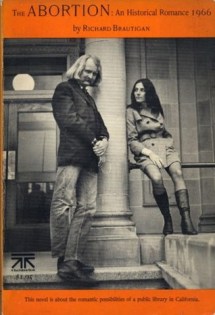
I’m listening to a recent This American Life podcast, when a section of Brautigan’s The Abortion is read aloud, I lay down the scissors I’m holding. I’m sixteen again, hidden in the public library stacks, unable to believe what I’m reading. What is this? Who is Brautigan?

An instant fan of Brautigan and simultaneously unable to exactly figure out why, when I listen to his words read aloud, I suddenly see his writing is all reverence, all poetry, all a hymn to living — in the most utterly mundane way — an acknowledgement of love and love gone awry, of abortion and bliss — funny and sorrowful and joyous.

Sometimes life is merely a matter of coffee and whatever intimacy a cup of coffee affords.

Richard Brautigan

160588

Reading

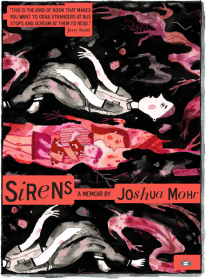
By lucky chance, I start reading Joshua Mohr’s Sirens — memoir of writing, drug use, broken spiritual and physical hearts — and I can’t stop. The slender book reminds me of when I was twenty, reading Death on the Installment Plan in bed in a second-floor Brattleboro apartment, savory from the downstairs Korean restaurant. Like Celine, Mohr’s writing is full of life as that Brattleboro Main Street, or as desolate as a snowy midnight.

Check out Two Dollar Radio’s Santa Fucked Up sale.

Our lives are always in flux, so many contradictions comprising our identities…. We are never one thing. I was never only the heart defect, only the author or junkie or husband or father or professor or drunk. I wear all these like layers of skin. Like stars creating a constellation.

— Joshua Mohr, Sirens

TDR_BookCover_sirens-by-joshua-mohr_2048x2048.png

Cracking Open the Door on Deafness

In my twenties, I was a typist for a novelist who not only had the misfortune to suffer from severe carpel tunnel, but was also profoundly deaf. The deafness had contributed to her divorce, and she holed in up in her parents’ summer house in rural Vermont. Once a professional musician, she cleaned houses before landing a teaching job and turning to writing children’s literature to make a living.

Sitting side by side with me, she dictated her novel.

One morning, an unfamiliar alarm rang out in her study, so piercingly loud I instinctively bent over. I heard nothing but that sound. Fearing it was a fire alarm, I stood up, panicked. Then I saw the novelist, sitting in her chair, was mystified by my actions. She was entirely oblivious to the noise. To her, that alarm didn’t exist.

A red flashing light on her computer power surge system warned that the power had gone out. I shut down her computer. I explained what had happened. Then I stood there, rattled — both from the physical shock and from my glimpse into her immense silence.

Here’s a line from Susan Orlean’s The Library Book:

… oh my God… do you think there are any conservative librarians?

IMG_3980.jpg

Lyndon, Vermont

My Long-Ago Mentor

The children’s librarian in the town where I grew up — Goffstown, New Hampshire — not only offered me first dibs on brand-new books (I began reading Judy Blume’s Deenie while walking home), she also came to my wedding. Every summer, I fill the glass purple vase she gave me for a wedding present.

So, when we were talking about the Giving Back issue at Kids VT — the magazine where I’m on staff — I wanted to write about Betsy Elliott. We aspired to write particularly about a few of the many people who give so generously, so meaningfully, without any expectation of return — maybe a kind of antidote to our troubled world. Here’s my short essay.


uyw

The Moral Arc

The fall after I graduated from Marlboro College, I was living in Brattleboro and working at Omega Optical where I crafted tiny round glass disks used as high-tech light filters — a strange and short-lived job for me.

That fall, David Souter was nominated for the Supreme Court, and on NPR we listened to every word of the hearings. A bachelor, Souter lived in Weare (pronounced where), New Hampshire, not far from where I grew up, a little town I knew well. Brilliant and witty, Souter made New Hampshire proud.

That fall, young as I was and newly in love, I rightly considered myself an adult. I walked to the company’s enormous building, not far from where I lived, and whose back doors opened to the weed-flanked railroad tracks, just above the wide Connecticut River. Before the winter, I knew I was unsuited that job and moved on. By the next spring, I was living in a tipi, and then my boyfriend and I packed up our old diesel Rabbit and a rusty Saab and moved west to graduate school.

I was glad to join adulthood, even though, as any young person, I had no idea how difficult that would be, how piercing a price the world would extract for my share of wrongdoings. My teenage daughter once urged me not to take our arguments personally — terrific advice. Step back; breathe. Justice isn’t personal to me, or anyone else, either. Watching her sister’s soccer game yesterday, in a row of women talking about Kavanaugh’s confirmation, I’m still astounded that she’s now one of us, more grownup than teenager, with all that means.

My fury about people is based precisely on the fact that I consider them to be responsible, moral creatures who so often do not act that way.

— James Baldwin
IMG_1005

Photo by Molly S.