Birthday Blessings

This afternoon, I stepped out of my library with a child to look at the sky. He was glad he had returned a stack of library books, a kind of clearing of his child conscience. In my clogs, I leaned against the building, a squall fattening in this valley, tucked up against Woodbury Mountain. What a winter this has been. Snowbanks dominate Hardwick like a pop-up mountain range.

Later, a friend and I leafed through a Vermont guide to wildflowers. Remember spring beauties? Remember trilliums?

Early March is my father’s birthday and, two days later, my mother’s. In their  80s now — old but not very old, not even close to very old — my parents who lived through WWII, the Vietnam War, Nixon’s resignation, and the eternity of the Reagan-Bush regime, through having careers and raising children, teaching and writing books and caring for the infirm and the dying, through decades of friends, through all the everydayness of living — and now through the particularly heartless regime of Trump — here’s Hayden Carruth’s birthday poem for love of a woman and love of living.

“Birthday Cake”

by Hayden Carruth

For breakfast I have eaten the last of your birthday cake that you
had left uneaten for five days
and would have left five more before throwing it away.
It is early March now. The winter of illness
is ending. Across the valley
patches of remaining snow make patterns among the hill farms,
among fields and knolls and woodlots,
like forms in a painting, as sure and significant as forms
in a painting. The cake was stale.
But I like stale cake, I even prefer it, which you don’t
understand, as I don’t understand how you can open
a new box of cereal when the old one is still unfinished.
So many differences. You a woman, I a man,
you still young at forty-two and I growing old at seventy.
Yet how much we love one another.
It seems a miracle. Not mystical, nothing occult,
just the ordinary improbability that occurs
over and over, the stupendousness
of life. Out on the highway on the pavement wet
with snow-melt, cars go whistling past.
And our poetry, yours short-lined and sounding
beautifully vulgar and bluesy
in your woman’s bitterness, and mine almost
anything, unpredictable, though people say
too ready a harkening back
to the useless expressiveness and ardor of another
era. But how lovely it was, that time
in my restless memory.
This is the season of mud and thrash, broken limbs and crushed briers
from the winter storms, wetness and rust,
the season of differences, articulable differences that signify
deeper and inarticulable and almost paleolithic
perplexities in our lives, and still
we love one another. We love this house
and this hillside by the highway in upstate New York.
I am too old to write love songs now. I no longer
assert that I love you, but that you love me,
confident in my amazement. The spring
will come soon. We will have more birthdays
with cakes and wine. This valley
will be full of flowers and birds.
IMG_4848.jpg

Making Sense?

At dusk, after washing the dishes, my daughter agrees to go on a walk with me — she is clearly good-humoring me. It’s cold, and I sense she doesn’t care all that much about the gorgeous blue horizon.

Plus, she’s 13. Having once been 13 myself — albeit in the last century — I know 13-year-olds cannot wear hats.

Walking, she asks me why is this necessary? I offer my usual lines — that it’s pleasant to walk in the evening, that a little cold and adversity build character (my dad’s line). I remind her of my amazing wealth of character.

So, she says, you have character because you froze your ass off?

Put that way, I admit that perhaps not all the pieces of my thinking always hinge together perfectly. Or perhaps they do….

Real poetry, is to lead a beautiful life. To live poetry is better than to write it.

Basho

0

February Yields To March

The snow lies so deeply around our house I might be wrong about that slender path, first through the transplanted hydrangeas from Susan and then along the milkweed behind the garden. Down the hill, through the wild tangle of pine and boxelder, I see a single porch light every night. Come spring, I imagine, I’ll walk in my boots through the melting snow, stand at the edge of the forest, and see whose light that is.

The light stays longer in the sky, but it’s a cold light,
it brings no relief from winter….

(The earth) says begin again, you begin again.

— Louise Gluck, from “March”

IMG_4814

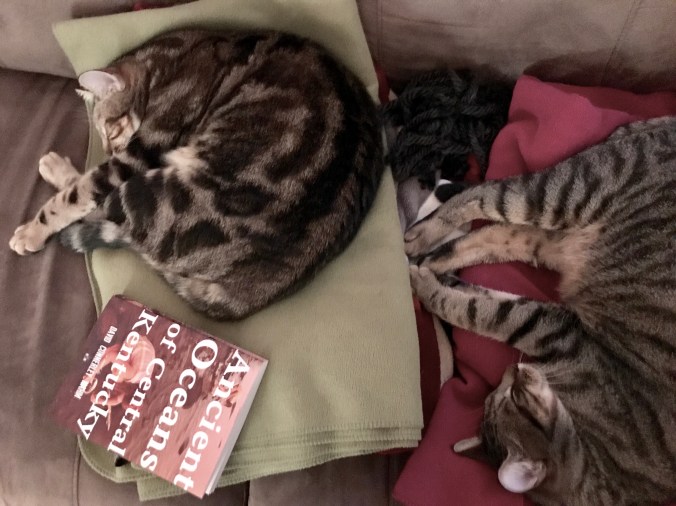
The cats — models of serenity.

The Lion, and The Lion Again

These days, I’m always writing about the weather and here’s why — with a vengeance, winter hurls at us.

In a select board meeting last night, someone paused and said, The wind. Soon afterward, the lights snapped out. In the utter dark, I stood talking, bodiless, about agenda. The town clerk appeared with two battery lanterns, her face flickering with shadows.

The 13-year-olds pulled me into the town vault where the clerk had shown them a book of vital records, each certificate in a plastic sleeve. The girls had gone wild about the death certificates, reading aloud cause of death: thrombosis, carcinoma, asphyxiation from car exhaust in a closed garage.

I read about a woman who had shot herself in the chest, in the 1950s, down the road from where I once lived. In my mind, I repeated her name and age.

The town clerk showed me handwritten ledgers from when the schoolhouse was built in 1914. Nails, $6.50.

At home, the power was out, too, and I finished knitting a baby sweater by candlelight. Before we went to bed, we looked out the second floor bedroom windows at the dark valley, a snowplow carrying its own light along Route 15. I reminded the girls of reading about wartime, in so many other times and places, when families shut off their lights, in fear of bombing. Three degrees. The wind shrieked around our house.

I lay on my daughter’s bed, listening to her day of babysitting and kid stuff. She knitted by her little lantern while I watched the shadows of her moving hands on the ceiling. A cat curled between us and slept.

6rI36jhT

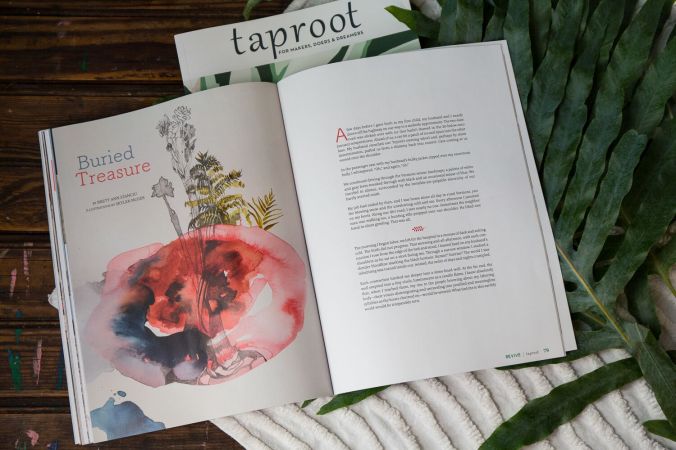
Artwork from the recent Taproot issue — appropriately titled Revive — where an essay of mine appears.

Wander with Laughing Teens

The girls put effort into dressing for a walk through the sugar woods — hair up and all in black, save for a borrowed pair of colorful leggings. In capitulation to winter (which remains), I exchange my holey and holy jeans for a better pair and pull on a raggedy sweater.

We’ve stretched into Sunday and into winter school break, with waffles in the shape of maple leaves and needlepoint projects the girls have pulled out of drawers. I’ve finished my taxes and offered what was apparently an incredibly dull overview of federal monies — who profits, who doesn’t. It’s no loss — the girls shake off the warmth of our kitchen and greet the wet woods and sprinkling rain with joy.

The woods are misty and ghostly, crisscrossed with animal tracks. The maples bend overhead, whispering their secret language. The 13-year-olds jump on each other’s backs like puppies, giggling, and empty snow from their boots.

After reading Donald Antrim’s harrowing essay in the recent New Yorker, I picked his memoir, too.

People are fond of saying that the truth will make you free. But what happens if the truth is not one simple, brutal thing?

— Donald Antrim, The Afterlife: a memoir

IMG_4779

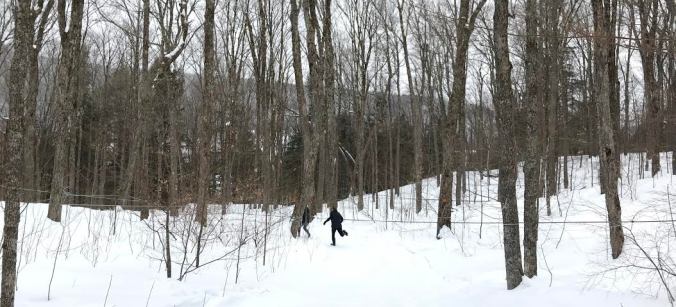
Hardwick Town Forest, tapped in for sugaring


Running Icicles

Birds are singing this morning when I step out on the back deck, and walk barefoot to the edge of the covered porch to see the blue layers of mountains and valley, the gray clouds from horizon to horizon, thin enough that sunlight might emerge, later this morning. It’s 3 degrees, and I don’t linger long, lacking socks and all.

It’s winter break for Vermont school kids, the week that straddles into March’s first Tuesday Town Meeting Day. While a surprising number of families I know are flying elsewhere — warmer climes, assuredly sunny beaches — ironically, I’m writing an article about parenting on the cheap, a topic I’m intimately familiar with. The writing will be creative and even informative, but the 2,000 or 2,500 words might as well be compressed into don’t spend, my general roadmap.

If economy is my roadmap, though, the compass points are not in the least money-related. Years ago, I walked around the halls of the Dartmouth Medical Center, baby in my arms. We were really merely passing through — our stay was so minor — but the stay of many, many others was not. I stood in one cathedral-ceilinged lobby, baby girl sleeping with her tiny head on my shoulder, listening to a man play a Mozart sonata on a grand piano. On a wall hung a painting of a red tulip in a flowerpot with take joy written below.

Those two words? A challenge, perhaps, but a reminder of sheer possibility. Yesterday, icicles dripped from our roof, all morning.

And, as always, it’s a pleasure to appear in State 14 again, sending out a Postcard from Hardwick.

(Happiness comes) ….to the clerk stacking cans of carrots
in the night.
It even comes to the boulder
in the perpetual shade of pine barrens,
to rain falling on the open sea,
to the wineglass, weary of holding wine.

—Jane Kenyon, from “Happiness”

IMG_4755