This May has been exceptionally beautiful, with a profusion of blossoms and warmth. Living in a village now, we reap the benefits of lingering outdoors in the evenings, with no black flies gnawing our bare skin.
In this vaccinated world, a headiness rears, too. My daughters are suddenly gone, this way and that, one grown up, the other nearly so.
In the evening, I sit on the covered back porch, breathing in the scents of lilacs and rain.
The drama of spring unfolds around all of us, blessedly so, this year.
I’m not a subscriber to so-called retail therapy, but I’m not averse to paint brightening up my patch of the world, particularly when I’ve chosen a light blue named Innocence.
My amusement mystifies my kids, and, honestly, myself, too. A better word to describe our life these days would perhaps be Koan. But try putting that on a paint can and marketing it. Who wants a little more koan, please?
Instead, I buy a used bureau from a couple who has seen far better days, or so I hope, and offer it to my daughter. From our basement, I pull out the can of yellow Little Dipper paint I used for our living room. She paints it on our back porch. I lean against the railing, looking at the trash that’s blown over the railing — junk mail, a used mask, a cardboard box I’ve used for kindling.
A sparrow sings in the box elders.
I turn around and watch her paint. What? she asks, looking over her shoulder at me.
Nothing, I lie. I reach for the quilt I washed that morning, hung over the railing, and fold it carefully.
I save my love for the smell of coffee at The Mill, the roasted near-burn of it, especially the remnant that stays later in the fibers of my coat.
Earth Day gives us snow in Vermont, that poor man’s fertilizer.
In a lightly falling snow, I lean against a school building, talking on the phone to my brother while my daughter plays soccer. Snow drifts in flakes about the size of a nickel, some melting on the pavement, others accumulating on tree branches and the toe of my boot.
The phone connection is stunningly clear — a surprise in rural Vermont.
As the snow falls, we wonder at the happenstance of circumstances — how the fall of a family member might have gone disastrously awry. Our conversation wanders beyond that, to the Chauvin trial, and the bystanders on that terrible day who, by happenstance, were present, and the teenage girl who pulled out her phone and shared her witness’s eyes with the world.
We’re in no hurry to hang up, and my brother suggests that, if Washington D. C. achieves statehood, the flag’s tidy stars will be kicked out of kilter. Vermont should succeed, he says.
After I hang up, I lean against that wooden wall. A fat robin lands in the snow, seeking a worm. My daughter and two friends walk across the parking lot, laughing, their braided hair damp with melted snow, their cheeks and bare knees bright red. It’s spring.
A retired man shows up at my job, looking for a little info and then stays to talk, sitting in a chair while I lean against one of the cement posts that hold up the ceiling, and the building overhead.
A former landscaper, he’s survived numerous joint replacements, an overseas war as a young man, and he’s holding cancer at bay, for now. He’ll succumb to the cancer, he says, at some point. But for now, he tells me how much he savors that first slurp of hot tea every morning.
I have plenty to do, but for that time, I might as well, really, have nothing else to do. He tells me about a double blossom primrose flowering in his garden. Another spring, he says.
Blue squill reappears in our front yard and over the hill behind our house, in the thickets of wild raspberry canes — tiny flowers that sprinkle color in our landscape that is otherwise brown dirt and gray mountain.
In the rough patches of roadsides and rocky ditches, coltsfoot springs up. Along the brick school gymnasium, I discover blooming dandelions.
These tiny flowers, some no larger than my thumbnail, are mighty tough. There’s a lesson here, I know, as I crouch in that tangle of thorny vines, admiring a clump of starflowers. That lesson might be as simple as the determination of the world’s beauty. Who planted these flowers, I don’t know. But every spring I’m grateful for that gardener who lived here and who so loved these spring gems.
The temperature weirdly shoots up to 70 degrees. 70 degrees in Vermont in early April! For anyone who doesn’t live here, know that this warm, daffodil-growing weather makes our world a communally happy place.
While my daughter plays soccer, I take a walk, then spread out my work on a picnic table. Three geese fly overhead, making a honking racket. On the other side of a school building, I hear the kids laugh. Two dads roll up on bikes and stand in the parking lot, chatting.
Another parent I haven’t seen for a long time appears and stands at a distance. We talk and talk, about how our work has changed, and what’s happening with our kids, and even more, about each of us might want this summer — happiness, in some small way. Listening, I think, of all the many things we’ve learned this year, surely valuing the connection between us rises high. How little that might seem, and how infinitely valuable.
My daughter returns with a blister. At home, the carpenter has just finished repairing the porch railings broken by falling ice. We stand for a bit, talking and waving at early mosquitoes. He admires the view of the village below us and asks how I like living beside a cemetery. I like it just fine, I tell him.
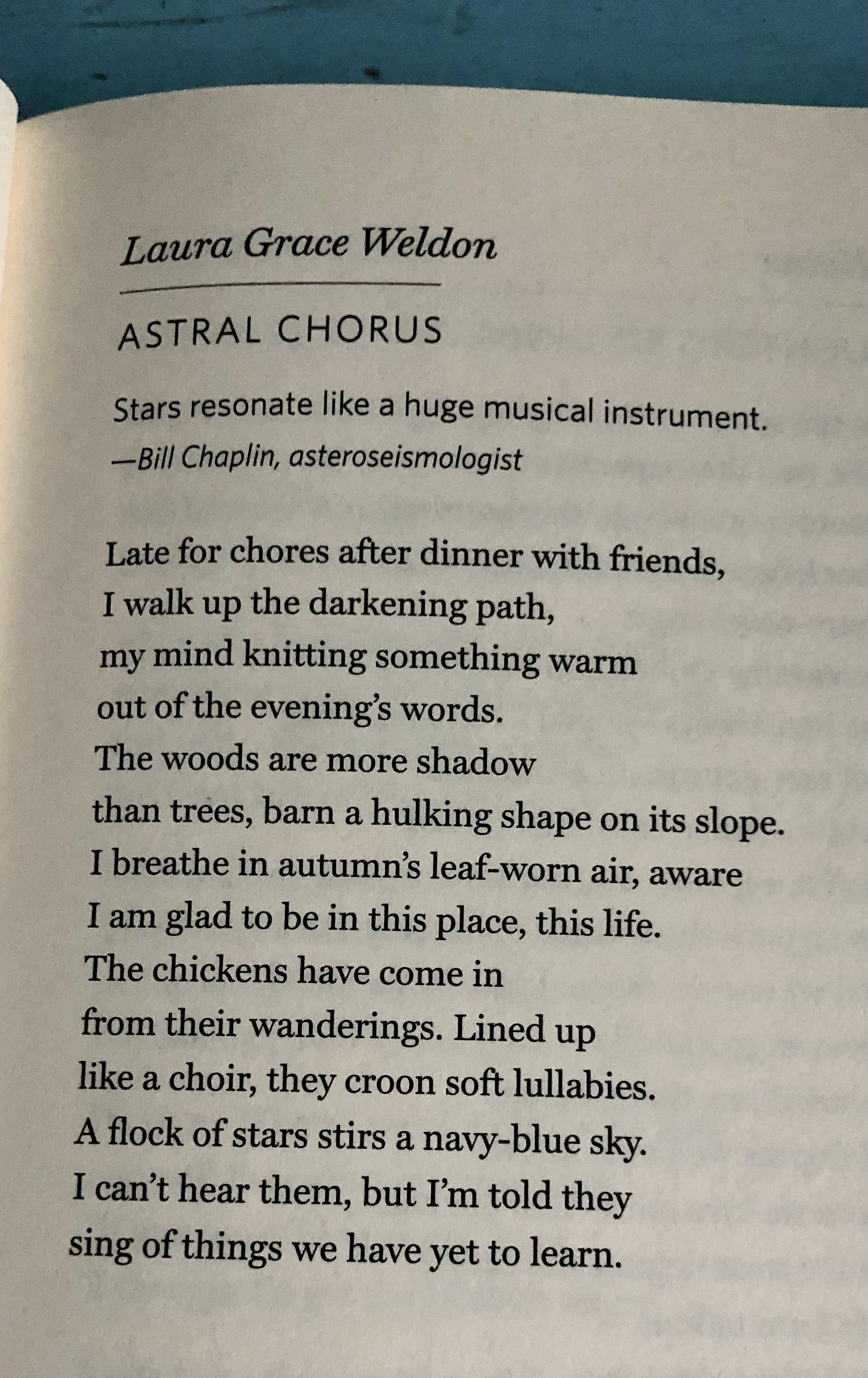
Don’t talk to me about the stars, about how cold and indifferent they are, about the unimaginable distances. There are millions of stars within us that are just as far, and people like me sometimes burn up a whole life trying to reach them.



 Stony Soil Vermont