“Everything blooming bows down in the rain…”

In the sultry dawn, I’m wandering barefoot in the garden, snatching the lingering strawberries before birds have nabbed the remainder. By late afternoon, thunderstorms have settled in. I’ve left a wooden chair on the porch, a throw rug over the railings, both sodden now. Book in my hand, I lean against our house’s dusty and pollen-layer clapboards, reading in the coolness that’s washed in. Our porch looks out over a bed of bleeding hearts, false Solomon’s seal, hostas. Beyond that, the cemetery, the river valley below. Behind our house, the wild presses in. Ferns tall as my shoulders, goldenseal, the groundhogs, thrush, chittering sparrows, the cut of ravine and the great life there.

Equinox; the lushness burgeons. Bring it on. The rain blows through the bedroom screens whose windows we left open all day. The box elder shoves between the porch railings. The grapes rise hungrily against the barn. All night our rooms are filled with moonbeams, the blowing dew, the mixture of milk trucks rattling down the road and the calling frogs.

Everything blooming bows down in the rain:

white irises, red peonies; and the poppies

with their black and secret centers

lie shattered on the lawn.

~Jane Kenyon

Some news…

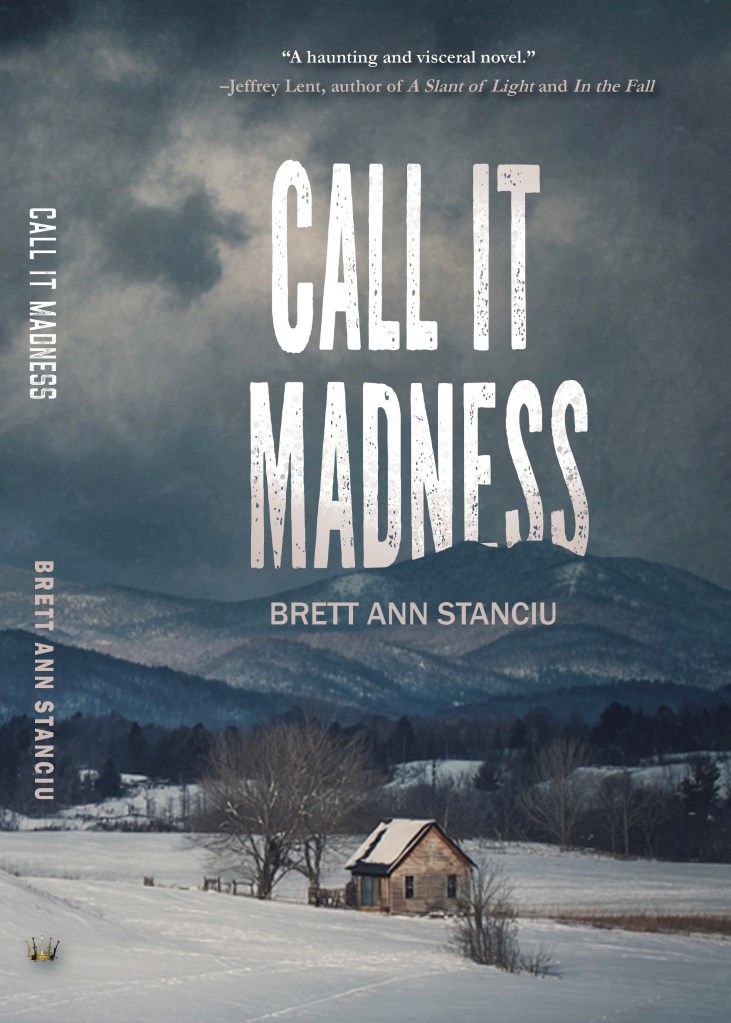
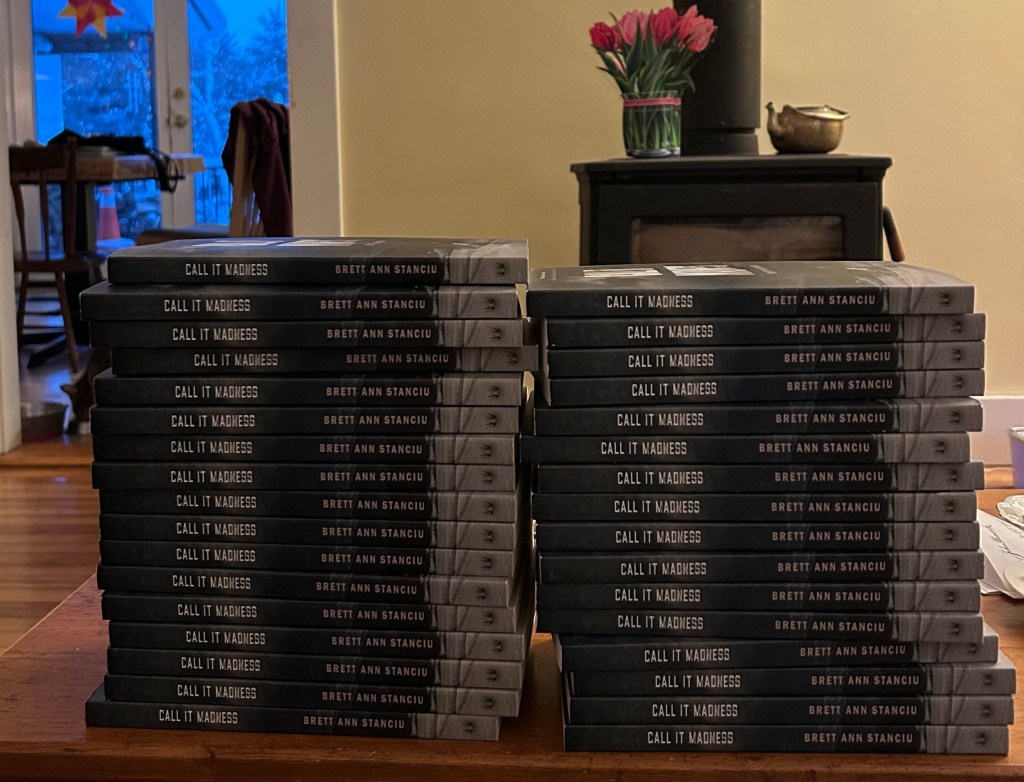
… in a year unlike any other year in my life (youngest off to college with the first year’s bill figured out, grating loneliness and joyous solitude, so much writing and small publications, a radiant writing residency, new friendships, and my mother’s death — say this again, my mother’s death) Regal House Publishing, an Indie press in Raleigh, picked up my second novel, Call It Madness, pub date summer 2026.

Chapter One

            I didn’t know what made my parents drive from Bellingham to faraway Vermont the summer I turned four. I had never met my great-grandfather Opa until that afternoon my mother rolled our station wagon down Breadseed Lane. Earlier that day, a stranger had helped my parents change a flat tire on the New York turnpike, but the spare was a misfit. For hours, our car had been thumping while I stared through the backseat windows at the trees and fields passing by, pondering the puzzle of that strange word breadseed. Could seeds blossom into loaves? We hadn’t stopped for lunch, and I was hungry. Was this Opa character cooking us dinner? Turned out, he was not.

Sips of May.

As the spring dusk settles down, I’m wandering around the edges of my garden. The lilacs have just begun opening, a tiny four-petaled blossom here, another there, the remainder of that lavender flower still knotted, not yet relaxed into the wide open spring season.

I’m in my ragged jeans, dirt under my nails, when my neighbor pulls into her driveway and gets out of her Prius. She’s wearing what she calls her rag-bag dress, and the two of us make a kind of pair. I’ve known her since our oldest kids were babes in arms, not yet eating smashed carrots.

It’s been a year for each of us — and I mean that: a year. We both have college-aged kids in and out of our houses. Under the fragrance of pear blossoms, we immediately head into that long-running conversation we have about her work and my work, about writing and art, about aging parents. The half moon rises over my apple tree.

May, in all her radiant beauty. Here I am, with a hundred chores in one day — a hot water heater repair, more writing, plant arugula and Brussel sprouts, my constant fiddling with the wood pile, the daughter chat. How this Vermont world loves to green. Yes, and again, more, yes, yes.

Heart Runneth Over…

The Gihon River runs through the Vermont Studio Center campus, turning as a river does just out my studio window. All day long, the mallards do their duck thing, swimming up and downstream. In the wild honeysuckle’s tiny bits of green leaves, cardinals perch.

In this week I’ve spent at the Vermont Studio Center, I’ve leaned with a ferocity and joy into writing. A week to write, unfettered by the everydayness of commerce and cooking, of checking the car oil, adhering to those endless lists of can the house insurance get a lower premium, and am I ever going to paint the back side of my house? A thousand things comprise a life — some stupidly trivial like repairing a kitchen cabinet knob, some sacredly profound, like mourning a parent’s passing. 

Does writing, does sculpture, printmaking, poetry, make the world a finer place? The jury’s out perhaps, but art certainly unites the finer parts of who we are as humans, and makes this life more bearable.

Thank you again for reading.

Where I Am.

For a week, I’m lucky to be staying at the Vermont Studio Center for the Arts, tucked in Johnson, Vermont, with writers and visual artists. A word, first: like anyone in this culture driven to create art, I’ve been swimming upstream (clumsily) for what seems like most of my life. But this magical place offers notsomuch an antidote but an alternative possibility.

In one way, I feel like I’m a college student at tiny rural Marlboro College again, eating communal meals with the same cohort, attending presentations, talking and so much talking. How’s your book going? What are you doing with copper? So many interesting people writing and sculpting and painting. But, like everyone else here, I’m far beyond college age, using my studio hours fiercely.

In my studio building, a former resident wrote in a communal notebook about arriving worn down from the grind of capitalism, and how rejuvenated she left after her stay here. I’ve long realized that our capitalist model often draws out the mean and petty strands of us, like a competitive gardening streak that weirdly surfaced in a long-ago baby group I attended. Which serves, of course, exactly no one at all. For this bit of time and space, I’m savoring this dear space, where my back is watched, and I can do my work.

… Last, thank you all for your notes and emails since my mother’s death. My father recently uploaded his memoir, 87 years of his indisputably distinct life.

The Rules.

Stopping beside me on a riverbank trail, a stranger grouses to me about the overcast weather hanging chilly and foggy. I share my month of May story: in my second pregnancy, rain fell every day in May. I’d heard on NPR that a rainy May predicted a sunny summer. That summer, with a new baby, I remember as one of the sunniest. Oh, but fickle memory…. perhaps rain fell all that summer.

The stranger answers, the rules don’t matter anymore, anyway, and loops away on his run.

Oh, the rules do matter. But which rules? My daughter, on a university campus, sends news of our Vermont world fracturing. Meanwhile, around the globe, misery. There’s that old nursery rhyme about for want of a nail the horse wasn’t shod and the battle was lost. The horseshoe nail matters.

Here’s a defining rule: mortality reigns. More: month of May, the tangled wild honeysuckle in the ravine behind my house sprouts leaves. The groundhogs fatten.

In her room at the prow of the house
Where light breaks, and the windows are tossed with linden,
My daughter is writing a story.

I pause in the stairwell, hearing
From her shut door a commotion of typewriter-keys
Like a chain hauled over a gunwale.

Young as she is, the stuff
Of her life is a great cargo, and some of it heavy:
I wish her a lucky passage…

It is always a matter, my darling,
Of life or death, as I had forgotten.  I wish
What I wished you before, but harder.

— Richard Wilbur, The Writer