Birthday.

Today my father is 85 — an extremely notable birthday. My father was born in the Depression, son of Romanian immigrants. His life spans through the second World War and incredible social changes, and he’s lived in Michigan, in Europe, in New Mexico, and in New Hampshire where he and my mother raised their three children.

This morning I woke from a dream about the blue Volkswagen Beetle my parents bought in Germany, not long after they were married, and shipped back on the boat to this country. They drove that beetle most of my childhood. We hiked and walked all through my childhood, too, always getting the lay of the land wherever we were. One weekend, the VW’s battery was on the fritz. We pushed the car to get it started, then parked on a hill at the trailhead, hiked, and rolled the car back into life.

Afterward, we stopped in a New Hampshire village, parked again on a hillside, and walked into town. He bought us ice cream cones at an old soda foundation, and we stopped in a used book store. Back at the VW, he had us push the little blue car, then he jumped in and popped the clutch. At the bottom of the hill, engine idling, he unrolled the window and leaned his head out. “Hop in!” he called to his kids.

By twist of fate, my parents, like so many others, are entering very old age in a pandemic, with immense challenges there’s no need for me to reiterate. But on this March morning, I also woke remembering 24 years ago, the day my then-husband and I first made syrup from our 2,000 tap sugarbush. In the cold, I walked back up the house, called my father, and wished him a happy birthday. We had made fifty gallons of syrup, and that sweet golden flow seemed miraculous. A year later, my parents visited and met their first granddaughter.

March is the season of promise that we live through, year after year, ice and gloom yielding syrup. Such sweetness.

Testament

by Hayden Carruth

So often it has been displayed to us, the hourglass
with its grains of sand drifting down,
not as an object in our world
but as a sign, a symbol, our lives
drifting down grain by grain,
sifting away — I’m sure everyone must
see this emblem somewhere in the mind.
Yet not only our lives drift down. The stuff
of ego with which we began, the mass
in the upper chamber, filters away
as love accumulates below. Now
I am almost entirely love. I have been
to the banker, the broker, those strange
people, to talk about unit trusts,
annuities, CDs, IRAs, trying
to leave you whatever I can after
I die. I’ve made my will, written
you a long letter of instructions.
I think about this continually.
What will you do? How
will you live? You can’t go back
to cocktail waitressing in the casino.
And your poetry? It will bring you
at best a pittance in our civilization,
a widow’s mite, as mine has
for forty-five years. Which is why
I leave you so little. Brokers?
Unit trusts? I’m no financier doing
the world’s great business. And the sands
in the upper glass grow few. Can I leave
you the vale of ten thousand trilliums
where we buried our good cat Pokey
across the lane to the quarry?
Maybe the tulips I planted under
the lilac tree? Or our red-bellied
woodpeckers who have given us so
much pleasure, and the rabbits
and the deer? And kisses? And
love-makings? All our embracings?
I know millions of these will be still
unspent when the last grain of sand
falls with its whisper, its inconsequence,
on the mountain of my love below.
Wild Honey.

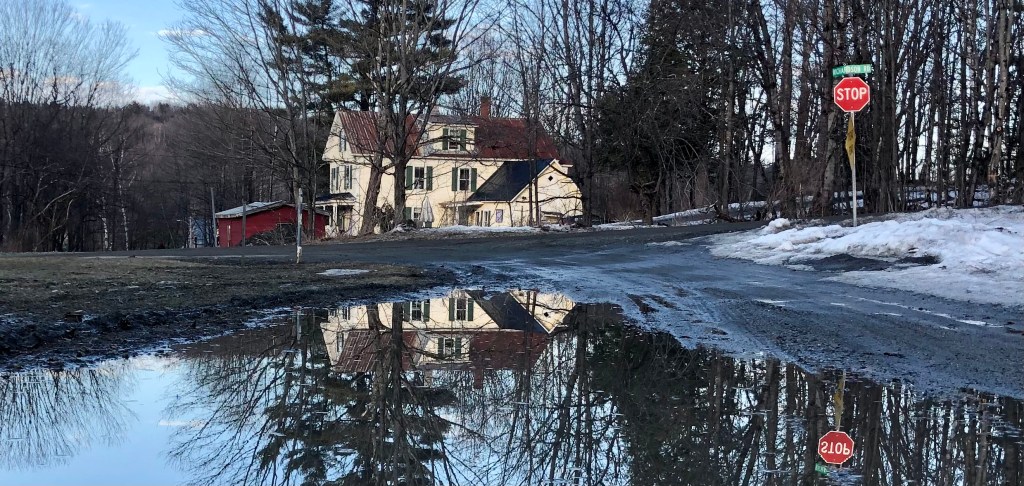
In what could be called Yet Another Phase of Life, I meet my oldest daughter at her apartment, and we take the dog for a walk up a dirt road where I’ve never been. It’s rural Vermont, and the road bends away from the river valley and winds steeply up a hillside. It’s sunny and cold, and there’s absolutely zero traffic on the road. The weather had turned warm a few days ago, rutted up in a foretaste of mud season, and now is frozen in deep ruts.

The trees end at a stone wall and a sprawl of farm fields, with an incredible four-story 19th century barn. Whoever lives here appears to be hosting a kids’ sledding party. The homeowner appears on the road, with his black dog, who coincidentally shares the same name as my daughter’s dog. We speak pleasantly for a few moments, and it’s clear not many strangers wander up this road.

My daughter snaps a photo of a dripping icicle from one of the little outbuildings.

The kids’ party slowly heads back to SUVs and station wagons, the kids red-checked, in snowsuits, carrying small white paper bags. The adults wave and smile at us.

A little later, I drive home through that river valley I’ve driven countless times now, alone or with kids or sometimes with friends. The road switchbacks through the shadowy Woodbury gulf, and shortly after that, I’m home again, feeding the wood stove and cats, then on the couch with my laptop and work, listening to the litany of reporting from the Ukraine. I remember clearly when I was 23, too, living in Vermont, and it seemed utterly normal to have strangers ask, out of curiosity and nothing more, where do you live and what’s your story?

I sweep up the stove ashes and bring in more wood. The night promises more cold. How much I’d love to put my hands on sun-warmed soil and plant a garden of sunflowers.

Wild honey smells of freedom 

The dust – of sunlight 

The mouth of a young girl, like a violet

But gold – smells of nothing.

― Anna Akhmatova

Holy Language.

Montpelier, Vermont

On a rainy day last week, I parked on a Montpelier side street and walked into town to attend an opioid summit as a writer.

The last time I had been in the conference space in the Plaza Hotel was nearly precisely two years ago, when I attended a conference as a journalist, charged by my editor to “make connections,” and spent most of it drinking coffee and eating sugar cookies and talking with a para-educator at my daughter’s high school about his experiences. Like darn near everyone else in Vermont, he has a side gig for income, and runs a seasonal bakery.

I sat at a table with people I admire who I’ve met through writing. For those few hours, I had the nearly heady experience of meeting new people; I had remember that deep pleasure. Years ago, I traveled on a train from Charlottesville, VA, to Chicago, and sat beside a man from West Virginia. We talked off and on for those hours. It’s been so long since I had that experience of just listening and talking with people.

For a few hours, I listened to stories about addiction and struggle, about suffering and redemption, about profound loss and grief. Listening, my heart grew full. Our stories and words, the act of telling and listening, of sharing the hard and the beautiful things in our lives, bound us together. The summit began and ended with singing. I’ve never been one for group activities, for open sharing, but at that moment, I utterly understood; I got it. The melody of our language and experiences pulled us together, acknowledging both the beautiful and the terrible about human life, and made our world shine brighter.

…. Grateful to have a terrific piece about Unstitched run in the Brattleboro Reformer and the Manchester Journal by Gena Mangiaratti. And The Rumpus included my essay about the backstory of Unstitched in their Voices On Addiction column this month.

The Black Plague. Our Pandemic. Working Life.

A small art find in Montpelier above….

In my morning coffee and reading this morning, I read Tobin Anderson’s Guest Essay in The New York Times about the Black Plague, Covid, and working.

Working has been a steady source of conversation in our house for this past week for a complexity of reasons. As Anderson writes, human lives are caught up in the sweep of human history — at this particular time, a decidedly less fun moment in history. Nonetheless, our individual small lives matter. (See enchanting tiny landscape above, in the granite block.)

Given where we are right now, it’s worth paying attention to the chain of events that led, link by link, from pandemic to panic to bloody uprising.

— M. T. Anderson

Unexpected Phone Call. Driving.

My friend who has no cell phone (yes, indeed) phones me from someone else’s phone when she needs a ride, due to being “in a pickle.” I don’t get the message, as I’m on the phone with a hard-working journalist who’s graciously writing about my book.

Since it’s my lousy cell phone, I get the message about 20 minutes later, as messages are conveyed to my cell phone via carrier pigeon. I phone the stranger, who’s no help at all, but really darn nice.

I get in my car and go search for my friend, listening to a replay of Vermont Public Radio’s Brave Little State about the housing crisis. I pull into Montpelier and get out to look for my friend right around the time the podcast delves into interest rates and their role in this actual Real Life problem.

My friend is fine and home by then, and I sit on the steps of a closed restaurant and talk to her for a good long while. It’s dark, but not late, and the air is warm. I’m in this tiny little city that smells deliciously of something spicy, not sweet like cinnamon, but spicy like hot chili oil. I’m across from my beloved public library, closed up now, where I worked so many lovely long days, pre-pandemic, with never a thought that those days might cease for me. Since I have no real place to be, and my friend is ebullient to be home and safe, I tell her about the night so many years ago when I stood with my baby just down the street and contemplated renting a room in the inn and never going home. I’ve thought about that night and those crossroads in my life for years now, but when I tell my friend this story now, I imagine that long ago night lifting on little dove wings and fluttering over the roof tops.

I turn off my phone and drive home under the starlight.

Snowfall.

We’ve had so little snow this winter in Vermont that this morning’s deep snowfall comes almost as a kind of surprise. The day before, a cold rain fell all morning. As I bent into work, I kept glancing through the windows, glad of the indoor work that morning.

This snow is the classic, pillowy powder of the most magical childhood memories. Sure, spring is far in the offing on a day like this, but the billows and mounds embody winter’s profound silent beauty.

A decade ago in my life, this kind of storm would have whooshed in with a number of worries — will the sugarhouse collapse before the roof is raked? How long can I endure cooped-upness with small children? Will our firewood hold out? These days, my worries are different, as my life is in another place. But I’ve changed, too. We’ll do what needs to be done. What doesn’t get done, perhaps doesn’t need to be done. And some sun is in the forecast for this weekend, too.

[The 1800s opium epidemic in China] was once widely interpreted as a story of a once noble society destroyed by a powerful drug, but more recent scholarship has argued that this simplistic explanation overlooks the turmoil, poverty, and widespread dislocation caused by the wars themselves which in turn exacerbated the epidemic.

Carl Erick Fisher, The Urge