Where I Am.

For a week, I’m lucky to be staying at the Vermont Studio Center for the Arts, tucked in Johnson, Vermont, with writers and visual artists. A word, first: like anyone in this culture driven to create art, I’ve been swimming upstream (clumsily) for what seems like most of my life. But this magical place offers notsomuch an antidote but an alternative possibility.

In one way, I feel like I’m a college student at tiny rural Marlboro College again, eating communal meals with the same cohort, attending presentations, talking and so much talking. How’s your book going? What are you doing with copper? So many interesting people writing and sculpting and painting. But, like everyone else here, I’m far beyond college age, using my studio hours fiercely.

In my studio building, a former resident wrote in a communal notebook about arriving worn down from the grind of capitalism, and how rejuvenated she left after her stay here. I’ve long realized that our capitalist model often draws out the mean and petty strands of us, like a competitive gardening streak that weirdly surfaced in a long-ago baby group I attended. Which serves, of course, exactly no one at all. For this bit of time and space, I’m savoring this dear space, where my back is watched, and I can do my work.

… Last, thank you all for your notes and emails since my mother’s death. My father recently uploaded his memoir, 87 years of his indisputably distinct life.
The Rules.

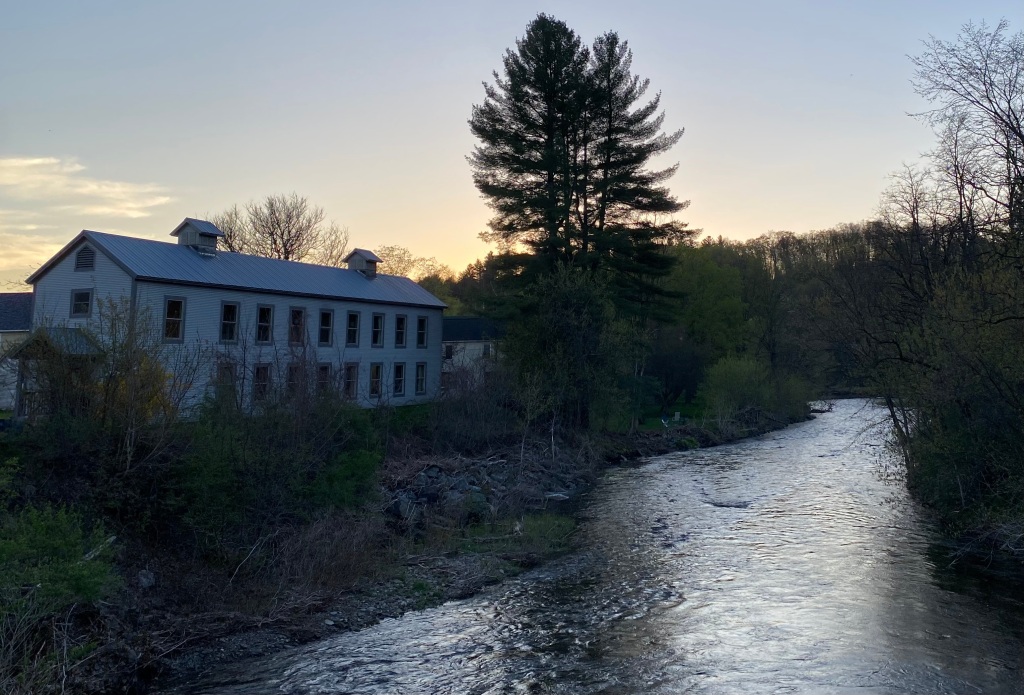
Stopping beside me on a riverbank trail, a stranger grouses to me about the overcast weather hanging chilly and foggy. I share my month of May story: in my second pregnancy, rain fell every day in May. I’d heard on NPR that a rainy May predicted a sunny summer. That summer, with a new baby, I remember as one of the sunniest. Oh, but fickle memory…. perhaps rain fell all that summer.

The stranger answers, the rules don’t matter anymore, anyway, and loops away on his run.

Oh, the rules do matter. But which rules? My daughter, on a university campus, sends news of our Vermont world fracturing. Meanwhile, around the globe, misery. There’s that old nursery rhyme about for want of a nail the horse wasn’t shod and the battle was lost. The horseshoe nail matters.

Here’s a defining rule: mortality reigns. More: month of May, the tangled wild honeysuckle in the ravine behind my house sprouts leaves. The groundhogs fatten.

In her room at the prow of the house
Where light breaks, and the windows are tossed with linden,
My daughter is writing a story.

I pause in the stairwell, hearing
From her shut door a commotion of typewriter-keys
Like a chain hauled over a gunwale.

Young as she is, the stuff
Of her life is a great cargo, and some of it heavy:
I wish her a lucky passage…

It is always a matter, my darling,
Of life or death, as I had forgotten.  I wish
What I wished you before, but harder.

— Richard Wilbur, The Writer

The Bardo.

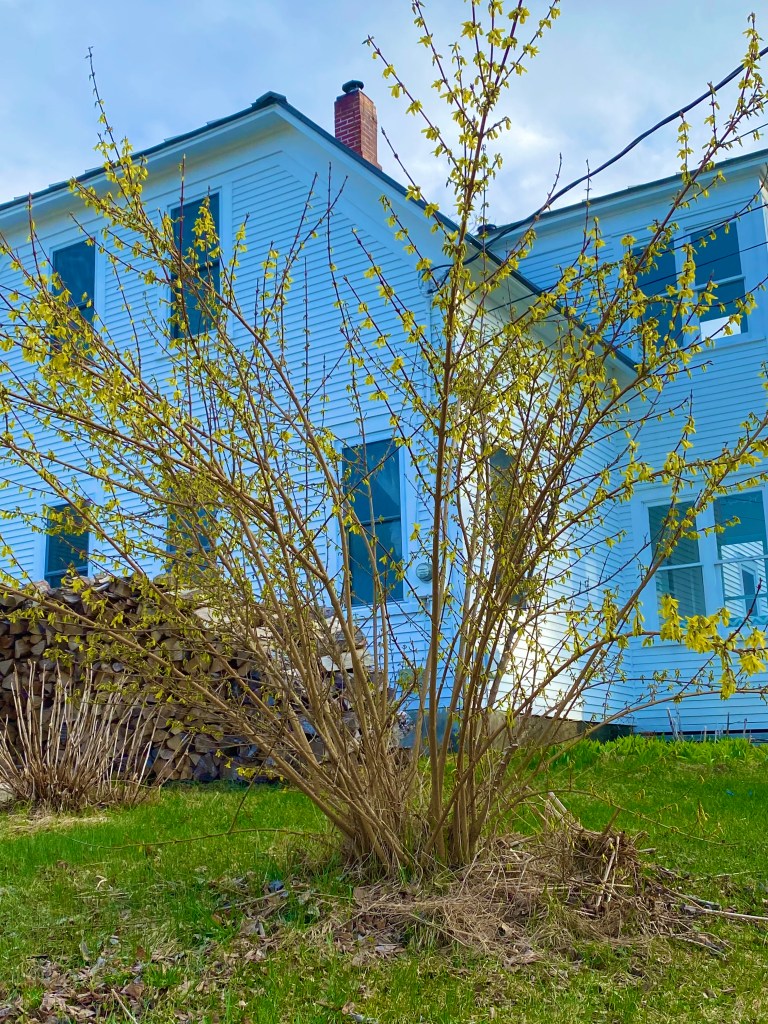
A few years ago, I bought a stick of a forsythia plant. The plant had withered in a nursery which hadn’t cared much for this plant, one of the three or four remaining perennials at the season’s end. For years, I had wanted to plant a forsythia with its cheery early-spring blooms, but I stood there and considered. The plant was about ten dollars. I eventually opened my wallet and took the admittedly meager risk.

The plant thrived. A few years later, I sold that house, dug up the forsythia, and carried the pot in the back of a friend’s pickup to my new house. The plant grew but never thrived, more stick and leaf than bloom.

This year, however, seven years into our life here, the blooms are abundant. I am not a Buddhist, not trained or schooled in any formal education at all, but here’s a thing. For a period of time after each of my daughters was born, I lived in a rarefied space, not of the common everyday world, but exposed and tender, as if the sky had opened up. I had labored to carry a six-pound baby into this mortal world. I had a foot in this world, and a foot still lingering in a gauzy undefined realm. But each day of nursing and crying, of meals of roast chicken and buttered toast, bricked up that entrance, planted me securely in this world again.

So, on the other end of mortality, I see my mother lingering yet with us, in profound and complicated manifestations, in the four of us — her husband and three children — and her four grandchildren as she drifts into her new realm.

In the house where I grew up, my mother and her neighbor bickered over ownership of an enormous forsythia that straddled their property line. As I walk around, planting and watering a lilac tree, stacking firewood, raking, I’m tugged to these delicate gold petals, so brief, such a long struggle, so miraculously splendid.

Darkness overtakes us on our way 

in my lodging the roof leaks 

weeping cherries in flower 

— Buson

The dark blossomings of chaos…

Again, this metaphor lens (how is it possible not to see the world in metaphors?) Paul and John’s Long and Winding Road, Dante’s gloomy forest, Sylvia Plath’s bees and beekeepers…

I lead a friend into a forest, a piece of Nature Conservancy land on a dirt road. We’re talking, talking, my eyes searching the forest floor for ephemerals (the trilliums folded shut, trout lilies still only leafy, no blossoms yet). I take one wrong turn, a second wrong turn. I backtrack, looking for the narrow stone steps. Our walking and talking — and my eventual smartening up to pay attention — takes us to Chickering Bog. In this pristine place, it’s just us and frog eggs, fat tadpoles, crimson pitcher plants — the confluence of ancient and freshly brand-new.

The strange thing is, I’ve walked to this bog half a dozen times, easily. Yet never in April when the sunlight drops down through the trees’ bare branches, when the winter-fall of broken branches strews over the paths. Or maybe I’ve never been here with this conversation about things tiny and great. The glassy water shimmers so clear the bog’s mucky bottom tantalizes, unreachable, so many centuries of so much life.

At the journey’s end, at the dirt road’s edge, the sprinkled gold coins of coltsfoot, a purple sprig of flowering Daphne.

On the reading front…..

“We must therefore be willing to get shaken up, to submit ourselves to the dark blossomings of chaos, in order to reap the blessings of growth.” — Gregg Levoy, Callings

Sweeping Out Inner Clutter.

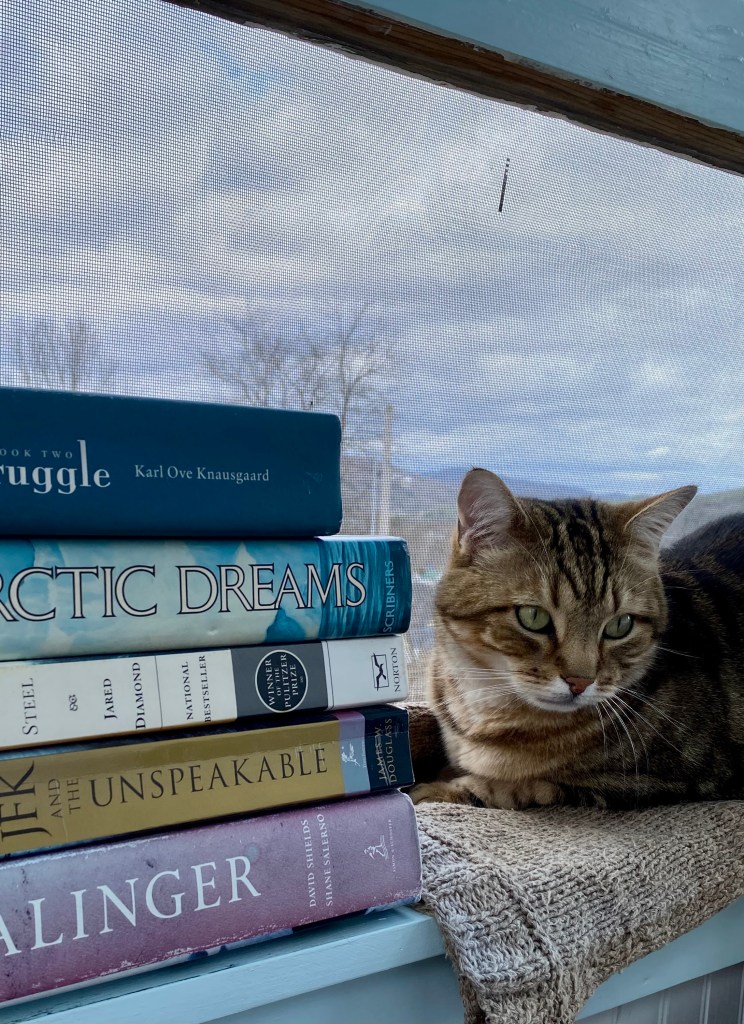
Spring window, upstairs study.

Early evening on Friday, after a long workday, I’m in a nearby town’s general store, talking to an old acquaintance on the porch. The store’s door is propped open. A warm breeze swirls. Rain isn’t far in the offering.

A few years ago, a stranger stopped on the porch steps where I was eating ice cream with my daughters and said my name. She’d read my first book, she said, and loved it. That conversation: a shift for me.

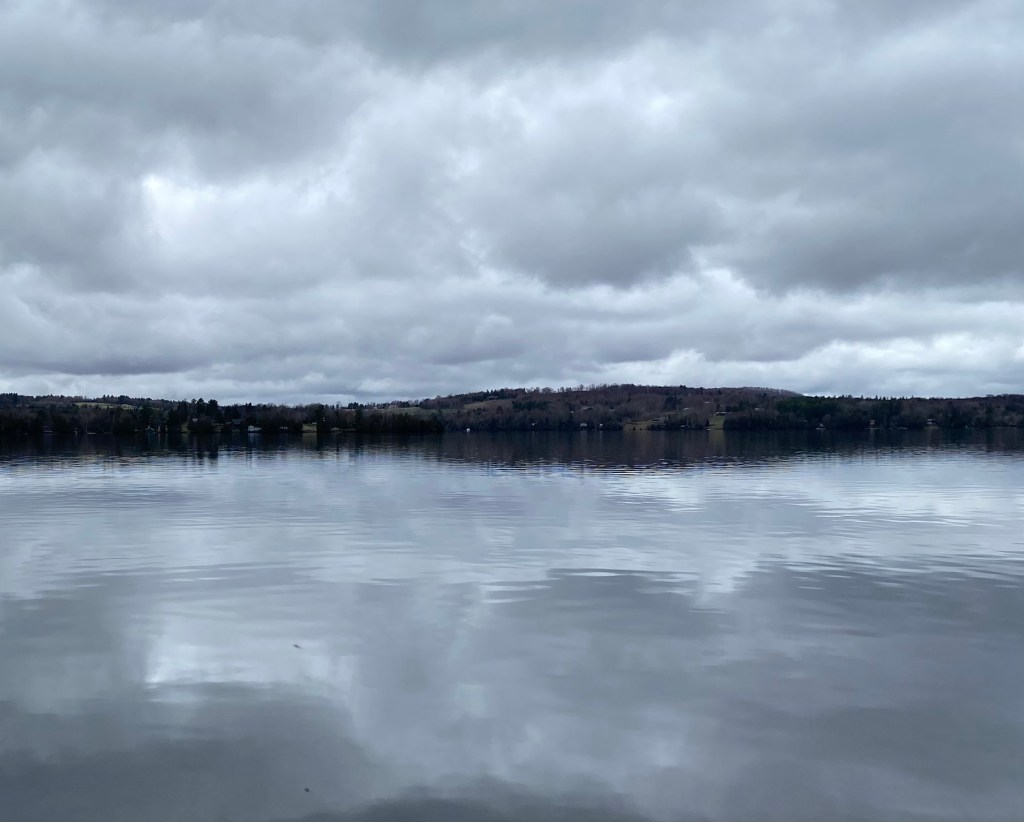
On my way home, I stop at the town beach and lean against the tall cedars, whitecaps chopping on the lake. The breeze is no longer so warm here, and I have the beach to myself. Last fall, weekend afternoons and stuffy evenings, I swam here, when everyone else was too busy or too disinterested to swim at my usual places. With my youngest at college, I lived alone again, and I determined not to drench my empty nest with tears. For those hours, I brought pages of my manuscript. Dusty sand drifted into my printed words and into my bag that held my ever-present things: library books and knitting. I’d swam here before with my daughters, but I began to know this lake in a new way: how the bottom drops quickly and few boats venture to this far end. I kicked far out, leaving the weeds and the strangers on the beach behind. Curious or not, the loons joined me.

And a line from the mesmerizing Annabel Abbs’ Windswept about women, walking, solitude, and creativity: “She purged her inner clutter with outdoor space.”

‘Eat all the plums from all the iceboxes. Apologize to no one.’

Not a spoiler alert — an eclipse is headed our planet’s way — and we live in the path of totality. Over the past few years, it feels like the state has prepared for so many things: snowstorms and windstorms, floods. Now, a river of people streaming in for The Awesome.

Meanwhile, lives churn on. I spend a pleasant and snowy afternoon writing a spreadsheet, followed by a ranting email which I (wisely) delete before I send. I write and write. A short excerpt of my novel is picked up for publication in May. I’m given a green folder and a white folder of old letters and documents and site map for an article I’m writing. The housecats twitch at the juncos in the feeder.

Ryan Champan’s advice on writing a novel:

56. If you’re struggling with revision, print out the draft. Cut each sentence into individual strips and papier mâché them into a sculpture of your head, scaled 2x. Once it’s dried, place the sculpture over your head—create eye holes at your discretion—and just sit like that.

And another:

15. Llosa again, on writing one’s first novel: “Those writers who shun their own demons and set themselves themes because they believe their own aren’t original or appealing enough are making an enormous mistake. In and of itself, no literary theme is good or bad. Any themes can be either, and the verdict depends not on the theme itself but rather on what it becomes when the application of form—narrative style and structure—makes it a novel.”

Read the whole 1oo here. Surely a few gems for anyone…