10,000 Years of Pollen: Storyline

An expert in New England’s ancient forests shares the story of taking a core sample from a pond not far from my library — easily within a few hours’ walk — and extracting 10,000-years-worth of planetary history. 10,000 years of pollen!

I’m standing in the dark in the back, while a few latecomers step in, carrying the cold on their coats, kicking snow from their boots. I’m also coincidentally near the hot tea, which I urge my guests to take.

10,000 years. His chart graphs the fluctuation of trees in this plot of Vermont — the persistence of beech, rise of rock maple. Exquisitely, I think of a larch not far from the library, how cool and welcoming that forest is in the summer, how brilliantly yellow its autumn needles. The extremely large view and the absolute specific.

Afterwards, finally home with my girls who are in an especially good humor, I think of the UVM museum my youngest and I just visited, chockfull of very ancient human artifacts, a variation of pollen — and in particular the arrowheads found along Lake Champlain. Whose hands made these?

Still socked in by winter… no pollen in the wild wind in the conceivable future…

IMG_4786

Specific child, specific 5 degree day, Burlington, February, 2019.

Snippets From the Snowy North

Snow falls on my 13-year-old’s hair as we walk through the falling snow. 13-year-old girls are empirically unable to wear hats. Ski helmets, sure. But hats? Get real.

Nonetheless, I ask her to walk with me. Beneath a pine tree, our neighbor’s streetlamp glows day and night at the end of her driveway, weirdly reminding me of the lamppost in Narnia. In this Vermont transformed to the otherworldly by so much snow might a faun appear around a snowbank? Has this neighbor left the lamp lit for someone? Or has she merely closed her curtains and forgotten?

We’re keeping tabs on the neighbor’s progress on his pale blue Honda. Before the storm, he’d removed the hood and laid it on a snowbank. With the recent storm, the car is buried again.

We speculate. Did he return the hood before the recent storm? Oooo, we hope so, thinking of the car engine open to 10 more inches of snow. Implicitly, we’re rooting for him, as if repairing this vehicle is synonymous with spring.

The Chinese junk
not stopping
moving on through the mist

— Buson

IMG_4670

Pre-storm….

Memory, Body

In the middle of the night, I’m awake thinking of myself, years ago at 30, standing at the roundabout in Montpelier between Main Street and Route 12, baby on my back, trying to figure out where my life—where our lives—would go. It was October then, 1999, and the news amped Y2K fears.

Every time I walk along that section of street in Vermont’s capital city, I think of that cold autumn’s crepuscular hour, as if I pass through its shadow again. The notion of linear time is supercilious. Walking with a friend in the Hardwick town forest, we talk about our 13-year-old daughters. Both of us mothers now, long past adolescence—and yet, we’re both 13. Our conversation crackles with memory.

That baby on my back is now 20. No one but myself will ever remember that evening. And yet, there it is: always with me.

Women have been driven mad, “gaslighted,” for centuries by the refutation of our experience and our instincts in a culture which validates only male experience. The truth of our bodies and our minds has been mystified to us. We therefore have a primary obligation to each other: not to undermine each others’ sense of reality for the sake of expediency; not to gaslight each other.

— Adrienne Rich

IMG_4653

Februrary sunbathing….

Cracking Open the Door on Deafness

In my twenties, I was a typist for a novelist who not only had the misfortune to suffer from severe carpel tunnel, but was also profoundly deaf. The deafness had contributed to her divorce, and she holed in up in her parents’ summer house in rural Vermont. Once a professional musician, she cleaned houses before landing a teaching job and turning to writing children’s literature to make a living.

Sitting side by side with me, she dictated her novel.

One morning, an unfamiliar alarm rang out in her study, so piercingly loud I instinctively bent over. I heard nothing but that sound. Fearing it was a fire alarm, I stood up, panicked. Then I saw the novelist, sitting in her chair, was mystified by my actions. She was entirely oblivious to the noise. To her, that alarm didn’t exist.

A red flashing light on her computer power surge system warned that the power had gone out. I shut down her computer. I explained what had happened. Then I stood there, rattled — both from the physical shock and from my glimpse into her immense silence.

Here’s a line from Susan Orlean’s The Library Book:

… oh my God… do you think there are any conservative librarians?

IMG_3980.jpg

Lyndon, Vermont

Why Love Cats

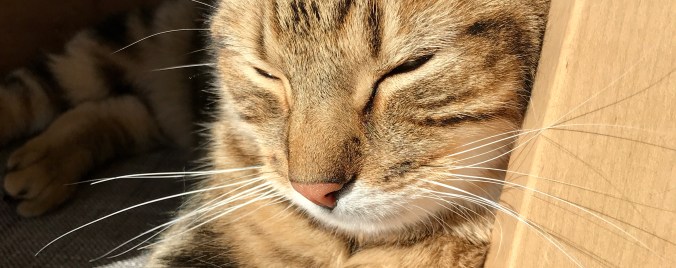
My daughters’ cat and I are listening to Chris Hedges lecture about the collapse of the American Empire — extremely serious and unfunny — when the cat falls off the hutch and splashes into my pan of lemon-yellow paint.

The cat probably yowled; I certainly shouted. The creature scrambled through the dining room to living room, through my study, into the kitchen, where my daughter grabbed the paint-soaked cat. While she cleaned paint from the cat in the basement, I washed wet paint from our floors on my hands and knees.

We’ve lived in this house not much more than a year. While I love the maple floors, I generally don’t spend much time mopping.

While Hedges kept talking, I realized some of the narrow boards were birdseye maple. Through the closed basement door, I heard my daughter murmuring, comforting her beloved cat.

Whoever laid the floors in this house passed from this life decades ago. I thought of these slender, hard boards in a carpenter’s hand, his sight appraising the grain.

The decision by the ruling elites in ancient Rome—dominated by a bloated military and a corrupt oligarchy, much like the United States—to strangle the vain and idiotic Emperor Commodus in his bath in the year 192 did not halt the growing chaos and precipitous decline of the Roman Empire…. Trump and our decaying empire have ominous historical precedents.

— Chris Hedges, America: The Farewell Tour

IMG_3819.jpg

The Larch Season, November, Vermont


Stockpiling

As the garden withers for the winter, I collect seeds — tithonia, marigold, coneflower — pulling the dry seeds with their tufted ends with my fingers, secreting them in my coat pockets.

My daughter takes a handsaw to the mammoth sunflower stalks fencing the garden, their heavy heads picked nearly clean of seeds from marauding birds. From a scant palmful of seeds, what pleasure these beauties have given us this summer. Now, the birds and the scavenging squirrels feast, too.

A friend stops by with a bare peony root, cushioned in paper, transported in a Negra Modela box. I’m out that evening. When I return, my daughter carefully unwraps the root — not merely a stick but a complicated branching — and then lifts another smaller root. Good luck, she says. They may not grow.

Or, they might.

Wait, for now.
Distrust everything, if you have to.
But trust the hours. Haven’t they
carried you everywhere, up to now?

— Galway Kinnell

IMG_3757.jpg


Juncos flock the double glass doors in our kitchen, tantalizing our cat.