Reading Harry Potter

Like in-laws who have overstayed their welcome, winter lingers. While you might be wanting to mop mud from the in-laws’ boots off your kitchen floor, they keep coming and going, anticipating lunch and then dinner.

So, too, winter.

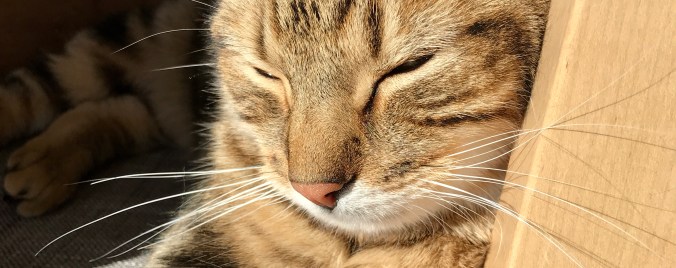
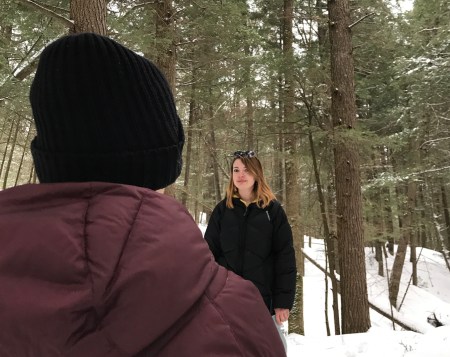
Sunday afternoon, my daughter reads Harry Potter with a cat curled sleeping beside her. I stretch on the rug with the other cat, reading David Wallace-Wells’ The Uninhabitable Earth: Life After Warming. She pauses to relay a Dumbledore tidbit. I consider sharing the word desertification, and then decide the heck with that. Later, we put on our boots — again, again. In the woods, we follow a narrow snowshoe trail.

I’m likely to lay down the grim reading and pick up Potter as a survival guide, in the current season and for the longer haul….

That epic era once derided as ‘prehistory’ accounts for about 95% of human history. For nearly all of that time, humans traversed the planet but left no meaningful mark.
IMG_4875.jpg

The Twisty Road North

Late afternoon on a Friday, I take a winter road trip north, nearly to Canada, along Route 14 so rutted with frost heaves my little Toyota bounces. The pavement and passing cars are bleached with road salt — rust, pernicious rust, I keep thinking, apprising the mortality of my vehicle.

My daughter and I return in the dark from her concert. It’s 8:30 pm, but might as well be midnight. No one’s on the road but a tractor with blinking lights before a barn. This is farming country. The few gas stations and general stores in the small towns we pass through have all snapped off their lights, shut up, gone home.

Even in the dark, this highway is familiar, although we rarely drive this way anymore. In the dark car, eating crackers, we swap stories. My daughter tells me about the  high school she just visited and its long locker room. I point out the state’s largest landfill. Whoo-hoo, my daughter says. A claim to fame. We pass a farm where she once believed Santa’s reindeer lived. I was so sure of that! She tells me about a tiny turtle on Lake Memphramagog I’d forgotten. She repeats the story with precise details; in a flash, I remember that brilliant April morning, the black and white checked dress she wore and loved.

Listening to her, at age 13, I hear her imagining a different life. What would it be like to live here? I think of her as so young, but I’m wholly wrong. Her stories keep flowing. Along this road we hardly ever travel, she has a whole history already, a detailed map of her past.

What an age 13 is: so full of wonder, of mystery: which direction will I steer my life?

To move, stay put, say the Buddhists. To see, stop looking. Don’t imagine paradise in the sky. Make paradise in the kitchen.

— Kate Inglis, A Field Guide to Grief: Notes for the Everlost

IMG_4855.jpg

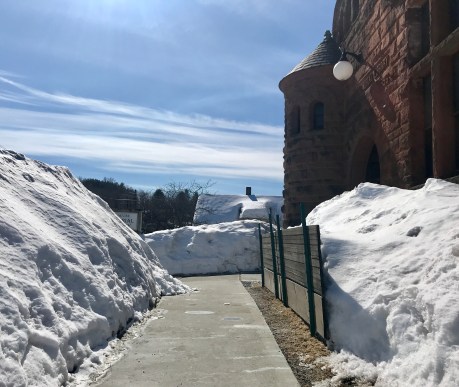
A sampling of our everyday snowbanks this March

10,000 Years of Pollen: Storyline

An expert in New England’s ancient forests shares the story of taking a core sample from a pond not far from my library — easily within a few hours’ walk — and extracting 10,000-years-worth of planetary history. 10,000 years of pollen!

I’m standing in the dark in the back, while a few latecomers step in, carrying the cold on their coats, kicking snow from their boots. I’m also coincidentally near the hot tea, which I urge my guests to take.

10,000 years. His chart graphs the fluctuation of trees in this plot of Vermont — the persistence of beech, rise of rock maple. Exquisitely, I think of a larch not far from the library, how cool and welcoming that forest is in the summer, how brilliantly yellow its autumn needles. The extremely large view and the absolute specific.

Afterwards, finally home with my girls who are in an especially good humor, I think of the UVM museum my youngest and I just visited, chockfull of very ancient human artifacts, a variation of pollen — and in particular the arrowheads found along Lake Champlain. Whose hands made these?

Still socked in by winter… no pollen in the wild wind in the conceivable future…

IMG_4786

Specific child, specific 5 degree day, Burlington, February, 2019.

Snippets From the Snowy North

Snow falls on my 13-year-old’s hair as we walk through the falling snow. 13-year-old girls are empirically unable to wear hats. Ski helmets, sure. But hats? Get real.

Nonetheless, I ask her to walk with me. Beneath a pine tree, our neighbor’s streetlamp glows day and night at the end of her driveway, weirdly reminding me of the lamppost in Narnia. In this Vermont transformed to the otherworldly by so much snow might a faun appear around a snowbank? Has this neighbor left the lamp lit for someone? Or has she merely closed her curtains and forgotten?

We’re keeping tabs on the neighbor’s progress on his pale blue Honda. Before the storm, he’d removed the hood and laid it on a snowbank. With the recent storm, the car is buried again.

We speculate. Did he return the hood before the recent storm? Oooo, we hope so, thinking of the car engine open to 10 more inches of snow. Implicitly, we’re rooting for him, as if repairing this vehicle is synonymous with spring.

The Chinese junk
not stopping
moving on through the mist

— Buson

IMG_4670

Pre-storm….

Memory, Body

In the middle of the night, I’m awake thinking of myself, years ago at 30, standing at the roundabout in Montpelier between Main Street and Route 12, baby on my back, trying to figure out where my life—where our lives—would go. It was October then, 1999, and the news amped Y2K fears.

Every time I walk along that section of street in Vermont’s capital city, I think of that cold autumn’s crepuscular hour, as if I pass through its shadow again. The notion of linear time is supercilious. Walking with a friend in the Hardwick town forest, we talk about our 13-year-old daughters. Both of us mothers now, long past adolescence—and yet, we’re both 13. Our conversation crackles with memory.

That baby on my back is now 20. No one but myself will ever remember that evening. And yet, there it is: always with me.

Women have been driven mad, “gaslighted,” for centuries by the refutation of our experience and our instincts in a culture which validates only male experience. The truth of our bodies and our minds has been mystified to us. We therefore have a primary obligation to each other: not to undermine each others’ sense of reality for the sake of expediency; not to gaslight each other.

— Adrienne Rich

IMG_4653

Februrary sunbathing….

Cracking Open the Door on Deafness

In my twenties, I was a typist for a novelist who not only had the misfortune to suffer from severe carpel tunnel, but was also profoundly deaf. The deafness had contributed to her divorce, and she holed in up in her parents’ summer house in rural Vermont. Once a professional musician, she cleaned houses before landing a teaching job and turning to writing children’s literature to make a living.

Sitting side by side with me, she dictated her novel.

One morning, an unfamiliar alarm rang out in her study, so piercingly loud I instinctively bent over. I heard nothing but that sound. Fearing it was a fire alarm, I stood up, panicked. Then I saw the novelist, sitting in her chair, was mystified by my actions. She was entirely oblivious to the noise. To her, that alarm didn’t exist.

A red flashing light on her computer power surge system warned that the power had gone out. I shut down her computer. I explained what had happened. Then I stood there, rattled — both from the physical shock and from my glimpse into her immense silence.

Here’s a line from Susan Orlean’s The Library Book:

… oh my God… do you think there are any conservative librarians?

IMG_3980.jpg

Lyndon, Vermont