Loon Piece, State 14

Having never lived in a large city — or any city at all, really — I don’t know the social lay of the land, or the complex paths of how people know each other.

In my small world of Vermont, I now write monthly for the online State 14, and my short essays are often paired with the incredibly talented Nathanael Asaro. His mother sold her handmade soap beside our maple syrup and root beer float booth at the Stowe Farmers Market, and we spent an awful lot of hours — sweaty, shivering, or under perfect skies — talking and laughing.

My friend has long since quit the soapmaking and finished law school. I’ve quit the syrup business and moved on, too. But here’s a connection between the two of us surfacing again.

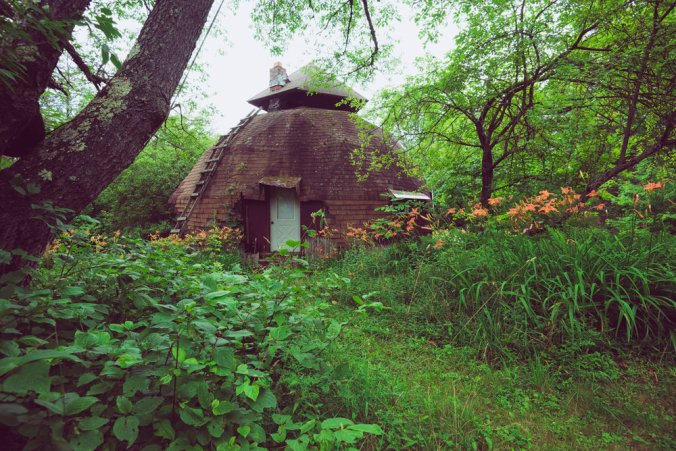
Dome_Greensboro_Bend

Nathanael Asaro

Wandering, Mid-August

Three boys loop in circles on their bikes, eating popsicles and talking. Walking by, I note one boy rides an old banana-seat bike, not unlike my brother’s when he was a kid.

Monday evening, the neighborhood I walk through is unusually busy with people — a woman yanking yellowing pea vines from her garden, a young man powerwashing his deck, two women deep in conversation walking tiny dogs.

I pause at a woodshed where friends have built a tiny house to raffle for the local library addition project. The raffle’s this weekend, and we speculate about who might win. Kids, we hope. Not simply a cute toolshed.

We’ve hit mid-August when the cricket songs have shifted to a longer, slower sizzle, that gradual unwinding of their energy until the singing simply dwindles away in the fall. August is the season of gardens gone rogue — this year my enthusiastic nasturtiums have nearly eclipsed my peppers. The mornings are dim now; the mist moves back into the valley for the cool night hours.

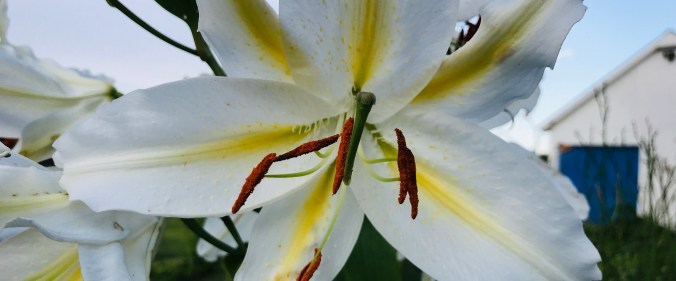
In the rose bed, whose flowers have long fallen, a single trumpet lily blossoms, and I wonder whose hands planted this beauty? Walking by, its fragrance pulls not only the pollinators but myself.

Here’s a line from a fascinating book I found in Maine — Don Kulick’s A Death in the Rainforest: How a Language and a Way of Life Came to an End in Papua New Guinea.

A language dies by contracting, by having its layers of complexity peeled off like an onion skin, getting smaller and smaller until there is finally nothing left.

IMG_6286

August Love

August is national picnicking month, I hear on the radio, in my crazy too-many hours of driving yesterday. I also catch an interview with a female comic whose voice reminds me I swear of all those August afternoons of picking blackberries. It’s not blackberry season yet, but soon will be. August often means the dirt roads have turned dusty.

First, I picked alone, then newly pregnant, then had a baby on my back, then all those years with a fat-wheeled hand-me-down stroller. Later, the children walked or biked. Our baby, on the back of her father’s bicycle, held out a hand and said blacks, blacks, hungry for the berries.

What to do with blackberries? Last August, the girls baked a tart with fresh peaches and blueberries, served it with maple-sweetened whipped cream.

That’s how good was this woman’s voice.

Home too late to swim, my daughter and I walk through the cemetery and down to the community gardens. Only the mist is out and a few women walking dogs.

August 1. We go to bed ridiculously early, because we get up ridiculously early. This morning, I open the windows to let in the gray dawn and its cut-grass scents. As a child, we camped nomadically, crawling out of the tent in the morning and discovering cold dew and trails of mist from the night. In the eternity of childhood, we were hungry for breakfast and whatever the day might bring.

Here’s Hayden Carruth’s August First poem, too good not to read again.

IMG_6183


Small Town Vermont Connections

Rain falls heavily not long after dawn, and I close the windows, the cats in the upstairs hallway watching me silently. The rain pounds on the metal roof. Too hot to sleep in the night, too noisy now — if that’s not a metaphor for life, I don’t know what is.

Three years divorced, I’m back in court, seeking child support — maybe just one payment? — but he’s not there. He’s elsewhere, traveling, his pockets full of under-the-table cash. In the afternoon, I’m in another Vermont county, in another courthouse, for another hearing, having worked in a library between the two, made an interview phone call on a bench beneath two enormous maple trees. Tell me about your farm program for kids and please ignore the ambulance siren whizzing down the street. Hot, hot, I’m barefoot, my hand sweating on my notebook.

In the courthouse — through a metal detector again — I wash my face in the women’s room and admire the high ceiling, the marble tiles. This courthouse — like the one in Orleans County where I’ve also been — were built with such craft, such pride, such respect and belief in law.

While rain crashes on my roof this morning, I remember that courtroom — those who are paid to be there, and those who aren’t — how desire in its myriad forms snakes through all of us. The public defender and I are introduced. A few years back, he was an attorney on a wind tower protest case involving people I knew. He doesn’t look at any of us. Instead, he gathers his files, says, That was in my other lifetime, and leaves. I’ll likely never know, but I can’t help but wonder, What’s his story?….

I don’t know exactly what a prayer is.
I do know how to pay attention…

— Mary Oliver

IMG_6181.jpg


Cicada Songs

I find an empty cicada shell beneath a leaf on an oak tree I planted this spring.

That line sums up midsummer, this lush and gorgeous summer. I planted that tree from my bare root order, a mere stick with a frizz of roots. Maybe, my kids said. And yet these trees thrive.

stillness–
sinking into the rocks,
cicadas’ cry

— Basho

IMG_6139

Molly and Fluffy

Thistles, Hemp, Coreopsis

Rain moves in; the heat moves out. I get up from my desk and put on a long-sleeved shirt. My older daughter and I — just the two of us — make pesto and spread it over a pizza with broccoli she slices. She looks at the pizza before she bakes it and says, Garden pizza.

Swimming holds no appeal. Instead, in the evening, we walk up a long dirt road heading out of Hardwick. I follow her into an overgrown pasture. She hands me her phone and has me photograph her in a field of Scottish thistles. She wades shoulder-deep into the prickles and purple flowers, and the memory of traipsing through forests and meadows behind her as a girl child returns to me. Those summers she and her best friends were obsessed with false hellebore as an ingredient for soup-making in her outdoor kitchen. Don’t mind the snails, she tells me. Let’s keep going.

As here’s a few lines from Wendell Berry’s The Hidden Wound I kept thinking about, as I drove to Middlebury on back roads, wondering if all these new fields of hemp might positively help to reshape Vermont’s economy….

A true and appropriate answer to our race problem, as to many others, would be a restoration of our communities—it being understood that a community, properly speaking, cannot exclude or mistreat any of its members. This is what we forgot during slavery and the industrialization that followed, and have never remembered. A proper community, we should remember also, is a commonwealth: a place, a resource, and an economy.

IMG_4632.jpg

Cultivated and wild in my garden. Photo by Molly S.