Bald Eagles. Vermont State House.

Montpelier, Vermont

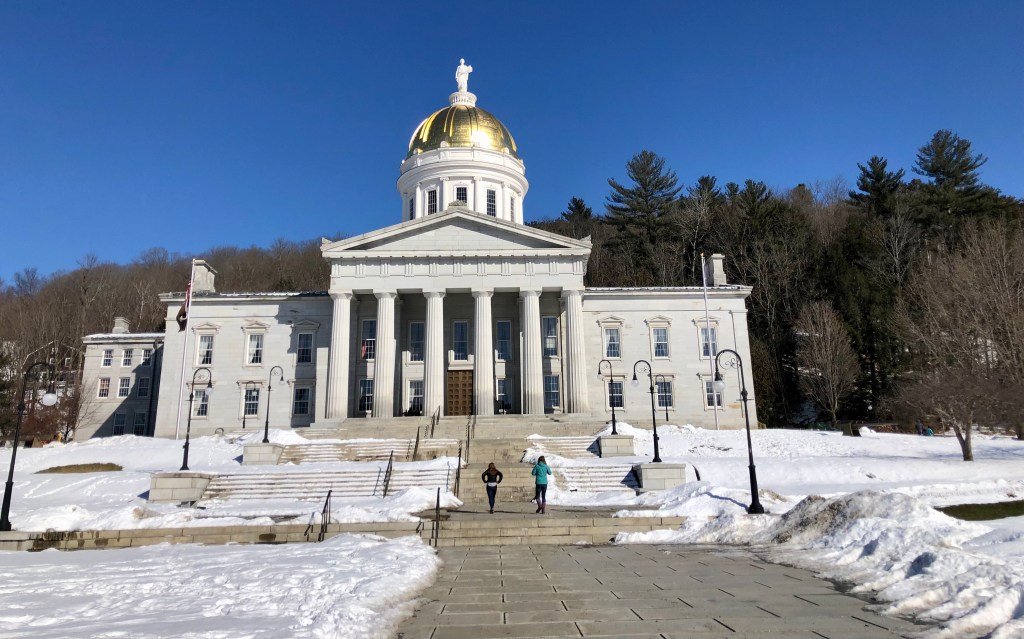
Sunday, we bought coffee and pastries in Montpelier (for a change of venue, a change of scene) and ate outside in the cold. There’s a pandemic, after all, and bakeries open on the weekend had closed their indoor seating anyway. None of us complained or even remarked — something I silently noted.

On this cold morning hardly anyone was walking. We passed a man sitting beside an apartment building, flossing his teeth. My youngest pointed out a bird gliding high above the state house. “Bald eagle.”

Bald eagles have recently been removed from the endangered species list in Vermont. I noted again how eagles are now part of our life. Last summer, in particular, we saw eagles frequently. I grew up in New Hampshire and never saw either an eagle or a loon my entire childhood. Now loons (also removed from the endangered species list) have always been part of my daughter’s life.

We walked up the street and then returned. The eagle was still silently gliding on its immense wingspan.

Like eagle that Sunday morning

Over Salt River…

Breathe in, knowing we are made of

All this…

Joy Harjo

Overheard.

Far enough after twilight that the darkness has set in for the night, I walk up to the library to leave my returns in the book drop. The bitter cold has snapped, worn down by the day’s warmth. Cold in February will return — it nearly always does — but the tide of winter has pushed over.

Spring in Vermont is a long ways off. This is a rude truth, and it’s also true that this is the time of year I begin hungering for green. I take my time, walking back through a neighborhood. Hardly anyone is out, save for a man standing on his back step, drinking a beer and smoking. The smoke curls upward in the lamplight just above his head. Down the street, a small child comes running at me, his or her head hung down a little, tired perhaps. The child wears a knit cap and a dark coat and hurries along, keeping a wide berth from him. At the house with the man and the cigarette, the child leaps the snowbank. The man says, “Hey now, been waiting.”

The boy rambles about “sledding gone soft.” As I turn the corner, the man’s deep voice follows me. He says kindly, “Wait a week, kiddo.”

Good advice for kiddo, I think. I follow the steep street up to my house, where the cat is waiting in the windowsill for me, and the daughter is solving math equations.

Collectively, I think, we’re all in a waiting period.

January. Twenty Below Zero.

Daughter and sap line

20 below this morning as I head out to start my car. The moon hangs in a crescent over our house, visible through the smoke from our wood fire. In January, Vermont, the days creak along with the cold.

In an evening meeting, it’s just me at the town hall, holding that physical place as an open meeting law requirement, everyone else virtual from their living rooms or home offices. From the hallway, I pick through a box of cast-offs and take a pair of Teva sandals. A kind of promise, for another season.

Tonight as it gets cold 

tell yourself 

what you know which is nothing 

but the tune your bones play 

as you keep going. 

— Mark Strand

Color.

We’re nearly at midwinter, the turning-around point of early February. The ice is hard; there’s snow; the light returns, an extra dipperful of it each day.

There’s that Currier & Ives vision of midwinter, nestled deep in fluffy snow that I’ve experienced in a few flashes. This year, unease eats us all around the edges, in strange kinds of ways. A shortage of kitty litter in the supermarket. What does that mean? Maybe nothing worth thinking about at all.

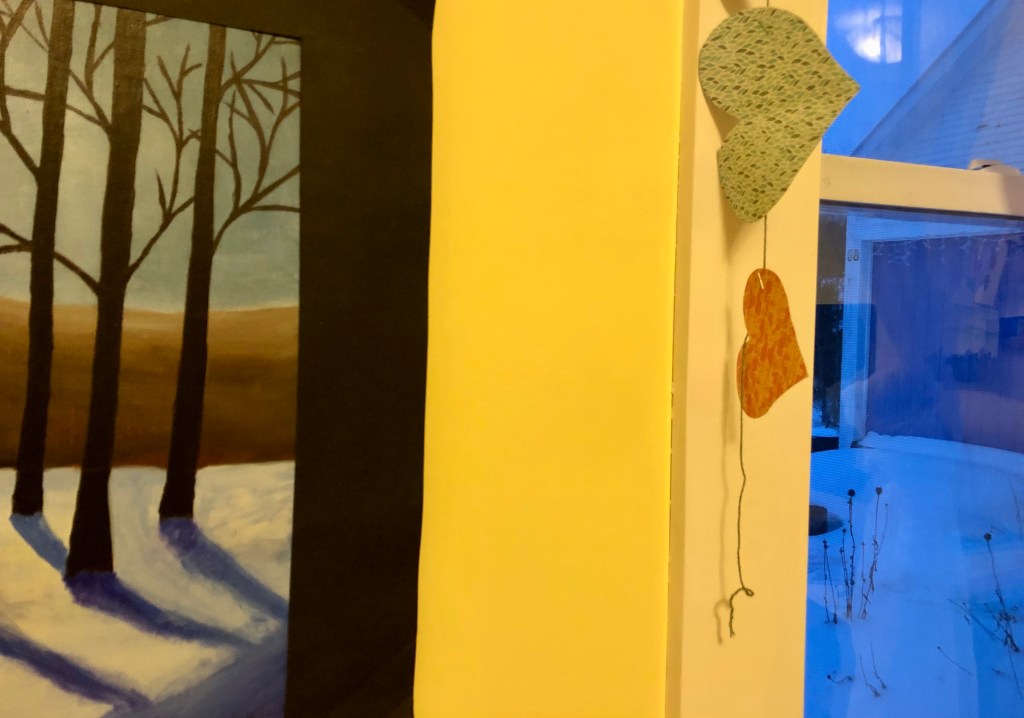
I buy a gallon of paint at the local hardware store. The young man who mixes it went to high school with my daughter. He puts the paint to shake, and I wait and wait in my winter coat and my knitted hat. I remember the first summer I canned so much from my garden and the endless jars I bought here — invested in, really — so many mason jars. High on a storage shelf above my head are those boxes of Ball jars, waiting for tomatoes and green beans and chutney.

He reappears, his face mostly hidden behind his mask. With a key, he opens the can of newly mixed paint. For a moment, he stands there, studying it. Then he asks if that yellow is the right color. I tell him, Yes. He hammers back on the lid, then pushes the can towards me. Good luck, he says.

As I walk out, I wonder if he means good luck with the color, or the painting, or just generally. But what’s the point, really? We all could use a little good luck.

Lovely review of Unstitched in Carved Spines. Thank you!

Ordinary Mystery.

The moon shines brilliantly tonight as I walk down the street to the co-op for cheese and cauliflower. Lady Moon: round as a dime and luminescent like no earthly thing.

In the best of times, January can rage like a shrieking stranger, a visitor who’s arrived with too many needs.

This year, time has slowed to incomprehensible. We wake; we do our things. Work and email. I paint a room. I endeavor to write another book. I keep Unstitched moving along.

The ordinary happens: snow falls. All day and into the night. When I wake in the morning, there’s inches and inches of fresh, sparkling snow. It’s not a blizzard, not feet upon feet. I have little trouble finding my Subaru in the morning. But the snow sugars our world for this day in utter beauty.

The rest of everything is still there — the pandemic, the crumbling American Empire, the chaos of human relationships in my house and all around — but walking home, the cold is so sharp that the snow squeaks beneath my boots. For a moment, I’m a child again, mystified that fluffy snow can yield a squeak. But there you go. A mystery incarnate.

Here’s an interesting essay emailed in by a reader about growing saffron in Vermont — yes, saffron & Vermont.