A few garden words…

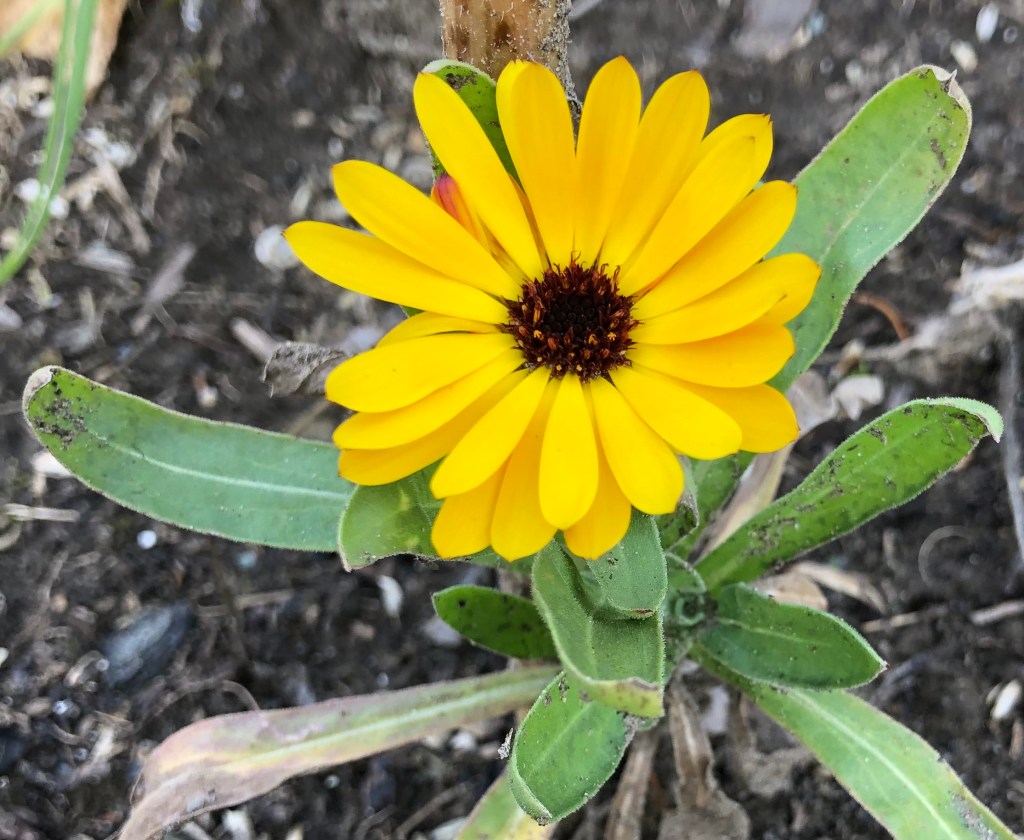
Calendula, such a pretty word, such a marvelous little flower, still blossoming beneath the frost-killed sunflowers in my garden.

Late Sunday afternoon finds me piling fallen maple leaves around these beauties in my garden, tucking in the soil for a winter’s hibernation. There’s celery, yet, too, among the Brussels sprouts. As I work, I snip off celery leaves, dusting off sandy soil on the hem of my shorts. The leaves are slightly grainy in my teeth, but when push comes to shove (as life inevitably goes), I’d rather have tried my teeth on a little grit than none at all.

Here’s what happens in New England’s October: the shadows creep in before the day has finished. We all know these shadows are edged with cold, with the intimation of winter and wind, of snow and more snow, and the always surprising dazzlement of winter’s glistening beauty. I bake an apple crisp, listen to election debates on public radio, comb my cat. October.

At no other time (than autumn) does the earth let itself be inhaled in one smell, the ripe earth…

— Rilke

Green Apples.

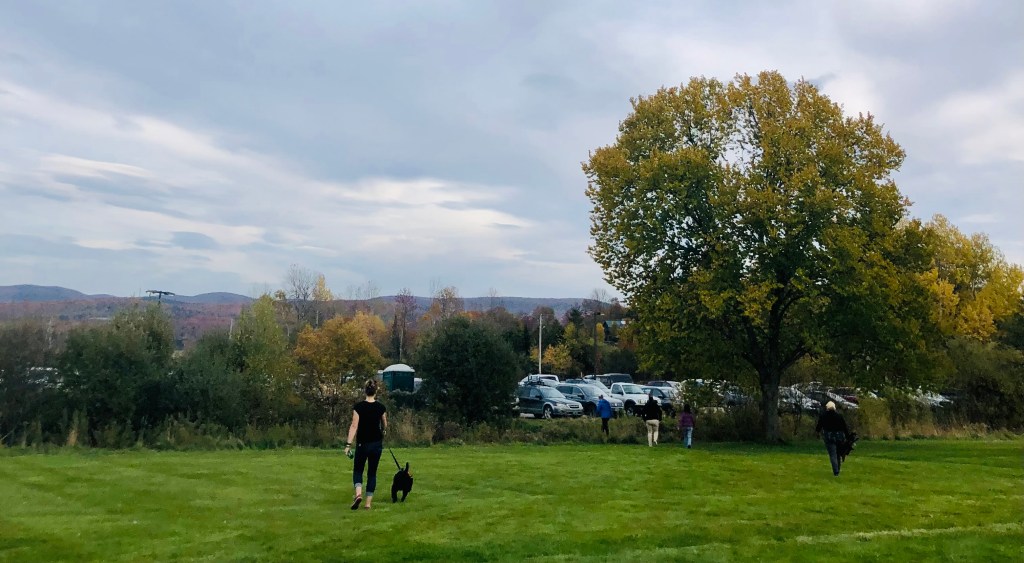
I flee work early with my daughter and her dog, to watch my younger daughter play soccer. Mid-October, and in my world everyone clamors to be outside as much as possible.

In the parking lot, a rusty white Toyota pickup sports a peeling bumpersticker with Joseph Campbell’s advice: Follow your bliss.

In my young woman days, I wholeheartedly championed this, easy-peasy, of course, I thought. Then I entered what seemed like a labyrinthian period of my life where the notion of bliss seemed facile and sometimes outright stupid. On this sunny afternoon, I chat with parents and strangers on the grass about little things — who’s started their furnace already and the merits of sprinkling cinnamon on hot oatmeal and is that the new superintendent with the coach?

As the sun heads down, the spectators pull on jackets. The wiser among us brought blankets. I find my hat in my car and loan my daughter my jacket. My youngest is a senior. Next year I won’t be here, clustered among the parents and grandparents, and so each game seems a bead on a counting game. On the way home, we stop at the general store for curried dumplings.

All afternoon I kept thinking of Ruth Stone’s achingly lovely poem “Green Apples.”

In August we carried the old horsehair mattress
To the back porch
And slept with our children in a row.
The wind came up the mountain into the orchard
Telling me something:
Saying something urgent.
I was happy.
The green apples fell on the sloping roof
And rattled down.
The wind was shaking me all night long;
Shaking me in my sleep
Like a definition of love,
Saying, this is the moment,
Here, now.

October Afternoon.

On my way back to Hardwick, I’m stopped in road construction on the County Road. While I wait for the steamroller, I glance at the passenger seat and notice my knitting has slipped from my bag. The project is a simple hat, and the yarn slid from the needles. To save my work, I lift the unfinished hat and slide the stitches back on the needles.

Just before my car hood, the woman in bright yellow holding a STOP sign leans against the pole. I turn off my Subaru engine, thinking of where I’ve come from and the high school soccer game where I’m headed. How quickly cold shadows edge in when the sun slips behind the mountains at this time of year. The mountains around the road dazzle with crimson and gold, but gray is visible in patches, too. Stick season marches in inexorably.

I’m at the town line somewhere between Montpelier and Calais. A few years ago, I sold our arch — the long firebox and pans used for making syrup — to a man who said he’d pick it up in a few months. His address was in this area. I promptly cashed his sizable check. He didn’t return. More than a few months later, I had sold the house, too, and my daughters and I were moving. I wrote list after list with things like pack canning jars and Salvation Army drop-off and get rid of Toyota transmission in shed. On those endlessly reworked lists, I added arch must be moved. While tracking down the buyer, I discovered an unspeakably sad thing had happened to his family a number of years before he wrote me that check.

I found him. He arrived with a friend and loaded the arch on a trailer. He and his friend were older than me, in a different phase of their lives than I was. They spoke kindly to my daughters.

For just a fleeting moment, still waiting for that steamroller to move, I remember that arch precisely. Stainless steel, black metal, the scrape of a shovel on firebrick.

The woman with the STOP sign appears at my open window. I expect her to chide me for daydreaming. Instead, she points to a nearby pond where a flock of geese have landed. The sun hits the sugar maples around the water. There’s so much in that moment — the clamoring and splashing birds, the stunning leaves, that crystalline memory, the sunlight and green yarn in my lap. The woman tells me, “Head on when you’re ready.”
Lost, Not Lost.

Tuesday afternoon finds me somewhat lost on the way to a soccer game. In a rush, I glance briefly at the map, take a mental note, and head off. My cell phone has given up its ghost, and I know I have a paper atlas in the back of my Subaru, jammed beneath a box of oil, if need be. I drive the way I knit — by feel — and generally that gets me there. In this case, driving by feel gets me to Hazen’s Notch, a twisty dirt road climb. The road has been recently graded; it’s slick with falling rain.

I’m headed to a town where I haven’t been in nearly 25 years. The last I was here, my then-husband and I were following a lead on a vacuum pump for maple sap. We pulled into a two-story house that was recently built. A pregnant woman dialed her husband at the town garage, and he drove up in a moment. That afternoon, I wanted to be pregnant. While our husbands talked about the pump, I asked her about the pregnancy. She wanted to buy a crib with the money from the sap pump.

We paid in cash. The pump remained one of the most reliable pieces of equipment in our sugarhouse. It became my nemesis, too, with the absence of housing around the belt. I feared for my hair and scalp, my fingers. It drank oil like crazy. It worked hard.

This Tuesday, I’m not really lost. I know, enough, where I’m headed, how to read the sky and rivers, the mountains, to get me in the right direction. I pull over near a swamp where maples are in full red already. What do you know, I think to myself, that sight is worth the drive.

Here we are…

Above pretty much sums up where we are now. 23 years into this parenting gig, it’s now me and the teen, and if a housecat has moved into a box on the kitchen table for the winter? Well, so be it. And the other cat refuses to drink water except on the kitchen sink? Well, so be that, too.

As a young mother, I read a literal library of parenting advice and made a trillion mistakes. I take my (diminished) reading time much more seriously these days. I continue to make mistakes. And I’ve decided the cats are fine companions, even on the table.

In so many versions of my previous life, this wouldn’t fly. Now, listening to Biden talk about his proclaimed End of the Pandemic, I wonder, What’s all that about? Who gets to decide what, anyway, and why believe anyone else when your experience doesn’t jive?

Rain comes down in buckets. A friend gives us a bucket of apple drops. I cook bacon in the oven and buy the best loaf of bread I can find for our dinner. Our tomato and basil plants are still churning out their delectables. Sure, winter is in the near offing. Much more than winter, too. Our cat is the happiest creature I’ve ever loved. We offer him drops of milk on our fingertips, licks of butter from a smooth silver knife, tender kisses on his head.

As the cat
climbed over
the top of

the jamcloset
first the right
forefoot

carefully
then the hind
stepped down
into the pit of
the empty
flowerpot

— William Carlos Williams

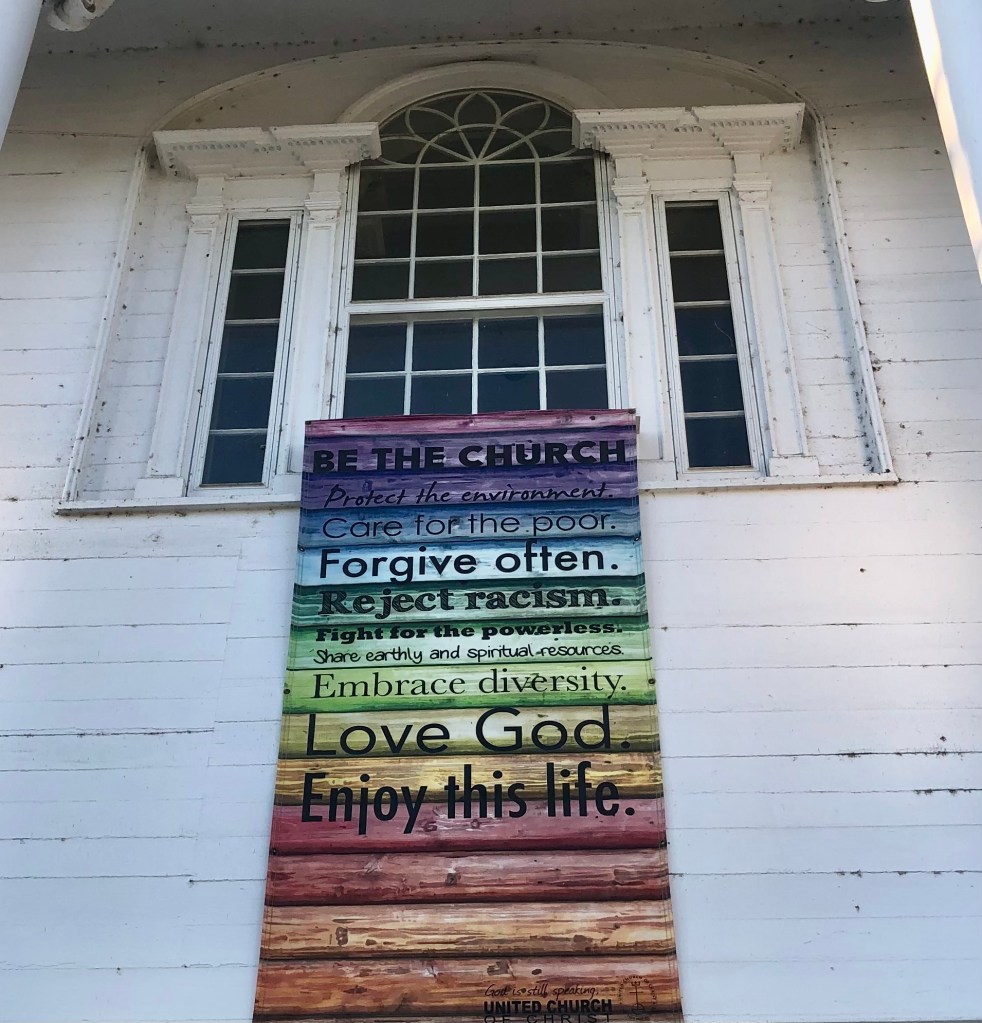
Found Sign: Enjoy this life.

Late on a Friday night, I’m reading on the couch when my oldest calls. There’s no heat, yet, in her apartment. The evening is tinged with near frostiness. I’ve returned home from an interstate drive in the darkness, thinking over the pieces of my manuscript. In my imagination, I see Lena, my main character, with her emerald green haircut.

A half-moon rises in the darkness as I drive along the Connecticut River. These days — long days — I’m grateful for these imposed breaks, for the opportunity to see the moon rise along an unfamiliar horizon, to stop before a church and read the congregation’s exhortation: Enjoy this life.

My dear cats are sprawled before our glowing wood stove. Listening to my daughter reminds me of my mother — our spunk and sassy irreverence and love of flowers — but my daughter is utterly herself. I close Beth Macy’s Raising Lazarus, and our conversation unfolds over the few miles between us. September, and the swimming season has passed. I hope for decades ahead to see what my daughter makes of her life. For now, this September evening.

... I like driving at night
in summer and in Vermont:
the brown road through the mist

of mountain-dark, among farms
so quiet...
— Hayden Carruth