No Mow May…

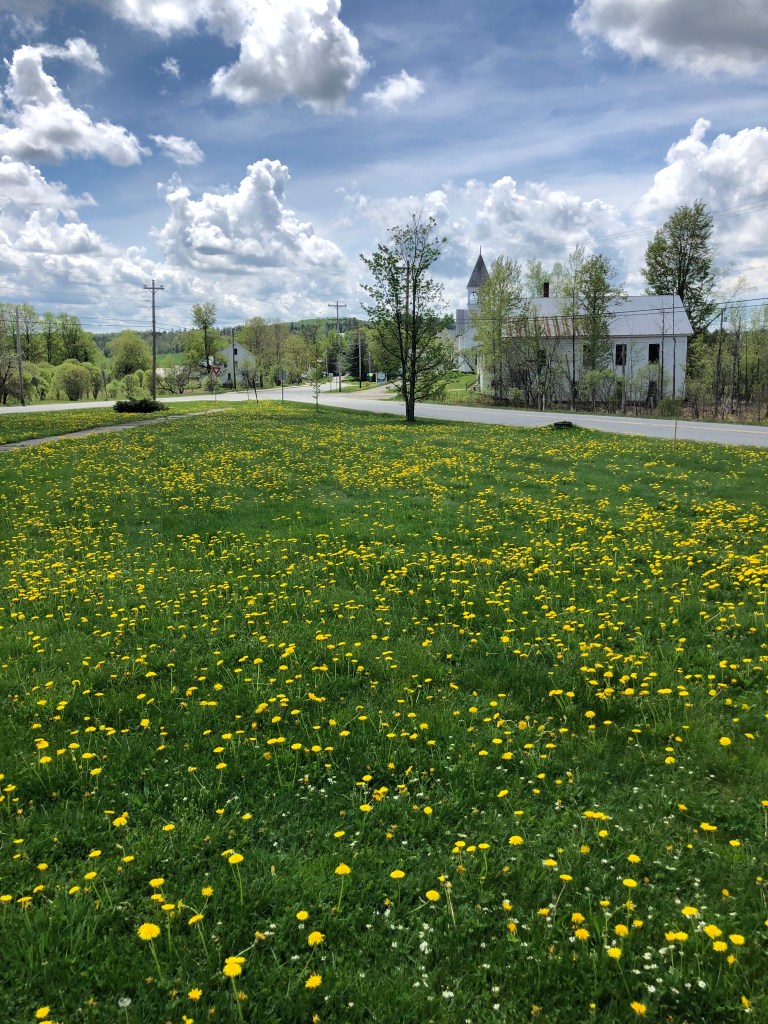
Days like this — or even hours or moments like this (see dandelions above) — remind me that the human world is poor shakes compared to the universe around us. All these things that nag and nip and plague me — from inspecting a car to wondering if my daughters are happy — fall into some kind of place on a sunny May afternoon in Vermont. These things are important; not for a moment am I trying to belittle our human days.

But this is, too. As I crouched in the field to take a photo, a woman bicycling by called out to me. “What gold! It’s cheeseburgers for bees!”

She got off her bike, and we stood talking to each other across the field. I suggested she look at the marsh marigold behind the grange. She mentioned the spring beauties in the woods.

Overhead, the clouds morphed and shifted. Come January, the field might be passable only by snowshoes. But for now, she and I called back and forth, the wind lifting and tugging our words.

 “No creature is fully itself till it is, like the dandelion, opened in the bloom of pure relationship to the sun, the entire living cosmos.”

~ D. H. Lawrence
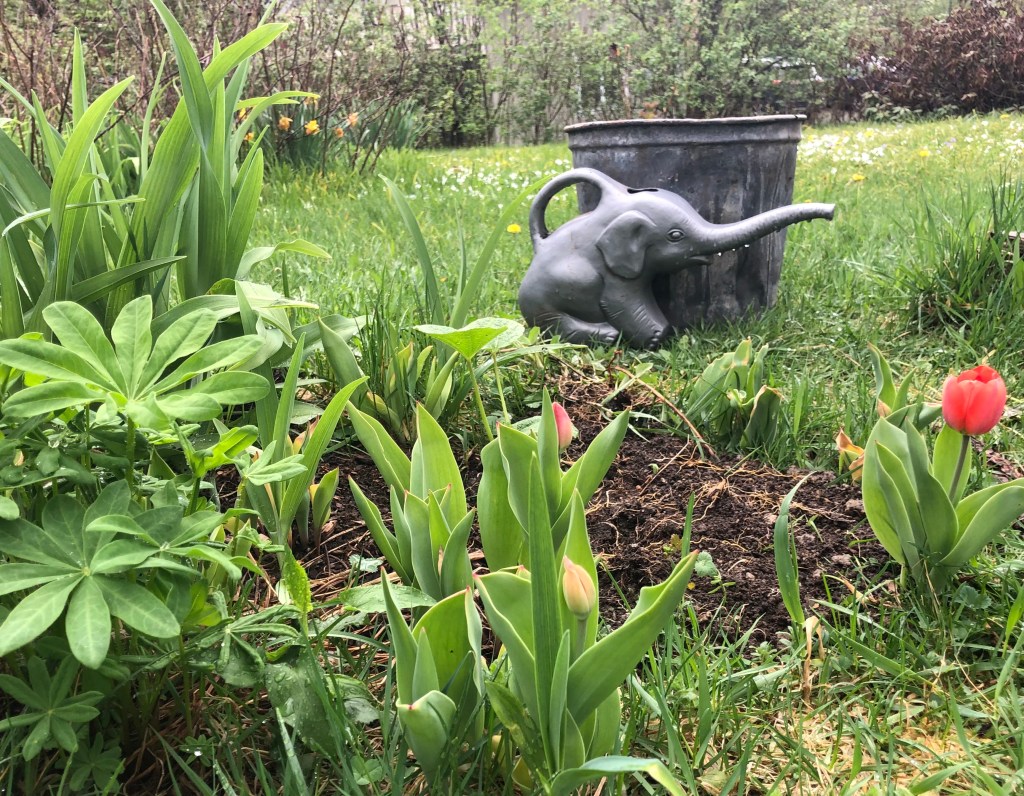
In the Garden.

Sunday morning, a light rain falls. The rain is a gardener’s dream, a light but steady enough drizzle, interspersed with sunlight. Our world grows. I stayed up late the night before, reading The Year of the Horses, and maybe it’s nothing but exhaustion — and who isn’t exhausted these days, anyway, but the kids — but I keep wandering around, in and out of the house. To the garden to move this or that. Then back inside to wash a window or sweep away some winter cobwebs.

Washed by rain, the colors in my garden are vibrant. I have this strange feeling that I’m inhabiting the Middle Ages, the realm of chivalry and honor, a time when art is justly valued.

All day long, I work at this, back and forth, making some kind of order in my raggedly life. Before too long, I know, the weeds and the black flies will swarm me. I might be overwhelmed with the messiness of gardening. But for now… just this potential. Just this moment. A single tulip, blooming.

Small, Good Things.

A friend and I drive to a nursery on a back road in Plainfield, VT, through fields that seem impossibly green. The trees have barely begun to bud. I buy a snowdrift crabapple tree there. The tree is so tall that my friend and I spend some time carefully nudging it into the back of my Subaru.

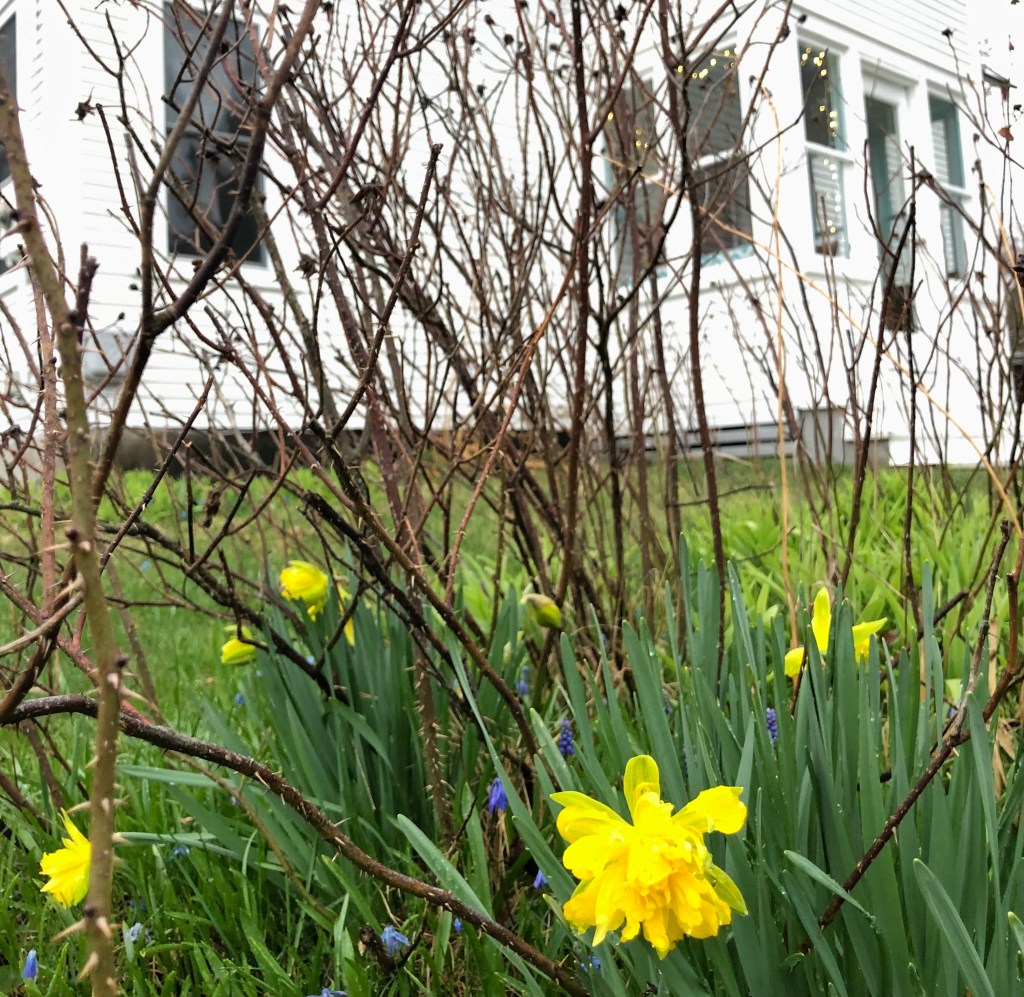
I’ve met the staff on my annual pilgrimage there. They all speak quietly, as if our words might disturb the rows of potted currents and grapes. I ask again for planting advice. As I listen, I suddenly realize I’ve gone at this tree planting and cultivating thing all wrong. Beneath my trees, I should create a forest garden of duff and broken up straw and that humus-y compost that plants must love like chocolate. Daffodils bloom in the gardens beneath their trees.

I expect the staff has told me this before, but for whatever I reason I didn’t listen, or their advice drifted the way of so many words.

All the way home and all afternoon, I keep thinking about these woodland gardens and about a Raymond Carver story, “A Small Good Thing.” Two years plus into the pandemic, in this jumbled world, a small good thing….

That night, my teenager comes home and suggests we get a creemee. Friday night, and there’s no one out. We stand under the moon, licking ice cream cones, the peeper screeching in the swamp behind the pizza joint. A small good thing.

Nameless Places.

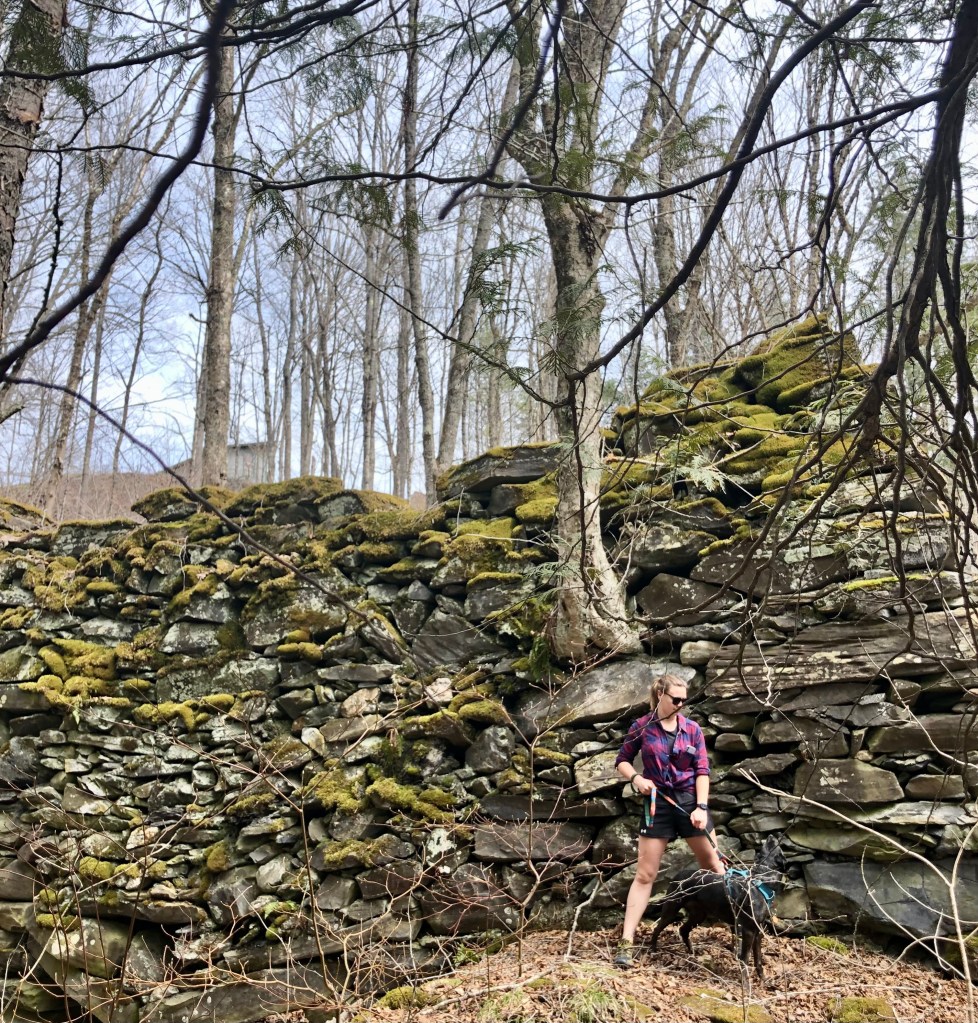
My daughter discovered the foundation of an old mill near where she lives, a fieldstone structure built beside a rushing stream. A grist mill I speculate.

Sunday afternoon, and the day has warmed. The bugs haven’t risen yet. The spring ephemerals haven’t unfolded from the forest floor.

With one daughter grown, my youngest nearly so, my own parents well along in old age, I think about the things I wish I’d done as a parent. I wish we’d traveled more, seen the northern lights, gone to concerts. I wish my daughters’ father had stuck around. That trite phrase — glass half-empty or half-full — comes to mind. But maybe a truer comparison is this foundation, this well-crafted structure that has now morphed into a wilderness home, where birch trees set seeds and grew in improbable places.

We keep walking, and she shows me a small swamp in a hollow far off the road. The peepers are singing. The mud beneath my boots is black and rich. Water runs through it.

Travels through Time. Along the River.

Write a novel and, at some point, you’ll start henscratching or typing notes about when the protagonist moves from reaction to action. Why not think of your life as a novel you’re writing?

I drove down the long center of my Green Mountain State yesterday to return to Brattleboro, where I lived for years as a college student (so long ago). I bought my first car for $500 in Brattleboro.

For the drive, I had one rule: stay off the interstate. I began through the chain of towns I know, Montpelier and down through Northfield and Brookfield, along the Dog River. I headed up through a pass where the snow returned in clots along the road, and where trailers were surrounded by old cars and pickups, the kind of stuff that someday might be used. The forest flattened and gave way to fields where barns were built nearly in the fields. I drove through upscale Woodstock and the burned-out industrial buildings of Springfield.

Southern Vermont was like a magical dream — sunlight streamed over blooming daffodils, forsythia spread bright yellow, emerald green paired with black earth.

I met an old college friend who works at Everyone’s Books on Elliot Street. Thirty years ago, I lived right near that bookstore, and I spent a lot of time there. We exchanged thumbnail stories about our lives and kids and work and exhusbands and books of course. My book was in the front window of the bookstore, and she told me it “had been selling like hotcakes” — utterly gratifying.

In a park, I pulled out my laptop and wrote up a few notes. As I headed back to my Subaru, my friend Sean Prentiss walked towards me. He lives just a handful of minutes from me and was meeting his lovely family for a few days in Brattleboro.

I went to Brattleboro to meet friends from my past, and I met a friend from my present. Put that in as an interesting plot point.

On the way home, I listened to This American Life about babies switched at birth. I’m an TAL devotee, and this episode is especially fascinating.

Breaking Ice.

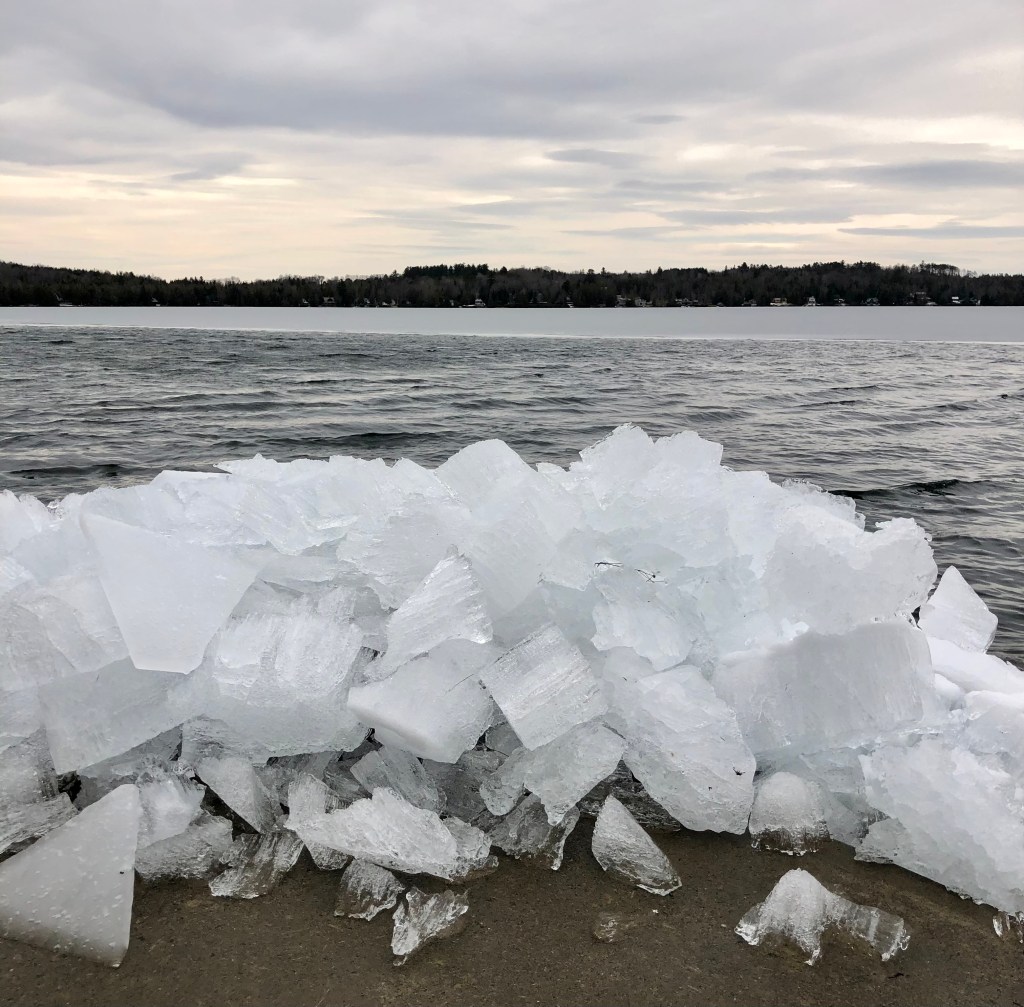
On a midday walk around the lake, I hear bits of breaking-up ice crash against a cement pier. Vermont spring — ice and green shoots, rain and rouge snow and sometimes sun.

This time of year — school break and tail-end-of-winter doldrums — many folks have flown to warmer and sunnier climates, seeking the old stand-by of the geographical cure. Around the lakes where summer folks own the large houses, hardly anyone is there, save for carpenters and roofers and painters, their pickup trucks clustered in driveways.

But the lake keeps on with its own steady world, the fierce ice gradually giving up its ghost. By the time these summer folks return, the water will have warmed again. For now, though, ice clinks as it breaks apart.

I tie my long hair back with a rubber band I found in my coat pocket. The breeze carries the damp scent of the earth, the dream of unfurling leaves, the memory of children crouched among the cedar tree roots, playing.

“The sun was warm but the wind was chill. You know how it is with an April day.”

~ Robert Frost