Thin Ice.

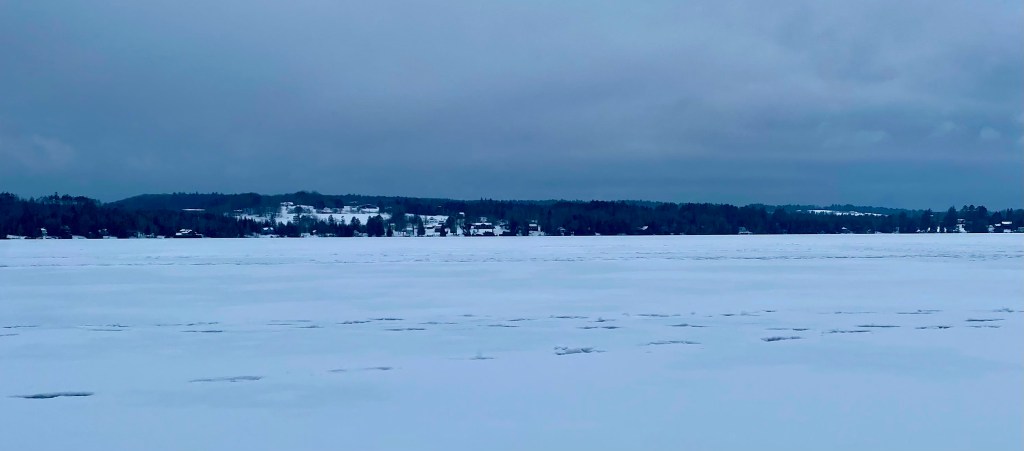
On my way home, I walk down to the lake and stand at its edge. Such a warm winter this has been. There’s not a single ice fishing hut on the lake. Across the middle, two people walk, talking intently, their hands gesturing. As they stroll south, I head towards the center of the lake.

At the beginning of any year I’ve walked or skated on lakes, there’s an always initial angst, a discombobulation about the deep water beneath, the zone where I’ve kayaked or swam. Midwinter, the summer folks are faraway on beaches or cities. The walking pair disappears, and then it’s just me and a lone crow making its steady way across the sky. This winter has clouds and clouds and clouds. Out on the ice, however, the sky spreads wide, its permutations of blue dazzling.

Twenty-five years ago, I was descending into labor with my first daughter, a period when dawn and twilight intermingled, a space where time had no meaning for me. Near the labor’s end (and she came into this world courtesy of a surgeon’s scalpel), all light had vanished from my world save for a distant circle, like a full moon gleaming on still water at the bottom of a well. I saw my right hand reaching down, fingers outstretched, seeking that gleam.

In each of my daughters’ births, the world’s illusions were ripped back. The rawness of blood and tears, of the ineffable power of a newborn’s gaze, filled my world with sacred might.

The ice groaned, shifting. I was certain of its strength for no real reason at all. In my thin jacket, I stretched out on the ice, let the cold hold my bones and flesh, and that vast sky steal my breath.
Roadside View.

In these tail-end days of January, I’m alone midafternoon when I stop by the edge of the road. We’ve endured a cold for days that’s not so much bitter but a raw damp that my brother says reminds him of the ocean. The kind of weather for wearing wool sweaters all day, that make you wrap your hands around cups of coffee. So many years ago, I lived for a winter in an apartment on a brick Main Street building in Brattleboro. The building was heated by radiators, clanging and spewing steam all over that large building, in a heating design where I was mere witness, the grateful recipient.

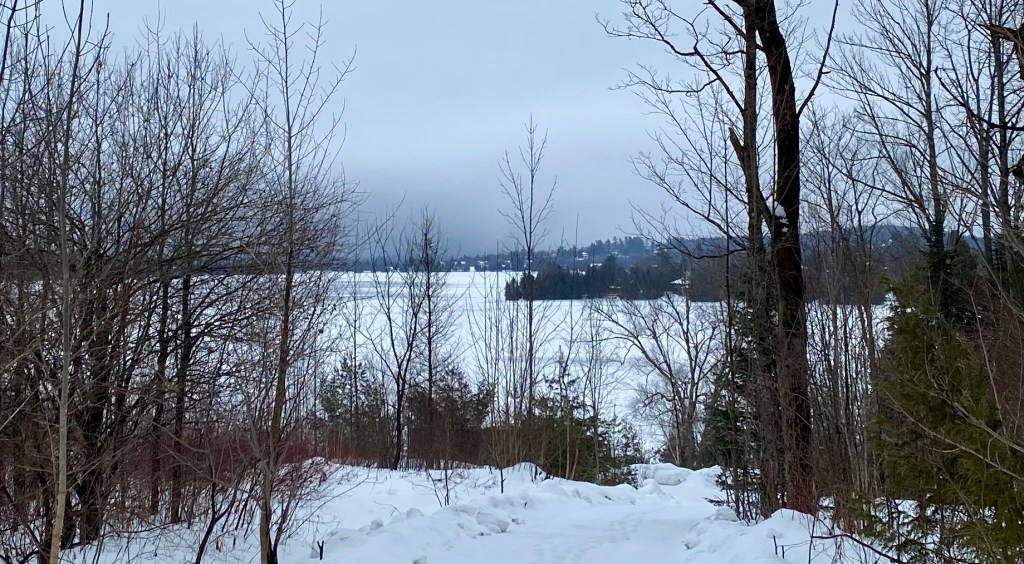
This dreary afternoon, I follow three-toed turkey tracks down a driveway. In the snowy field, the large birds set up a clanging holler when they spy me, ruffling feathers and jostling. It’s just me, I’d like to tell them, a small woman who’s forgotten her mittens and hat. I stand for a bit. Down the hillside, the frozen lake spreads immensely around the spits and coves of the shoreline: breathtakingly awesome.

After a bit, the turkeys seem to care little about my dull presence, gleaning through the thin granular snow.

Are you for real?!

The other night, I’m leaving a meeting in the high school library devoted, more or less, to hashing out what community means (nothing to be solved in a few hours). In the parking lot, a woman says Goodbye, Brett — and quicksilver, I shout, Are you for real?!

As the other folks empty out of the school into the spitting snow, she and I talk beneath the ghostly streetlamp. Very quickly, it’s clear to me how utterly wrong I am about this woman. What I believed was true was not. I once ate chocolate covered strawberries in her house with my youngest daughter. The woman packed up a bowl of these delicacies for one sister to give to another.

In ten minutes, we are speaking animatedly of matters of our hearts. We’re both shivering by then in the damp snow. We hug and head to our homes.

I don’t know what’s happening in the rest of the country, and I surely can’t speak for anyone else, but how glad I am that I called out in anger. And how much more grateful I am that she took the time to listen to me, to lend me her shoulder, and I could do the same for her. Indeed: real.

A community… is the knowledge that people have of each other, their concern for each other, their trust in each other, the freedom with which they come and go among themselves.

— Wendell Berry

Onset of Pre-Cabin Fever.

I shake stunningly beautiful snow from my mittens onto my cats. Mid-January. Winter’s loveliness has just arrived. My house is again the three of us, two fluent in Cat and one marginally fluent in Human. The one who speaks Human gets the deciding vote, so we get up very early. The Cat speakers are wholly in favor of this, as the wood fire is fed and the cat kibble rationed into bowls. Eventually, the dawn finds us, and the rest of the world creeps in.

If this keeps us, the prognosis is mad-as-a-hatter by Honest Abe’s birthday. No fear of that. Any hermiting is constrained around here. Two small excerpts from my novel are accepted by journals. The cats and I nestle into our narrative. I let them lick butter from my fingers. Snow silently fluffs around us, concealing the stars, the sunflower stalks, the ash bucket I left by the step.

Music = flowers = courage.

Nearly a decade ago, my then-husband and I attended an improv poetry reading and concert in a church in Cabot, Vermont — an afternoon I later remembered as the last good thing we did together as a couple. Later that afternoon, news arrived of illness in our family. Although there was no way I could have predicted it at the time, the stress of disease further fractured our fragile marriage.

This weekend, I returned to that church with its high-ceilinged rough beams and unadorned crucifix for a performance with native flutes and storytelling as part of the town’s Twelfth Night celebration. Before the performance, the storyteller remarked about a flute, tens of thousands of years old, made from the rib of a cave bear. Flute music, like the drum which mirrors our mothers’ heartbeats, is bound into our DNA. With a rattle of shells, he began with the Chippewa’s creation story of the flute and expanded into a meditation about music as auditory flowers. Not Hallmark’s pastels: flowers are the rugged beauty that propagate our world. The music poured my heart full with courage.

Outside, a light snow sprinkled. Somewhere in the pandemic, my youngest played spring soccer in this town. In that time, no one was carpooling, and so I always drove. While she played, I walked along the river, early enough in spring that the peepers were singing but the black flies hadn’t hatched.

I had left my hat on the pew. When I walked back in, I met the poet’s wife. The poet, who was once so kind to me, has passed on now. His wife and I spoke for a few minutes, and then I went out, hat in my hand, snowflakes falling into my hair.

“… the need is now for a gentler, a more tolerant people than those who won for us against the ice, the tiger and the bear. The hand that hefted the ax, out of some old blind allegiance to the past fondles the machine gun as lovingly. It is a habit man will have to break to survive, but the roots go very deep.”

— Loren Eiseley

What we can’t know.

The cold hammers down around us in the way we’ve known Januarys before — nothing fierce, but sharp. January is a season that draws us up against our own mortality. Stumble and you’ll break a bone. Sleep outside, ill-prepared, seriously down on your luck, and you could perish.

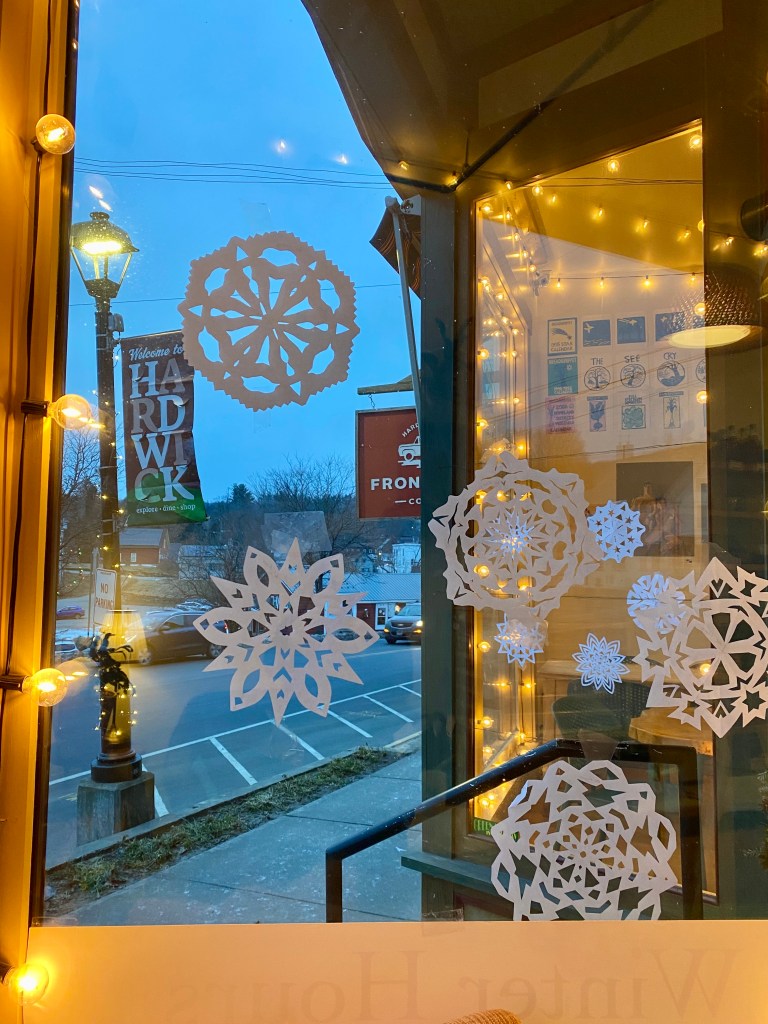
Wednesday morning on the early side, I’m drinking coffee and staring at the snowflakes that have appeared in the downtown again, a memory for an absent person. News has wound my way of the death of a person distant from me by numerous steps, the fate we’ll all meet, one way or another, the great leveler. In the afternoon, when I return from work, the window washers are carefully removing the lacy paper, setting the delicate flakes to one side, and then re-taping them on the windows. A gentle, wordless act of care. A piece of our human puzzle.

These winter days, I’m devouring Paul Lynch, about as good as anything can be.

“I believe it is worth writing to remind ourselves of what we can’t know. To remind ourselves that certainty is dangerous. That factual knowledge of the world casts only a small light. Fiction is necessary because it seems to me that only fiction can accommodate the total strangeness that is life. To remind us that truth is actually impossible.”