A little Madness in the Spring.

Post-eclipse, rain moves in, balmy tinged with cold. Rain will force spring’s green. Our lives spin on — of course, of course — but the eclipse and all its radiant glory trails us, the collective experience of the cosmos’ unflinching steadiness and how the heavenly bodies align, majestically moving in their infinite complexity. No stasis in this life.

Someone recently asserted to me the caliber of her character — I’m a good person — and the phrase lingers with me, far more a reflection of my wavering self than of the speaker. We’re so unlike the celestial bodies, our mortal bodies driven by gravity and time, but our actions dominated by our uniquely strange brew of our jumbled lives, passions, weaknesses.

The eclipse’s profound beauty for a few moments swept away the pettiness of our thin ideas, our nattering chatter about so much that, in reality, amounts to scant little. Perhaps the eclipse unified us not only by its luminescent beauty, but tugged out the finer strands of us, too.

For a day or two, Vermont was jammed with visitors from so many places. Vermont’s not unique with much that’s happened in recent history — floods and wildfire smoke, the pandemic, and division and division and division. My state also has some of the greatest privileges on the planet: absence of warfare, significant wealth. Let the eclipse bloom last long, carry us through a muddy spring and into summer, keep us questioning what our own goodness might mean, and how goodness transmutes into action.

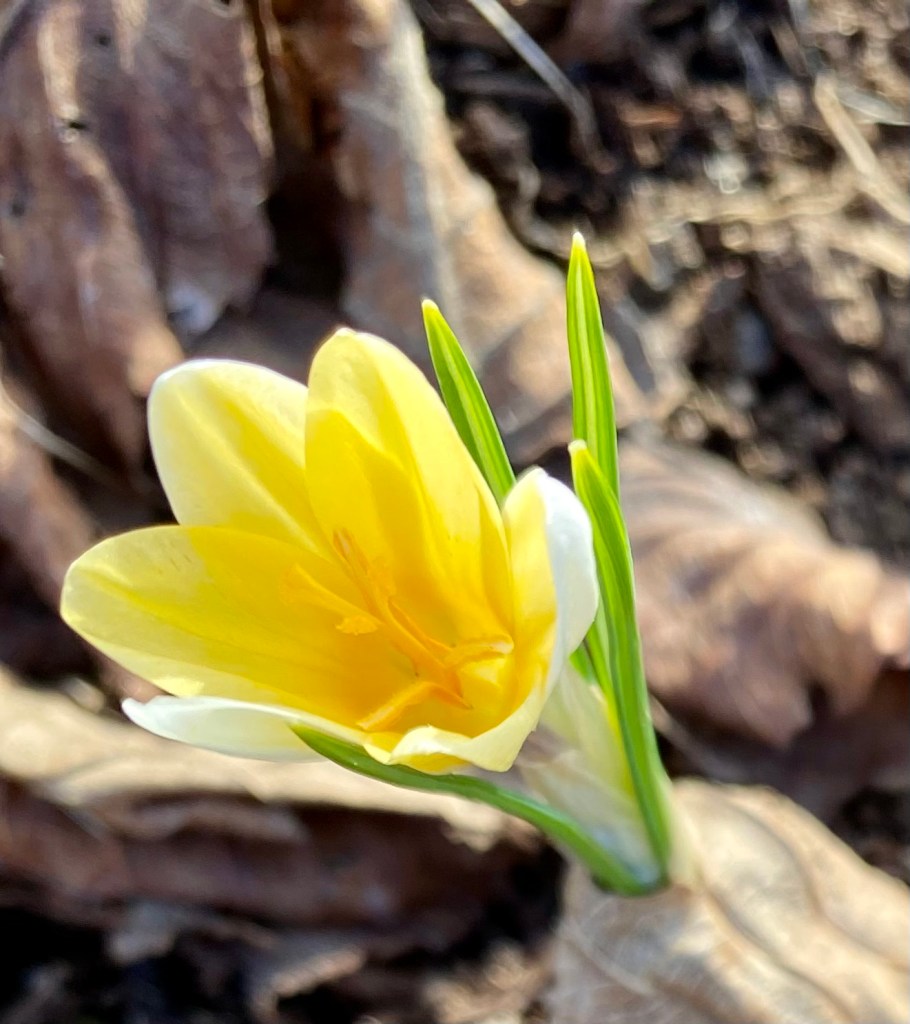
Last, not least: my giddy joy of gold crocuses. Chionodoxa, AKA glory of the snow, scattered over muddy hillsides, last year’s dull lawns.

A little Madness in the Spring
Is wholesome even for the King,
But God be with the Clown—

Who ponders this tremendous scene—
This whole Experiment of Green—
As if it were his own!

— Emily Dickinson

Awe.

Photo courtesy Molly S.

Just about a year ago, my daughter and I climbed multiple stone steps in the Cathedral of Santa Maria del Fiore in Florence, the stunning cathedral finished before Columbus set sail on a journey that changed the fate of the globe. As we climbed, the organ played. The windows were holes in the stone, and wind washed in. Suddenly, we stepped out onto a narrow ledge where we could see down into the giant cathedral. I knew myself part of this ancient building — alive in the most beautiful structure, in a time that flew back to medieval Europe.

Awe. I’ve participated in so many radiant experiences, but peak awe? It’s a rarity. Right? We couldn’t live if we were always in awe: the Florence Duomo, childbirth, a night of the constellations and some psychedelics….

For those of you not in the know, northern Vermont has been amping up anticipation for the total eclipse. For once, the weather cooperated absolutely perfectly. The state shut down. Go home! Enjoy! We sprawled over the wet grass with neighbors. As the moon and sun began to cross, traffic sounds ceased. Did the wind pick up, or could we simply hear better? I had expected a few moments of the lovely night sky in the middle of the afternoon. But no, no. Instead, a radiant world abruptly glowed. Along the mountains where the sun rises scarlet these mornings, the sky was heavenly blue, rimmed with the purest gold. There were no three minutes of totality. No time at all. It was simply us — all of us — breathing and gasping with great joy.

Your own darkness.

An old friend from years ago sends me a message. She’s persistent, wearing down through my imposed or self-imposed hermitage, whatever this thing is I’m doing, and I drive myself out on muddy roads. She has such a lovely little girl, I’m smitten immediately. I sit down on the floor and chat up the child, and eventually remember my good friend and how much I enjoy her world. She’s funny, with boundless good will and cleverness, in a life that’s had her share of lemons.

End of March, nearly Easter, my perennials spike up further every day. How the earth desires green. I’m far enough along now in my own life that I know the cupboard of my mortal life will always hold certain grooves and scars, its beaten shape, the way the material in my life has shaped me. Aren’t we all that way, though? Maybe this is why spring is the dearest of seasons, that from mud and ice emerge tender shoots, the improbable made manifest every year.

Beginning

The moon drops one or two feathers into the field.   
The dark wheat listens.
Be still.
Now.
There they are, the moon’s young, trying
Their wings.
Between trees, a slender woman lifts up the lovely shadow
Of her face, and now she steps into the air, now she is gone
Wholly, into the air.
I stand alone by an elder tree, I do not dare breathe
Or move.
I listen.
The wheat leans back toward its own darkness,
And I lean toward mine.

— James Wright

Kindness of strangers.

If there’s a sadder building in Vermont than the county courthouse in Barre, I don’t know where that might be. Over the last nine years, I’ve been here again and again and again and again. On Friday, I arrive again, stepping through the metal detectors and removing my knitted hat to show my barrette. My errand is to leave a handful of copies. I wait behind a man in an orange jacket at the counter who cannot understand what the clerk is saying. She repeats her instructions. Another clerk calls to me. I ask my questions, repeat back her answers to confirm. The man beside me weeps.

The last time I was here, I waited in a room of women waiting to be heard by a judge. In those days, I had survived those court appearances and the craziness of my life by imagining myself a mother wolf. I slunk in, took what I needed, and ran. All morning, the room gradually emptied, until only myself and one other woman remained. She was young enough to be my daughter. The bailiff appeared and said it was the judge’s lunchtime, and we could return in two weeks. Wolf, I stood up, all 4’9″ of rage, and said I wasn’t leaving. The bailiff muttered and disappeared behind the wooden door.

The woman’s name was before mine on the court’s list. She offered to let me go before her. You have a child, she said, and I don’t. I didn’t one single strand of this woman’s story. The judge delayed his lunchtime.

On this Friday afternoon, six years later, when I return to this courthouse I had promised myself never to enter again in this lifetime, I carry the memory of this stranger’s kindness.

Outside, at my car, I can’t find my keys, and so I return again, back through security, back to the window where the man is yet weeping, the clerk repeating the same impossible words. Then I realize my keys were in my hand; I hadn’t looked.

Here’s a poem very much in this sentiment, emailed from my father. Listening to the audio is highly recommended.

Necessary Birdsongs.

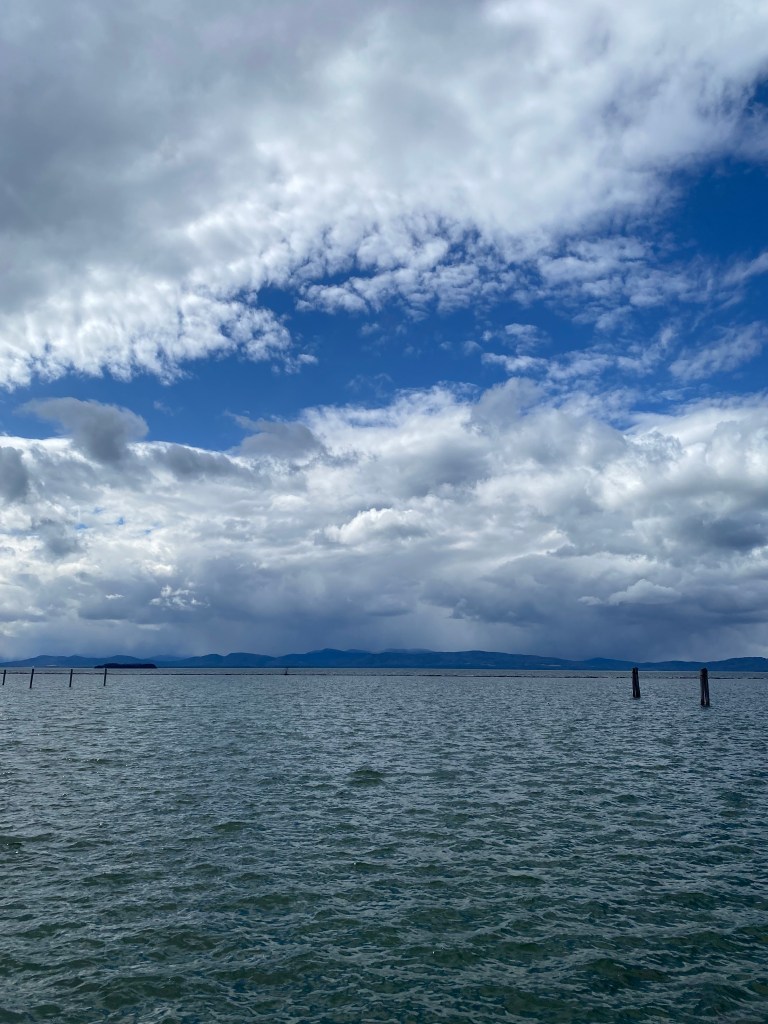
Lake Champlain

Mid-March, the unlovely muddy Vermont: I bend beneath the snarled rose bushes, seeking green nubs pushing through the wet earth. By June, this world will be verdant, lush, those old roses a tangle of green, tiny blossoms each a delicate bouquet of pale pink. These roses, planted by someone doubtlessly long passed over into the other world, ruggedly fence my house, their flowers such a dear sweet fragrance.

In this brown world, I wander to the places where, in springs past, I’ve heard the early songs of redwing blackbirds. Yesterday, I hear these birds, not the full chorus yet, but the warm-up crew. We are well before the yard clean-up and gardening season. The town roads are rutted, hard to travel, and the summer folks have not yet returned. Hidden in this clump of cedars, the blackbirds steadily, without any fuss, go about their blackbird lives. Not so many weeks away, marsh marigolds will blanket these wetlands — dazzling yellow, killer green — but for now, the dun palette of silvery cedar, umber earth, the birdsong melodies yanking us along to spring.

Like the creation of the cosmos out of chaos…

I stopped in a wood stove/chimney sweep shop in Montpelier, looking for a replacement length of insulation for my stove.

I’d bought the stove in 2020, in that strange period when some businesses had reopened; Vermont’s mask mandate was brand-new. I was looking to install a metal asbestos chimney in my 100-year-old house, determined to heat this house with wood and not rely on oil. I was new to wearing a mask. My teenager waited in the car.

Four years later, on a rainy morning, I stop in and two men are warming themselves at glowing stoves. I ask my question about the catalytic combustors and insulation wrap. One man reaches in a stove and pulls out a honeycomb piece. He asks me if I’ve taken my stove apart. Yes, I answer, and I’ve put it back together — not once or twice, but regularly.

The store is on the retail strip between Montpelier and Barre, and the greasy scent of the never-closed McDonald’s pumps through the damp air. On that same 2020 trip, I texted a staff member of the state’s Department of Libraries about hand sanitizer. The department was closed, of course, and I never met this woman, who left me sanitizer and children’s books. We wrote back and forth to each other, and then she vanished elsewhere into a job, or so I guessed, a different phase of her life.

This morning, my daughters and I park at the edge of town and follow the running water: tracking uphill from river to streams. The mushy snow melts in the rain. Three geese fly overhead, clamoring. There’s that famous line from ol’ Henry David Thoreau: the coming in of spring is like the creation of Cosmos out of Chaos and the realization of the Golden Age. On this March morning, the silty waters running high and fierce, Thoreau’s chaos line returns to me. My old familiar, chaos, the companion sometimes in my pocket, sometimes in my face.

Then, this: the evenings are beginning to stretch with light, rich with the scent of wet earth. Last night, my daughter and I pull on our jackets again and head out into the damp world, in hopes of red-winged blackbirds. A no go, yet. But halfway through, I interrupt her and say, “Robin.”

And again, “Robin.”