Bridge Over the Abyss, With Baby

Today, in a grassy field, with sunlight everywhere and school children running around, another parent told me about a long bridge he had frequently crossed as a young man, and how at times he had been afraid of that bridge. Today was so quintessentially Vermont, with a hike through the woods behind the school, little kids and big kids, just fifty in all. The grass was warm, and my daughter and I ate wild apples we had picked the evening before.

The parent’s description was entirely metaphorical – he had now progressed far enough into his life, over that halfway point, that he felt darn certain if the Subaru went over the bridge, he and the kids would pull through.

Listening, I remembered when my older daughter was one, a baby chewing on a stuffed rabbit, and I was driving down the Vermont interstate to visit my parents in New Hampshire. I was driving a beat-up red Toyota pickup too big for me, and I wasn’t able to fasten the safety belt as I sat so far forward to reach the clutch. At highway speed, I approached a long bridge spanning the White River. By chance, I happened to see the bridge in just a certain way, at great speed, and I saw how enormously high was the bridge over the river far down below in the valley.

I had a sudden fear that I absolutely could not traverse such the narrow path over that abyss. I slowed and saw a highway worker along the shoulder, and I had an abrupt impulse to stop and beg this man – a complete stranger – to drive myself and my baby across that bridge.

I didn’t, of course. Somehow I knew I would have to get myself and my baby from here to there, in whatever rattletrap I was driving. Since then, I’ve driven both daughters over many bridges, through all kinds of snowstorms, and once through a terrible ice storm, and I’ve always ferried them safely home.

But like my parent companion today, I often see that abyss beneath us, an intimation of our own morality, and yet I press on. As I drove over that bridge on my fearful day, however, I slowed more than perhaps was prudent on an interstate, and I steeled myself to peer over the guard rails. Far down, in the same tenor of autumn sunlight I sat in today, the bend of river glowed like gems.

Albert Camus wrote a novel, The Stranger, in which his character, Meursault, is condemned to death. Three days before his execution, he is able for the first time in his life to touch the blue sky. He is in his cell. He is looking at the ceiling. He discovers a square of blue sky appearing through the skylight. Strangely enough, a man forty years of age is able to see the blue sky for the first time. Of course, he had looked at the stars and the blue sky more than once before, but this time it was for real. We might not know how to touch the blue sky in such a profound way. The moment of awareness Camus describes is mindfulness: Suddenly you are able to touch life.

–– Thich Nhat Hanh, True Love

IMG_8872

Tomatoes on the Way Out/Photo by Molly S.
Soccer Practice & The Secret Garden

One of the sweet things about September is soccer practice. There’s a handful of nice kids, enthusiastic coaches, and as a mother it’s a defined moment of time in an otherwise crazy-busy life. It’s a chance to hang out with other parents or grandparents I never meet otherwise.

The field behind Woodbury Elementary backs up against forest and wetland. At this time of year, its wall of green is just giving over in patches to intimations of russet and gold, with ferns beginning to brown around the edges. The wildness there is so overgrown, that, lying on the grass and waiting for the practice to end, I thought of Mary and her secret garden, how that rose garden was hidden for ten years behind walls covered in wildness. My child’s little elementary school has a genuine domesticity to it, with flower beds and a vegetable garden and a 100-year-old schoolhouse so finely built and well-tended it welcomes you in, as opposed to the windowless cinderblock schools of my childhood.

Looking at these things – the wild wood framed around the playing children – I suddenly realized what I hadn’t seen in Burnett’s book:  the secret garden is in our hearts. Both the woods – lovely and frightening – and the school’s field with its laughing, happy children, have equal terrain in our human lives. I closed my eyes and listened to the crickets, singing what must be nearly the end of this season’s song, in the mowed grass and among the wild cucumber along the field and along the path leading into the woods.

“The girl’s… begun to be downright pretty since she’s filled out and lost her ugly little sour look. Her hair’s grown thick and healthy looking and she’s got a bright color. The glummest, ill-natured little thing she used to be and now her and Master Colin laugh together like a pair of crazy young ones. Perhaps they’re growing fat on that.”

“Perhaps they are,” said Dr. Craven. “Let them laugh.”

IMG_8906

Photo by Molly S.

Ordering our Space

My daughter brought in her treasures from her creme stand today, preparing for winter. The creme stand, passed down from her older sister, is an open-sided playhouse complete with salvaged gems:  a dented wok, a rusting percolator found in a farm dump, a broken food mill, and bottles and jars and containers. Back in the summers when I sold maple syrup, I bought hundreds of dollars worth of bottles every year, and I often acquired special bottles at her request. Bottles in the shape of a smiling sun, a crescent moon, a sugarhouse, a miniature heart. Whatever hasn’t broken has been bequeathed to the second daughter. Following her older sister’s lead, these bottles are filled with colored water, and hence the need to gather before the water freezes in the coming cold.

Likewise, today, I’m gathering tomatoes, pulling spent plants, putting to end-of-season rights what I can. So today, this Sunday at home, my daughter put her things in order, too.

We must bring about a revolution in our way of living our everyday lives, because our happiness, our lives, are within ourselves.

––Thich Nhat Hanh

IMG_2672

Photo by Molly S.

Book in the Hand

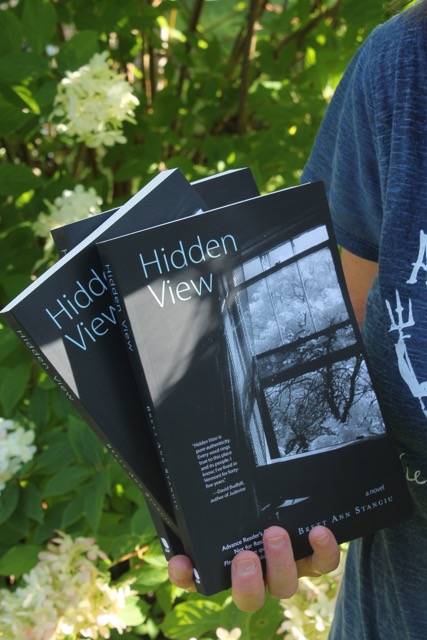
A cardboard box of advance reader copies of my book–my first book–appeared in the mail. Returning home from work and school, my daughters and I had gone in through the kitchen door, and it wasn’t until I was at the kitchen counter slicing tomatoes for dinner that through the window I saw the box on the stone step at the back door.

It was the most curious feeling to pull out crumpled paper and find my bound  books, so beautifully designed, crafted with such care and attention–this novel I have spun from nothing but my own experience and language, through all those hours scavenged, often late at night, early in the morning, during child naptimes. Like nothing else, this book in my hand is a bridge between the mysterious well of my working imagination and the world, a tangible here I am.

Whenever we give our pen some free will, we may surprise ourselves. All that wanting to seem normal in regular life, all that fitting in falls away in the face of one’s own strange self on the page. […] Writing or making anything — a poem, a bird feeder, a chocolate cake — has self-respect in it. You’re working. You’re trying. You’re not lying down on the ground, having given up.

–– Sharon Olds

IMG_8841

Companionship, Mothering

When I went through my time of parenting two-year-olds, I thought that was difficult. Exhilarating, exhausting, maddening at times: but yes, difficult. Oh, how young I was.

To parent a teenager is in some ways like walking through a ring of fire. Going forward, I will doubtless be scorched, and my emergence is not guaranteed. Last night, my daughter asked me with genuine anguish, But why do people suffer? When I was sixteen, I asked this question, and I’ve continued to ask this question, in a multiplicity of ways, through decades. I can spew off varieties of answers, but ultimately, to my daughter, with her honest face, I come up short.

Late in the night, with my children sleeping, a solitary light burning, the windows open to the crickets with their sound of tiny shaking bells, I read a passage from a chaplain who had been at the scene of a horrific plane crash. When I finished the book, in those quiet, dark hours, I thought of my child. Just as she fought in her birth to be free of my body, I see this girl thrusting her way from the tatters of her childhood, striding so urgently toward what she believes is the golden realm of womanhood. Here I am again, ready to catch my daughter, wanting only to be here.

“… I don’t know why that young child was killed. This is a true mystery. And so I enter into it with you. I cry with you if you allow me into that space. I’ll walk with you. And this is something that a lot of chaplains I know that were involved in Iraq and Afghanistan–talking with their soldiers–they’ll say, Look, I’m gonna journey with you on this. I’m not here to explain it. I’m gonna journey with you. There’s a sense of humility there that I think connects with people, because I think in their heart of hearts we know, Oh, I don’t have an answer. So let’s walk into that mystery together.”

–– Laurence Gonzales, Flight 232

Gabriela/Photo by Molly S.

Gabriela/Photo by Molly S.

Anniversaries and the Children

Anniversaries held keen importance to James Joyce. June 16, Bloomsday, was the date he and Nora Barnacle first went walking. This date–September 16–marks a different kind of anniversary for me, the date of an accident in our family a number of years ago, a genuine shifting point in our lives. I wrote an essay about that accident, which was published, and I was paid a good amount of money for it.

While the experience was excruciating, so much came out of that night, like a fount of energy, a swirl of all kinds of things. Looking back now, I see how, even then, in what appeared to me a stillness of stupefying suffering, our very lives continued to pulse, to throb on with the very things that make us human–desire and love and laughter. Much as I might have longed to retract into into my own misery and fear, I was pulled forth by the insistence of such simplicity as hunger, dirty diapers, a child’s hand in my own.

….and the sea the sea crimson sometimes like fire and the glorious sunsets and the figtrees in the Alameda gardens yes and all the queer little streets and the pink and blue and yellow houses and the rosegardens and the jessamine and geraniums and cactuses and Gibraltar as a girl where I was a Flower of the mountain yes….

–– James Joyce, Ulysses

IMG_2527