The Fourth Cottage

Here’s a story from Timothy Snyder’s recent book Black Earth. During World War II, a young Lithuanian woman tumbled into a pit of corpses during a mass execution. When the killing was finished, earth was thrown over the grave. Somehow, buried beneath the dead, she managed to survive. Naked, shot in the hand, covered in her own blood and the blood of others, she managed to claw herself free of the pestilent trench. Terrified beyond what is imaginable, she sought help at a cottage. She was turned away. She found a second cottage, and was turned away again. At a third cottage, she again pleaded for help and was refused. At the fourth cottage, she was given succor, and she survived.

Snyder writers,

Who lives in the fourth cottage?…. When the outside world offered threats but no promises, the few people who acted to rescue Jews often did so because they could imagine how their own lives might be different. The risk to self was compensated by a vision of love, of marriage, of children, of enduring the war into peace and into some more tranquil time.

As a writer, I keep thinking of that fourth cottage, its habitants long-lost in the horrifically bloodied past. And yet:  whose hand opened the door in the fourth cottage? And who dwelled in cottages one, two, and three?
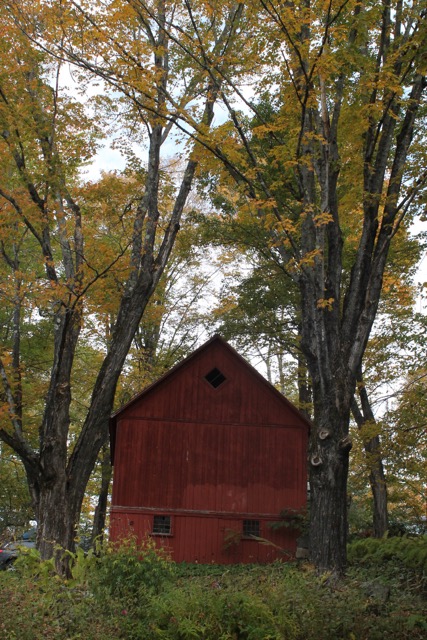
IMG_9341

East Calais, Vermont/Photo by Molly S.

Financial Aid Lingo

Tonight, my older daughter and I sat in her high school library listening to a power point presentation on college financial aid – don’t nod off right now! Sitting there, wishing I had a cup of coffee, I glanced at my daughter’s eyes glazing over as she doubtlessly sat thinking of something else entirely. I added up the loan amounts for four years of college (holy cow!) and underlined my note: Don’t miss deadlines.

On our way out, I asked for the presenter’s email address, and she asked me if I had gone to collegeI told her I had, but my dad filled out the forms – and that was in the prehistoric non-digital age. The woman commiserated that my dad had to xerox tax forms.

Driving home, my daughter remarked that no one used the word xerox anymore. Why do you and grandpa keep doing that? The word is copy.

I assured her xerox is definitely a verb. Like a more modern version of mimeograph.

She was silent a moment, driving through the darkness, and then she asked, Mimeograph? What’s that?

… Sometimes, I see parts of myself in my older daughter – an exasperation I had when I was younger at the adult world’s infuriating mediocrity, a why-can’t-you-get-yourselves-together-ness.  At sixteen, on the cusp of stepping into her adult life, the whole great world of love and desire and ambition (and heartbreak, inevitably, although not too much, please) yet to spin out before her. And then sometimes, in that cyclical way time moves, I see my father reflected in me, all those careful files he kept, putting his three kids through college.

At home, I laid the evening’s materials in a folder on my desk. My daughter came into the room and asked with great seriousness, Can we do this?

I smiled at her. Piece of cake, I assured her. Meet deadlines, stay organized, follow the rules, fill out all the forms. 

Forms are the easy part.

When we are loved, we wish the other to recognize our presence, and this is a very important practice. You must do whatever is necessary to be able to do this:  recognize the presence of the person you love….

— Thich Nhat Hanh

Small Pond in Woodbury, Vermont

Small Pond in Woodbury, Vermont

Enjoying the Digital Age

While I frequently rail against the digital age, the nefariousness of video games — while I believe children should play outside in apple trees and ride bikes, and read real books — while I am the champion of the world made by hand and do-it-yourself ad nauseum — the truth is, I find the digital world just plain fun at times.

My dad sent me a power point presentation he made for his class, and I watched it with my older daughter. At one point, she started exclaiming, Did grandpa photoshop that? I had no idea; I was too busy reading the words. God, she said, of a monastery in Bhutan, I’d like to be there.

At the end, she said, Cool beans to grandpa — that’s high accolades from a teenager.

This past day, I’ve been sending text back and forth to my publisher, making the very last changes on my novel before it heads, digitally of course, to the printers. An s was dropped here; I added acknowledgments, a dedication, and permissions. It’s all email, back and forth, with notes and exclamations, and phone calls of course, too. But truly, having read these 278 pages over and over, in the end, it all comes down to the writing. To story, craft, beauty, and meaning.

But the digital realm offers much to us in rural Vermont. I remember some winters standing outside the co-op with a baby on my back, reading the posters as cultural infusion. Here’s a paragraph I filched from that bounty of my dad’s material:

Like anything that one makes well with one’s own hands, writing good nonfiction prose can be profoundly satisfying. Yet after a day of arranging my research, my set of facts, I feel stale and drained, whereas I am energized by fiction. Deep in a novel, one scarcely knows what may surface next, let alone where it comes from. In abandoning oneself to the free creation of something never beheld on earth, one feels almost delirious with a strange joy.

“The Craft of Fiction in Far Tortuga”
Interview of Peter Matthiessen
The Paris Review 60 (winter 1974)

IMG_9111

East Calais, Vermont/Photo by Molly S.
Autumn Light: Painting and Writing

When my sister was at Williams College, I used to take the Greyhound to stay with her, and while she was in class, I walked to the Clark Art Museum. The museum admission was free, and you could walk in and stay as long as you liked. The museum wasn’t enormous, but it was sizable enough that you could begin with the Remingtons and head up to the Impressionists. On the second floor was a large light-filled room filled with Monet and Cassatt and Degas and Pissarro.

Every fall, I remember Monet’s The Duck Pond, and how I could stand in front of that painting, age seventeen, and gaze at all those golden hues of oil paint.

These paintings were portals opening my eyes to looking at the world, just at the time when I discovered James Joyce. Thinking back now, I realize visiting these paintings repeatedly contributed to who I am as a writer. If there’s one thing we need in this country, surely more art would rank near the top, and free art at that, where a girl from a small New Hampshire town can walk through a museum’s open door, over and over, and begin to know a handful of paintings.

(In a Vermeer painting)… scattered flakes of gold…. are strewn lavishly through shadows and luminous areas alike, and the eye simply accepts their presence. Vermeer’s most penetrating critic, Lawrence Gowing, describes this phenomenon as a glittering “commentary of light.”

— Michael White, Travels in Vermeer

IMG_0085

Montpelier, Vermont/Photo by Molly S.

Other Gods

At the dinner table the other night, my older daughter had some questions about the ten commandments. Although she attends a secular public high school, apparently the commandments surfaced in a health class discussion. Transported back to my few elementary school years in Sunday School, I remembered crayoning two suspiciously tombstone-like tablets and a mighty Moses figure. I assured my girls honoring their mother was a key commandment.

But the commandment that stumped her was the second:  Thou shalt have no other god. What the heck could that mean?

We were eating bacon-traded-for-our-syrup from a friend’s pig, an enormous porcine wonder once named Douglass. I had fried the thick fat golden crunchy on the outside, creamy and savory-smoked on the inside. The frost hadn’t yet gotten to my peppers, and with the bacon fat I had sautéed poblanos with my garden onions and garlic and nearly the last of the tomatoes. My younger daughter tore pieces of crusty bread and laid these on our plates.

I suggested: think about what fills your life. What if your life was consumed with the desire to win an Olympic figure skating medal, or insatiably to earn money? Or what if your life was filled with cultivating thousands of acres of commercial corn? Overseeing a small town library? Teaching kindergarten? Or suffused with a quest for something else: gambling, anorexia, heroin? What about Vermeer and his eleven children, the unpaid bakery bill at his death, and the two paintings his wife hocked in exchange for that debt? For better or for worse, isn’t what you fill your life with, and what you pursue, precisely what you kneel before?

There’s an upper window in our kitchen, and at this time of year, sunlight falls down in the late afternoons on our table. Years ago, my parents gave us this table from my girlhood home. The butcher block has held up all these years.

Oh, little girl,
my stringbean,
how do you grow?
You grow this way.

— Anne Sexton

IMG_0083

Montpelier, Vermont

Laughter and Rain

The February my older daughter had just turned one, she and I went to a playgroup in Craftsbury, and only a woman I hadn’t met and her one-year-old son showed up. The tykes fought over a red plastic shovel (my child was the aggressor), and eventually we hid the shovel. While the kids checked out the plastic toys, the woman and I talked, and talked, and talked, and in some ways haven’t really stopped talking since.

Today, in one of these weird slips of time, my friend and I drove around Woodbury, this rural Vermont town, population 902, over dirt roads, up hills and along narrow roads without guardrails beside ponds, looking for one particular thing.

Crisscrossing these roads in the rain, we passed my daughter’s elementary school several times, and I thought of my child at her tidy desk, in the warm red schoolhouse with the rain coming against the windows.

My friend and I met no one else but a pickup truck or two on these back roads. Several times I asked, Should I drive up there? It looks like a bike trail and not a road.

Yes, she insisted, yes — and only once got out so I didn’t back into a ditch.

How long our friendship spins out, stitched through with so many things:  new babies, and gardening, books and more books, a courtroom, jobs, days at the lake, coffee, broken vehicles, farmers markets, deaths, and a whole lot of laughing. I wouldn’t trade the laughing for anything.

Nobody sees a flower, really – it is so small it takes time – we haven’t time – and to see takes time, like to have a friend takes time.

– Georgia O’Keefe

Photo by Molly S.

Photo by Molly S.