Small Talk

Last evening, an elderly doctor I was introduced to asked me how I survived childhood.

For folks who don’t know me, I’m small — I mean, really small. I’m a smidge over 4’8″. Technically, I’m tall for a dwarf.

Only as an adult did I realize my smallness, to some extent, defined my habits. Teased in elementary school, I was ridiculously shy. Find me sitting at a school board table, and I can be fierce and demanding, the playing field innately leveled.  In a crowd, I instinctively gravitate towards the kids.

Once upon a time, I know I cared tremendously. Now, being small is such a minor thing, a mere curiosity.

My job requires I ask questions of people — sometimes reflective questions, sometimes difficult ones. But this one? Like anyone else, I know people who have had terrible things in their childhood. But smallness? I skipped school sports and went to the library a lot. Could have been worse.

Here’s some Alice Munro….

‘The thing is to be happy,’ he said. ‘No matter what. Just try that. You can. It gets to be easier and easier. It’s nothing to do with circumstances. You wouldn’t believe how good it is. Accept everything and then tragedy disappears. Or tragedy lightens, anyway, you’re just there, going along easy in the world.

IMG_3008

Cat’s work day

A Sweeter Version of Macbeth’s Day to Day

On our back deck yesterday, my 19-year-old and I talk about the crickets, how their songs are lengthening and yet quieting at the same time, their strength slowly leaking away with summer.

The sunflowers are high in our garden.

This summer has been one of the daughters coming and going, and myself mostly staying put. The younger daughter’s suitcase is packed again, as she happily heads to Maine with friends. The older daughter has been working mixed-up nursing home shifts — most recently the graveyard hours. Her bags are packed, too, as she anticipates returning to college.

We’re busy, sure, but not that busy. In the midst of all this, we cook dinner together when we’re all home, and in these long dusky evenings, we go for walks.

Last night, we were in the town’s community gardens, taking photographs in the pink-leaved echinacea. I remembered that very first year I was a mother, and I kept trying to grab some stability — Oh, this is what being a mother is like. This is how our life will go. But my baby kept changing. She slept, or she didn’t sleep. She crawled, and then she ran. She babbled. Sometimes, she cried fiercely. She was radiant and fierce and deeply loving — a babyhood version of who she is as a young woman.

But she grew and changed all the time, which is — and I really don’t know why this came as such a shock to me — the essence of this earthly life. But the deep down elements of our lives haven’t altered: her eyes are the same curious, merry upside-down crescent moons I first saw on the night she was born.

All this, I suppose, means that I intend to swim in the nearby pond as long as possible. The water is warm yet, and the banks are brilliant with goldenrod.

I had to learn that I was a better mother and wife when I was working than when I was not.

— Madeline L’Engle, Walking On Water

IMG_6927.jpg

Photo by Molly S.

Opening Up

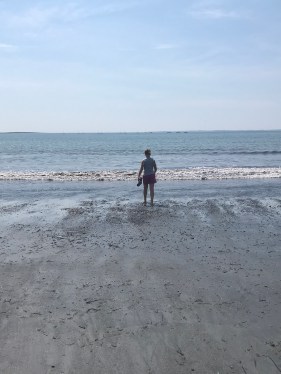
On a muggy afternoon, my daughters and I swim in a cold New Hampshire mountain stream with my brother’s girlfriend. She suggests going to the ocean the following day. I see my younger daughter’s eyes — the quiet girl — gleam with love of ocean.

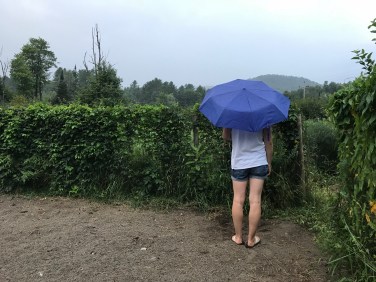
While I drive that familiar way back over the mountains back to Vermont and back to work, the girls and my brother and his girlfriend head the opposite way, east, to the sea. Later that evening, I read Louise Erdrich while the cats sprawl on the windowsill, watching a pouring rainstorm. In my garden, the sunflowers stretch far above my head, not yet blooming, their golden faces not yet opened up to the world.

The Erdrich book is her memoir of early motherhood. Watching the rain with the cats, I imagine my 13-year-old when she was three, picking colorful bouquets of zinnias in my garden for her two best friends.

At 13, wearing sunglasses and jean shorts, she’s so often savvier than I give her credit for, happily stepping into a wider world.

… with each celebration of maturity there is the pang of loss. This is our human problem… how to let go while holding tight, how to simultaneously cherish the closeness and intricacy of the bond while at the same time letting out the raveling string, the red yarn that ties our hearts.

— Louise Erdrich, The Blue Jay’s Dance

IMG_3007

Maine/Photo by Molly S.

Crickets

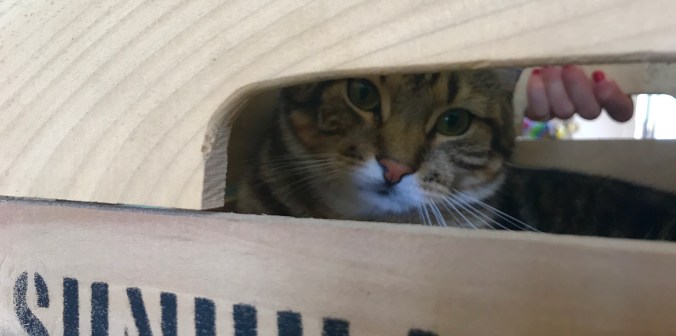
My daughter’s pinpointed the difference between her two tiger cats: Acer has an imaginative life keeping him busy — he’s a mighty African lion, a belly-crawling spy, a baby who must be carried up the stairs — while Tar is simply happy being a cat.

I’m a little worried the contrast offers great metaphor for human life. Satisfied and sweet? Or creative and twitchy?

Yesterday, on such a lovely August day, after swimming in the pond, my friend reminds me of this E. B. White quote from Charlotte’s Web. Ah…..

The crickets felt it was their duty to warn everybody that summertime cannot last for ever. Even on the most beautiful days in the whole year – the days when summer is changing into autumn – the crickets spread the rumour of sadness and change.

IMG_2985

August First

August 1st dawns quietly — the songbirds winding down, the dew slipping in silently overnight — save for the cats who mew in hunger.

Yet another summer day, a small kind of miracle that will disappear, a day promising to be packed with work and obligations, with laundry hung on the line, and a very long list on a scrap of paper beside me.

But it’s August. Just a few blocks from where I sometimes work in Burlington is a fine bakery named after an even finer poem by Hayden Carruth.

August First

Late night on the porch, thinking
of old poems. Another day’s
work, another evening’s,
done…..

IMG_2898.jpg

Hardwick Reservoir, Vermont


Black-Blue, Turquoise-Blue

Sharing poems with little kids this week, I keep reading this one:

I’m glad the sky is painted blue,
And the earth is painted green,
With such a lot of nice fresh air
All sandwiched in between.

While Long Winter in Vermont has its endless permutations of snowfall and cold, Spring in the Green Mountain state yields treasures every day — coltsfoot in this unexpected place, emerald so luminescent it seems nearly impossible. How quickly this season sometimes moves.

Last night, from the windows at the top of our house, I saw blue-black thunderheads far down the valley, and white curtains of rain. Rapidly, dead leaves blew against the glass, and handfuls of hail.

This is the morning for the other poem the kids especially liked, about a rain-glazed red wheelbarrow and white chickens.

IMG_1727.jpg