Demian. Hermann Hesse.

This afternoon, I tore through my bookshelves searching for a paperback copy of Hermann Hesse’s Demian, a book I first read in high school. The book above — brand-new, Harley Rustad’s Lost in the Valley of Death — reminds me of Demian. Like so many other people, in some ways reading Hesse as a young woman shaped my life, every one of my years off the well-trod path. Demian has reappeared at certain keys points in my life, always rising with a strangely mysterious power. At the end of a very long winter, that book returns to me like a breath of spring air.

Fittingly, perhaps, I’m unable to find my copy. Maybe that hardly matters. For the first time in months, I take a long hatless walk, listening to the singing birds, remembering the unstoppable power of spring, and that the world wraps around us in ways we understand, and in ways we’ll never comprehend.

On this sunny Sunday in Vermont, here’s a few lines from the incomparable W. H. Auden on the nature of war. For more about this poem, the New York Times has an essay today.

About suffering they were never wrong,

The Old Masters: how well they understood

Its human position; how it takes place

While someone else is eating or opening a window or just

walking dully along…
Holy/Unholy

A warm Christmas Day rain washes away every bit of snow in our patch of northern Vermont, save for a few ice-hardened and blackened plowed-up ridges. As the dawn drips in with its gray, the landscape appears unfamiliar to me in December — an experience that, again, sums up 2020.

Friends of ours had Christmas dinner on the in-laws’ porch, with the in-laws inside and themselves on the covered porch, eating Christmas dinner 2020-style. Strange and weird, but what wouldn’t I have given that for hilarity.

Talking with my brother on Christmas morning, he mentions he may grout a floor that afternoon. My youngest, afterward, tells me how fun that sounded and then wonders if she would see her uncle before she’s all grown up, headed out into the world on her own, not so far away.

And so it goes in this landscape of unfamiliarity: suspended in a warp of uncertainty. In the midst of all this, there’s me with my lists, my agendas, my determination to craft plans for happiness.

In this gray and blue and brown landscape — not the traditional Vermont snowy Christmas — there’s nothing to do but let all that fly away in the rising and balmy breeze. The heart of the Christmas story, after all, is the unexpected gift in the barn’s manger, the promise of joy where we least expect its appearance.

Photo by Gabriela S.

Evening Out — Of Sorts

A friend and I stand in the high school parking lot, watching our daughters finish soccer practice on the field. At least, I say as the girls walk towards us, laughing and talking, they’ve had one practice.

That’s where we are — maybe our world will fold up again tomorrow, but at least the girls had an afternoon together, running on the field on this sunny August day.

At dinner, I quickly realize the soccer team is angry about a school board position, and my daughter glares at me. I have a seat on the board; I listen to her complaint, and think, Let her be mad at the board.

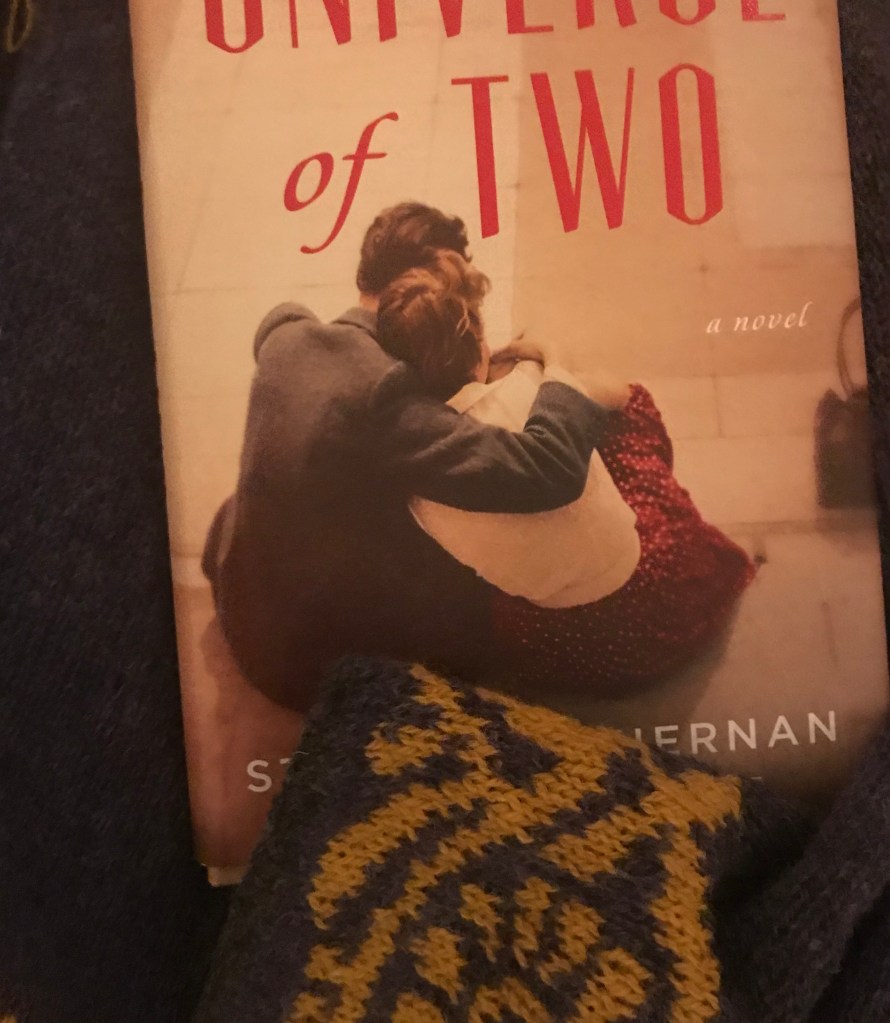
I almost don’t head down the hill to Atkins Field, for the first reading I’ve attended in months, in a beautiful post-and-beam gazebo. A strong breeze blows up, threatening rain. There’s just over a dozen of us, bundled in jackets and blankets folks have pulled from their cars, sitting in lawn chairs. I’m regretting coming, when the author begins speaking. I’ve heard this author before — Stephen Kiernan — and loved his stories. Before coming, I knew nothing about his book, but as he begins speaking, I realize the book is about Los Alamos — a place I know. I put away my knitting, huddle into my chair, and listen.

The dusk comes down. Across the way, I see a single turkey vulture flying across dark clouds, its rising wing glossy with sunset as it struggles to fly into the wind.

At the very end, Kiernan reads the opening page of his book. Kiernan reads particularly well. Listening, for just a moment, I sense all these things coming together — the craziness of attending a reading spread out with masks, unable to whisper and giggle, the ever-present pandemic, but also the setting of Kiernan’s book — WWII — and how ordinary people have endured through terrible times, and we will, too. The chilly wind reminds us of autumn’s imminence, but for these moments, the beauty and power of Kiernan’s writing pulls us together.

And when I arrive home, my daughter is waiting for me on the porch, happy again to see me.

“I met Charlie Fish in the Chicago in the fall of 1943. First, I dismissed him, then I liked him, then I ruined him, then I saved him.”

— Stephen Kiernan, Universe of Two

Teenagers Recite Poems

Reluctantly, my daughter drags herself to a required high school poetry recitation.

While I chat with parents I haven’t seen in ages, I see her laughing with a boy she’s known since third grade.

Adolescents and poetry — how fun! One boy gives a comedic performance of “Stopping by Woods on a Snowy Evening,” beginning by asking the prompter, Where am I stopping now?

Another boy’s fingers tremble as he reads a particularly beautiful poem. A shy girl comes alive.

Afterwards, talking in the dark on the short drive home from the theater, my daughter tells me about each student, how they chose their two poems, and what their voice was like. My daughter’s second poem was Frost’s Two roads diverged in a narrow road, so familiar, such a beloved poem. Nervous for her first poem, Emily Dickinson, she gained her voice with the second, her eyes on the upper balcony, her voice clear, melodious, utterly her.

Tonight the bear
comes to the orchard and, balancing
on her hind legs, dances under the apple trees,
hanging onto their boughs,
dragging their branches down to earth.
From ‘The Bear” by Susan Mitchell
IMG_7193

Left the Shoes on the Back Porch…

After a day of brilliant sunshine, rain moves in during the night. My daughters’ cats, in the screened windows, wake me with their hungry mewing, against the background chorus of steady rainfall and birdsong.

Arriving home from work, I see my daughters have been swimming that afternoon, their hair in damp lanks around their shoulders.

As if in an instant, summer has unrolled in Vermont — verdant and colorful — while simultaneously the woods darken mysteriously with foliage.

90 days, poet David Budbill wrote. Frost-freeze — maybe — for 90 days in Vermont. Hallelujah.

Sparrow singing–
its tiny mouth
open.

— Buson

IMG_5721