Song against Reductionism.

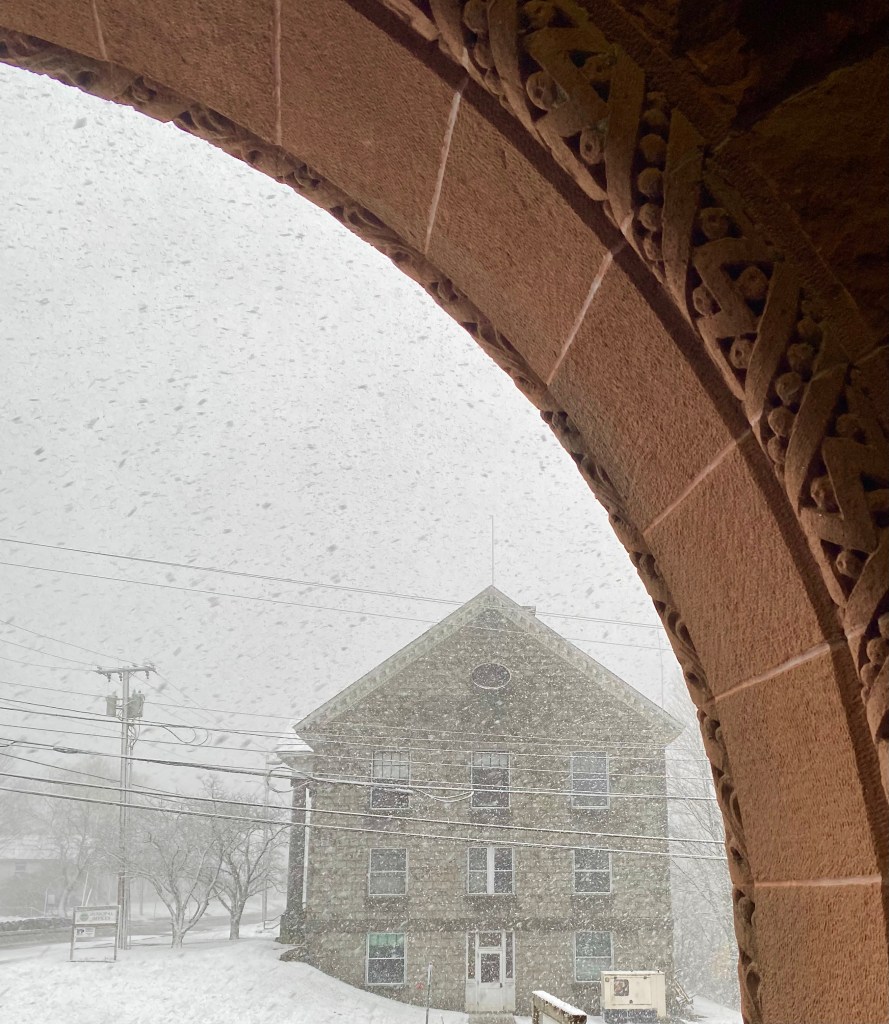
A pretty wet snow covers our muddy world — temporarily, for sure, a grace of sugar snow in a long mud season. Early March, and I’m already hanging the laundry out to dry, the pale green nubs of perennial bulbs pushing up through matted debris of last year’s leaves, broken twigs.

On a warm afternoon, I put the snow shovel away — my usual blind enthusiasm about spring! I’m the woman who rails against reduction, that the world can be defined as this or that. This world is nothing but gray, an unending smear of thaw and freeze. And yet, I’m wrong about that, too. Daily, the bird chorus gains, the winged creatures flocking in the box elders in the ravine behind my house, feasting at the feeder in the mock orange.

A poem from the late David Budbill:

“What Issa Heard”

Two hundred years ago Issa heard the morning birds

singing sutras to this suffering world.

I heard them too, this morning, which must mean,

since we will always have a suffering world,

we must also always have a song.

Birthday Cake.

March 7 is my father’s 87th birthday. My daughter, the oldest grandchild, visited my parents a few days ago and asked what to do for my parents’ birthdays. Cake and flowers. And be sure to eat the whole cake.

At town meeting, on the fly, I had to add a few numbers, tally a total. Writing with my pencil, the 100 or so audience members looking at me, I thought of those childhood evenings when I handed my dad an algebra or calculus problem and asked for help. He always made me sharpen my pencil, align the numbers so the problem made sense, and exhibit some respect for mathematics, please. These three things have stuck with me my entire life.

Every year on my father’s birthday, I think of this Hayden Carruth poem. My father — a man who taught his kids about Arkhipov Day and Ancient Greek philosophy, and spent so many nights in the desert, playing cards with his kids at a picnic table lit by a battery lamp….

Birthday Cake

For breakfast I have eaten the last of your birthday cake that you
had left uneaten for five days
and would have left five more before throwing it away.
It is early March now. The winter of illness
is ending. Across the valley
patches of remaining snow make patterns among the hill farms,
among fields and knolls and woodlots,
like forms in a painting, as sure and significant as forms
in a painting. The cake was stale.
But I like stale cake, I even prefer it, which you don’t
understand, as I don’t understand how you can open
a new box of cereal when the old one is still unfinished.
So many differences. You a woman, I a man,
you still young at forty-two and I growing old at seventy.
Yet how much we love one another.
It seems a miracle. Not mystical, nothing occult,
just the ordinary improbability that occurs
over and over, the stupendousness
of life. Out on the highway on the pavement wet
with snow-melt, cars go whistling past. 
And our poetry, yours short-lined and sounding
beautifully vulgar and bluesy
in your woman’s bitterness, and mine almost 
anything, unpredictable, though people say
too ready a harkening back
to the useless expressiveness and ardor of another
era. But how lovely it was, that time
in my restless memory.
This is the season of mud and thrash, broken limbs and crushed briers
from the winter storms, wetness and rust,
the season of differences, articulable differences that signify
deeper and inarticulable and almost paleolithic
perplexities in our lives, and still
we love one another. We love this house
and this hillside by the highway in upstate New York.
I am too old to write love songs now. I no longer
assert that I love you, but that you love me,
confident in my amazement. The spring
will come soon. We will have more birthdays
with cakes and wine. This valley
will be full of flowers and birds.

‘Soon it will be the sky of early spring…’

Wild February!

At noon, I stand talking to the road crew in a sparkling snowfall. I wax on about the prettiness of snow on the emerging earth. The crew, who’s endured the strange vagaries of mud season in December, the fickleness of Vermont’s winter weather made weirder by climate change, humor me with a nod.

Fifty degrees and rain forecasted for today, followed by more, followed by bitter cold, then rain and wind, the sun I lean towards…. Late winter, again, and I remember when I could distinguish the years: the spring we boiled sap from March 1 to the 31st. The year we made 540 hard-earned gallons, two of us and a five-year-old, and I wore through three pairs of gloves carrying in wood and feeding the arch.

Walking around my snow-scattered garden, I envision where I will plant the bare root Japanese lilac I’ve ordered, for me or someone else to admire and love. The path down to my compost is both icy and soft mud, the conundrum of winter reluctantly losing its teeth to spring. The true joy is the inevitability, the earth’s order to proceed from twinkling snowflake to downy crocus, the planet’s sheer opinionlessness regarding skunks and black flies.

The road crew and I kick around a few more pithy remarks about government corruption, and then we head along….

From my one of my favorite Louise Glück poems, March:

The sea doesn’t change as the earth changes;
it doesn’t lie.
You ask the sea, what can you promise me
and it speaks the truth; it says erasure.

Finally the dog goes in.
We watch the crescent moon,
very faint at first, then clearer and clearer
as the night grows dark.
Soon it will be the sky of early spring, stretching above the stubborn ferns and
violets.

The true religion, the religion of snow…

I stand at my kitchen’s glass door devouring blood oranges and watching the sifting snow. Blood oranges — could I choose a less local delight? I open the door and cast out the peels for the birds.

The cat Acer sits on my feet, listening to the morning radio news, too. Just over the river, my home state New Hampshire revels in the Presidential primary. Meanwhile, Vermont prepares for its March Town Meeting Day, with the calculations and passion of budgets and petitions. Close an elementary school? Pledge to become a pollinator-friendly town? So much of January in my state is devoted to public meetings and discussion/debate, to a reckoning of the way forward, a jostling for who’s running for what seat — and what seats might remain empty.

Meanwhile, snowy winter has finally arrived, spare and elegant. Fearsome and enchanting. As the days deepen in cold, the light hours increase: no stasis in this world.

A fan of local chicken, bacon, milk, my cat stares at my orange-sticky fingers with disdain. I crunch the orange seeds, too, devouring this sunlight sweet.

Here’s Billy Collins’ poem about shoveling snow with the Buddha:

[Shoveling snow] is so much better than a sermon in church,
I say out loud, but Buddha keeps on shoveling.
This is the true religion, the religion of snow,
and sunlight and winter geese barking in the sky,
I say, but he is too busy to hear me.

Continuing without a sign.

An inveterate list-writer, at the end of each day, I’m often summing what I’ve done. Somedays, my hands and my hand seem to come up empty. Or my heart has articulated a question.

I pass a few days drinking coffee and talking with my daughters, walking through the woods, along rivers and streams and a rock-throated gorge. They’ve teased me for years about my focus on the gritty and hardscrabble, my fascination with wandering into abandoned cellar holes, my curiosity about abrupt turns in human stories. But when has the world ever not been falling into pieces? There’s this, though: surely at times the world’s misery spins harder and swifter and unbearably more painful.

In those cellar holes, gardens of flowers and sustenance once bloomed at doorsteps, their seeds dormant in the soil. Sunday, nearing dark, I brake for wild turkeys meandering across a dirt road. There’s no one around. I pull over and walk down the road to snap a photo, but the turkeys suddenly rush, hearing my footsteps, and I’ve forgotten my phone in the car anyway. I’m at a driveway that bends up the hillside, the house of out sight. Many years ago, the man who lived there offered me his dead wife’s fur coat. He must be long gone, too. I’ve long since lost any sense of who lives there now.

“Matins”

You want to know how I spend my time?
I walk the front lawn, pretending
to be weeding. You ought to know
I’m never weeding, on my knees, pulling
clumps of clover from the flower beds: in fact
I’m looking for courage, for some evidence
my life will change, though
it takes forever, checking
each clump for the symbolic
leaf, and soon the summer is ending, already
the leaves turning, always the sick trees
going first, the dying turning
brilliant yellow, while a few dark birds perform
their curfew of music. You want to see my hands?
As empty now as at the first note.
Or was the point always
to continue without a sign?

— Louise Glück

Apple Blossom Petals Like Snow.

When my youngest was born, nearly 18 years ago, my brother had a new cell phone that had a camera. I didn’t own a cell phone then and didn’t predict I ever would. Who wanted to carry a phone around with them?

Turns out, my brother had forgotten his phone, anyway.

I could rhapsodize about how many phones and how many laptops have now passed through our house, the zillions of digital images and words, but really…

This is the most amazing blossom season. In the late afternoons, I read beneath an apple tree while petals fall, the pollinators hum, the spring crickets creak on. The first crop of dandelions has already morphed into gossamer globes of seed. How fast this passes. Sometimes, waking in the night, I get up and read. I am now beyond those baby waking nights, no longer so hungry to rest. Jays bicker over something I’ll never know. The day slips along.

The sea is calm tonight.

The tide is full, the moon lies fair…

— Matthew Arnold