Dumpster Raiding, Poetry, Independence Day.

Ocean Vuong reads at a nearby arts center that is built in a farm field with a stage modeled on the Globe Theater. My friend and I cruise in, nearly late, and the parking lot is full. Hundreds of people have arrived. On this holiday weekend, I’ve swam and eaten ice cream, stepped inadvertently from friend to friend, like the twilight walk that ended in darkness on a trail, two small women talking, talking, fireworks booming in the blackness around us.

Vuong reads mesmerizingly, like a dream. He begins with remarking that humanity began in poetry and war, and how this will shake out after the Anthropocene is yet of course to be determined. By the reading’s end, I wipe tears from eyes. Immensely talented, utterly humble, Vuong offered homage to craft of storytelling—its essential role in all human life—and to the women who raised him. Four Vietnamese women in hardscrabble Massachusetts wrested free from their bad men and raised seven sons. None of these women were writers, but they were all oral storytellers who told their stories to salvage their dignity from the harms of the men. The repair was for their sons—and themselves.

And the poetry and war where Vuong began? By the hour’s end, his words stream through me, like that Buddhist retreat I attended last summer, my body still bitten by cancer to more bones than flesh. In those days, for fleeting moments I could envision my own near death, that this body I’ve used so hard will go down into soil and stone, that tendrils of roots and melting snow will erase me from this world of language and teeming desire, and yet I will have never gone anywhere at all.

Likewise, listening, I realize the poet carried all of us, not one more than another, along his mellifluous words, that the human history of this country, America, is inextricably bound in the polarity of war and poetry, a profound rushing flood of passing time and undefinable generations.

Later, my dear friend headed home to her dog and her life, I wandered along the back end of the village where a dumpster lies overturned. From the rubble, I extricated a glossy Dorothea Lange photo, the famous portrait of a mother and children. I rolled it up and tucked it beneath my arm. For you, I write for you, because you are me.

NOTHING

We are shoveling snow, this man and I, our backs coming closer
along the drive. It’s so quiet I can hear every flake on my coat. I
used to cry in a genre no one read. What a joke, they said, on fire.
There’s no money in it, son, they shouted, smoke leaking from
their mouths. But ghosts say funny things when they’re family.
This man and I, we take the weight of what will vanish anyway
and move it aside, making room. There is so much room in a
person there should be more of us in here. I wave to you, traveler,
inches away but never visible from where I am. Are you warm
where you are? Are you you where you are? Something will come
of this. In one of the rooms in the house the man and I share, a
loaf of rye is rising out of itself, growing lighter as it takes up more
of the world. In humans, we call this Aging. In bread, we call
it Progress. We’re in our thirties now and I rolled the dough just an
hour ago, pushing my glasses up my nose with my flour-dusted
palm as I read, reread, the hand-scrawled recipe given me by the
man’s grandmother, the one who, fleeing Stalin, bought a ticket
from Vilnius to Dresden without thinking it would stop, it so
happened, in Auschwitz (it was a town after all), where she and
her brother were asked to get off by soldiers who whispered, keep
moving, keep moving
 like sons leading their mothers through
wheat fields in the night. How she passed through huddled coats,
how some were herded down barb-wired lanes. The smoke from
our mouths rising as the man and I bend and lift, in silence, the
morning clear as one inside a snow globe. For how can we know,
with a house full of bread, that it’s hunger, not people, that
survives? The man pours a bag of salt over the pavement. But
from where I’m standing it looks like light is spilling out of him,
like the ray of dusty sun that found his grandmother’s hands as
she got back on the train, her brother at her side, smoke from the
engine blown across the faces outside blurring into pine forests,
warped pastures, empty houses with full rooms. The man
clutches his stomach as if shot, and the light floods out of him, I
mean you—because something must come of this. Poetry makes
nothing happen
, someone who is dead now said after a friend’s
death. When the guard asked your grandmother if she was
Jewish, she shook her head, half-lying, then took from her bag a
roll, baked the night before, tucked it in the guard’s chest pocket.
She didn’t look back as the train carried her, newly seventeen,
toward where I now stand, on a Sunday in Florence,
Massachusetts, squinting at her faded words: sift flour, then beat
eggs until “happy-yellow.”
 The train will reach Dresden days before
the sky is filled with firebombers. More smoke. A bullet in her
brother under rubble, his name everywhere outside her like the
snow falling on your face forty years later, on December 2, 1984,
while your mother carries you, alive only three hours, the few
steps to the mini-van where your grandmother, nearly sixty now,
crowns your head with her brother’s name. Peter! she says, Peter!
Peter!
 as if the dead could be called back from rubble into new,
stunned bones. The snow has started up again, whitening the
path as though nothing happened. Oh, to live like a bullet, to
touch people with such purpose. To be born going one way,
toward everything alive. To walk into the world you never asked
for but then choose the room where your hunger ends—which
part of war do we owe such knowledge? It’s warm in this house
where we will die, you and I. Let the stanza be one room, then.
Let it be big enough for everyone, even the ghosts rising now
from this bread we tear open to see what we’ve made of each
other. I know, we’ve been growing further apart, unhappy but
half full. That clearing snow and baking bread will not save us. I
know, too, as I reach across the table to brush the leftover ice
from your beard, that it’s already water. It’s nothing you say,
laughing for the first time in weeks. It’s really nothing. And I believe
you. I shouldn’t, but I do.

~ Ocean Vuong
Life can only be understood backwards…

Kierkegaard wrote that famous line, “Life can only be understood backwards; but it must be lived forwards.” This is the story of my life, and probably of yours, too. I’m a few weeks shy of a year away from the last chemo session. During those hours of infusion, I dozed, watching cardinals and house wrens through the cancer center window. That night, I slept profoundly, believing done, done, not yet realizing an excruciating surgery would lear up unavoidably a month later, that I would phone my siblings and beg for their arrival, that I needed fresh horses, the calvary’s arrival, that the end to these months of cancer treatment seemed impossible.

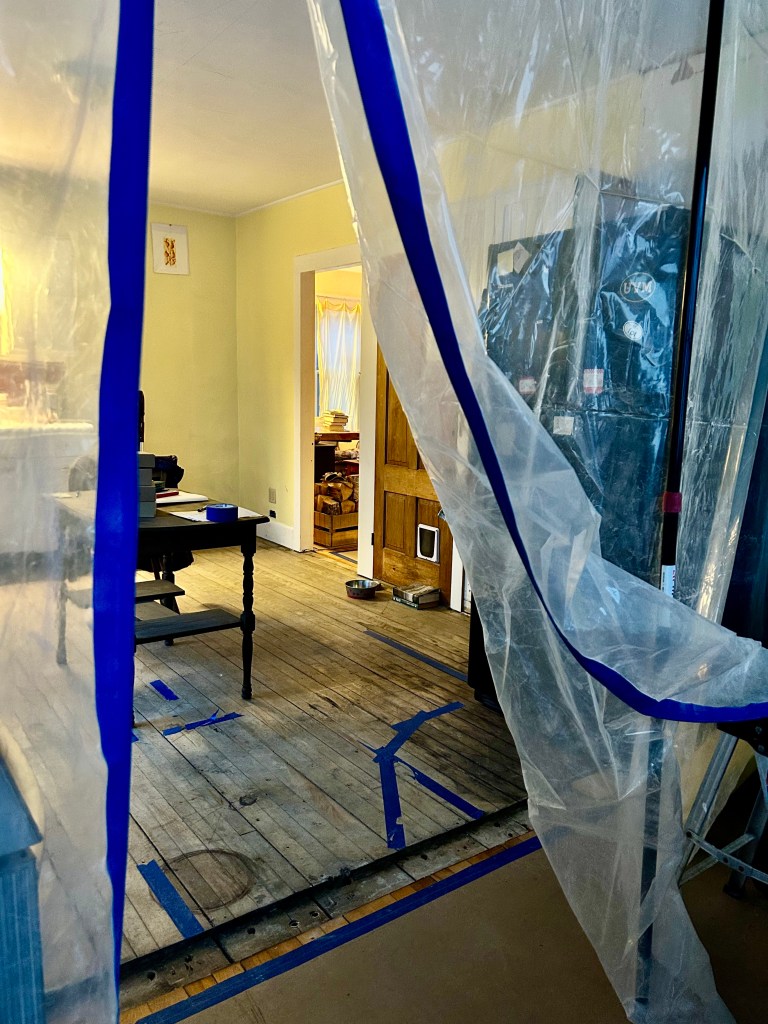
A year later, I’m still here, living forward, still waking before dawn to reckon what kind of light might kindle the day. A year ago, I could hardly lift my laptop. Now, I text a friend to borrow a belt sander. I am determined to lean my shoulders and back into revitalizing this old wooden floor that had been hidden for years beneath vinyl.

Cancer reshaped me in multiple ways, diluted my rage, cushioned my prickliness, whetted my fierceness to entertain no truck with catty foolishness. Disease fed my solitude and forced me to reach out and grasp hands. And now a sander.

A friend recorded Vermont’s poet laureate Bianca Stone speaking about Robert Frost. The recording is up for a few weeks on the local radio station, WGDR, on the March 22 Bon Mot show; it will feed your heart.

And one of my favorite Frost poems:

Into My Own

One of my wishes is that those dark trees,
So old and firm they scarcely show the breeze,
Were not, as ’twere, the merest mask of gloom,
But stretched away unto the edge of doom. 

I should not be withheld but that some day
Into their vastness I should steal away,
Fearless of ever finding open land,
Or highway where the slow wheel pours the sand.

I do not see why I should e’er turn back,
Or those should not set forth upon my track
To overtake me, who should miss me here
And long to know if still I held them dear.

They would not find me changed from him they knew—
Only more sure of all I thought was true.

“Everything blooming bows down in the rain…”

We make the trek again to Dartmouth for a surgical consult, the sign-off after surgery. I’ve met numerous members of this team, but not this kind NP, who’s read my history and says, What an ordeal. I’m not expecting these words, and I pause. Last November, when was I first admitted to Dartmouth, I had unplanned surgery. That snowy November night, the surgeon spent so much time with me. Then her Fellow returned and answered my endless questions. In May, I had surgery again. Two bookends – that November night and this sultry summer day. I’ll be treated here for years, but my hope – and none of know squat about the future – is that I’ll never need a surgeon again.

I thank her and the surgical team and student entourage who appeared in all those ER and hospital floor rooms where I stayed – me, the reluctant patient, who tried to negotiate some other outcome than surgery. To my surprise, she’s grateful for my words, too. We try our best but it’s hard to know how we come across to patients. The surgeons who operated on me are trauma surgeons. My surgery was routine, but routine surgeries go south. Mine did not.

Afterwards, my daughter and I stop at Dartmouth College’s Hood Museum. There’s a Georgia O’Keefe painting we want to see and two Monets. The current exhibit has mesmerizing photographs. This is a good day and a good visit. We eat sandwiches in King Arthur Flour’s patio, where so many families have pudgy babies tucked into a parent’s arm. We linger, talking about my mother who would have loved eating here.

So many of those drives on the interstate home, I slept, nodding in and out of conversation. My weak days are long passed, and we keep talking, the interstate edging near the Connecticut River and up on the ridge again. In June’s green, the drive no longer seems so desolate. Traffic here is always sparse. We pass a trailer of hay bales, a pickup with three wheelbarrows.

Enduring cancer turned my world (and my family’s world) inside out. In the first five-day continuous course of chemo, I forced myself to wash every morning. In those days, my hair had not yet fallen out. I was too weak to brush my hair, so I tied it at the nape of my neck. That month, my daughter cut what snarled hair remained. Those miserable uncertain November mornings, how grateful I was for hot water and soap, to have access to a brutal but hugely effective treatment, in a sterile hospital in one of the richest states in a phenomenally country. I made my choices, but I had choices.

In the inside-out world where I am now, I’m ticking through my list: profusely thank my oncologists and surgeons for saving my sometimes-surly life, tend my garden, figure out my youngest’s college bill, finish my book, accept the ravenous roaming woodchucks….. my domestic realm.

In our little end-of-the-road neighborhood, visitors come and go on my back deck, gardens on three sides, the wild pressing in on the fourth. My own nexus.

Everything blooming bows down in the rain:

white irises, red peonies; and the poppies

with their black and secret centers

lie shattered on the lawn.

~ Jane Kenyon

Dazzling light.

Here’s the weird thing about this March: cabin fever is not a thing. March has always marked the time of year when snow and cold has piled unrelentingly on us for veritable months. Not so, this warm year. But climate change does squat for the dearth of light, and certainly nothing for the dissatisfaction that’s creeping into our social consciousness. I am a woman who craves the planetary might of blooming crocuses, the radiant headiness of a forest strewn with spring beauties, the serene hover of a bee tucked into a downy apple blossom. Patience, patience.

Walking home from the library, a sudden snowfall drenches my eyelashes.

On this early morning, poetry:

Strewn

It’d been a long winter, rags of snow hanging on; then, at the end

of April, an icy nor’easter, powerful as a hurricane. But now

I’ve landed on the coast of Maine, visiting a friend who lives

two blocks from the ocean, and I can’t believe my luck,

out this mild morning, race-walking along the strand.

Every dog within fifty miles is off-leash, running

for the sheer dopey joy of it. No one’s in the water,

but walkers and shellers leave their tracks on the hardpack.

The flat sand shines as if varnished in a painting. Underfoot,

strewn, are broken bits and pieces, deep indigo mussels, whorls

of whelk, chips of purple and white wampum, hinges of quahog,

fragments of sand dollars. Nothing whole, everything

broken, washed up here, stranded. The light pours down, a rinse

of lemon on a cold plate. All of us, broken, some way

or other. All of us dazzling in the brilliant slanting light.

— Barbara Crocker

Song against Reductionism.

A pretty wet snow covers our muddy world — temporarily, for sure, a grace of sugar snow in a long mud season. Early March, and I’m already hanging the laundry out to dry, the pale green nubs of perennial bulbs pushing up through matted debris of last year’s leaves, broken twigs.

On a warm afternoon, I put the snow shovel away — my usual blind enthusiasm about spring! I’m the woman who rails against reduction, that the world can be defined as this or that. This world is nothing but gray, an unending smear of thaw and freeze. And yet, I’m wrong about that, too. Daily, the bird chorus gains, the winged creatures flocking in the box elders in the ravine behind my house, feasting at the feeder in the mock orange.

A poem from the late David Budbill:

“What Issa Heard”

Two hundred years ago Issa heard the morning birds

singing sutras to this suffering world.

I heard them too, this morning, which must mean,

since we will always have a suffering world,

we must also always have a song.

Birthday Cake.

March 7 is my father’s 87th birthday. My daughter, the oldest grandchild, visited my parents a few days ago and asked what to do for my parents’ birthdays. Cake and flowers. And be sure to eat the whole cake.

At town meeting, on the fly, I had to add a few numbers, tally a total. Writing with my pencil, the 100 or so audience members looking at me, I thought of those childhood evenings when I handed my dad an algebra or calculus problem and asked for help. He always made me sharpen my pencil, align the numbers so the problem made sense, and exhibit some respect for mathematics, please. These three things have stuck with me my entire life.

Every year on my father’s birthday, I think of this Hayden Carruth poem. My father — a man who taught his kids about Arkhipov Day and Ancient Greek philosophy, and spent so many nights in the desert, playing cards with his kids at a picnic table lit by a battery lamp….

Birthday Cake

For breakfast I have eaten the last of your birthday cake that you
had left uneaten for five days
and would have left five more before throwing it away.
It is early March now. The winter of illness
is ending. Across the valley
patches of remaining snow make patterns among the hill farms,
among fields and knolls and woodlots,
like forms in a painting, as sure and significant as forms
in a painting. The cake was stale.
But I like stale cake, I even prefer it, which you don’t
understand, as I don’t understand how you can open
a new box of cereal when the old one is still unfinished.
So many differences. You a woman, I a man,
you still young at forty-two and I growing old at seventy.
Yet how much we love one another.
It seems a miracle. Not mystical, nothing occult,
just the ordinary improbability that occurs
over and over, the stupendousness
of life. Out on the highway on the pavement wet
with snow-melt, cars go whistling past. 
And our poetry, yours short-lined and sounding
beautifully vulgar and bluesy
in your woman’s bitterness, and mine almost 
anything, unpredictable, though people say
too ready a harkening back
to the useless expressiveness and ardor of another
era. But how lovely it was, that time
in my restless memory.
This is the season of mud and thrash, broken limbs and crushed briers
from the winter storms, wetness and rust,
the season of differences, articulable differences that signify
deeper and inarticulable and almost paleolithic
perplexities in our lives, and still
we love one another. We love this house
and this hillside by the highway in upstate New York.
I am too old to write love songs now. I no longer
assert that I love you, but that you love me,
confident in my amazement. The spring
will come soon. We will have more birthdays
with cakes and wine. This valley
will be full of flowers and birds.