Now, Stop & Admire the Scenery, for a Change

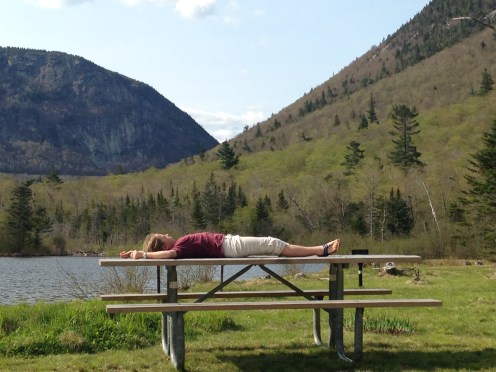
Yesterday, my daughters and I drove from Vermont and crossed over the White Mountains,  in a route I love and have travelled for years. This time, though, with a daughter’s friend, we stopped at a place in the mountains I’ve always rushed by, at fifty or sixty miles per hour. The point is near enough to the end (or, backtracking, to the beginning) of the trip that I’ve never wanted to pause.

In a meadow along the Sacco River, with enormous granite mountains steeply rising on either side, the area was exquisitely beautiful. The river flowed clear, clumps of bluets bloomed in the emerald grass, and the mountains held us like a pair of immense hands. In the bitter depths of winter, hail, snow, fiercely unrelenting winds pummel these slopes, but  this spring May afternoon, I remembered my childhood infatuation with Johanna Spyri’s little orphan Heidi.

As a mother, years later, when I read the book to my first daughter, I was appalled I had missed the heavy-handed Christian urging in this novel; this book was radically different from the book I had read over and over as a ten or eleven-year-old child. But was the book really different? What sang to me in the story was an orphaned child who loved her grandfather, a bed of fresh hay, the shimmering constellations, toasted cheese sandwiches and mountain meadows of wildflowers. Through her life’s circumstances, she experiences loneliness, cruelty, abject misery, and yet love of the mountains draws her beyond her own particular unhappiness: love of beauty and the inherent goodness in people is the staff of her strength.

Sanctimonious? Need not be.


But she had to go to bed first, and all night she slept soundly on her bed of hay, dreaming of nothing but of shining mountains with red roses all over them, among which happy little Snowflake went leaping in and out.

– Johanna Spyri, Heidi


IMG_1234

White Mountain National Forest, New Hampshire

Reading, Now and Then

Back when I was in high school, I copied Salinger’s Seymour Glass and wrote quotations on index cards and thumb-tacked the cards all around my desk. Some days, it feels like veritable centuries have passed since my high school days, and I’ve long since abandoned that practice. But every now and then, reading, I come across some of those lines I favored, and I’m often struck by how much I still admire whatever I was reading then.

What’s changed is me. What’s changed is that I no longer primarily understand with my head, but all the way down to the roots of my abscessed tooth, or twined around the scars of my caesarians, or in the pronounced veins on the backs of my hands.

Isn’t that one of the beauties of literature? Some places I’ve returned to from my childhood are far smaller and paler versions in my adult life than my memory held. But books? So many are infinitely better, this time around…..

We shall not cease from exploration, and the end of all our exploring will be to arrive where we started and know the place for the first time.

– T.S. Eliot

IMG_1224

Lake Elmore, Vermont


New Growth

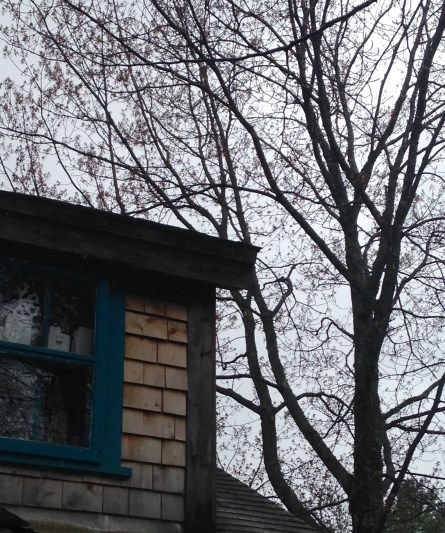
The maple tree before my house was seeded in this ragged lawn before I lived here, and it has grown steadily over these years. This beauty is likely much older than I’ve ever given her credit for. And yet here again, this May, her gnarled, lichen-covered branches are sprouting green again, with the tenderest of leaves.

I love that mystery; I love that rebirth; I love that change. One of my most favorite endings in a novel is Akhil Sharma’s Family Life, at once simple and exquisite, while throwing the reader back into the depths of the novel, the infinitely deep, living sea.

That was when I knew I had a problem.

– Akhil Sharma

FullSizeRender.jpg


What’s A Poem Worth?

Yesterday, someone said to me, why would people write a poems if they weren’t going to be paid for them?

That’s a gulch of perception I may never be able to cross. What is a poem worth, anyway?

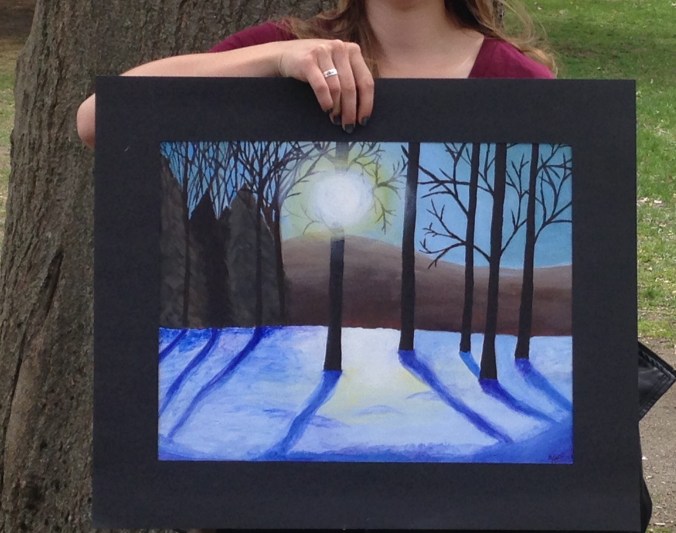
This morning in Montpelier, I attended an art show, where my daughter had a painting entered. In the opening remarks by Tom Greene, president of Vermont College of Fine Arts, he said creating art widens our experience and makes us more humane. I’m not sure that sentiment would have imprinted on me as an adolescent, but as an adult, far down in the cavernously lonely well of writing a second novel, those words shone like a bright beacon far above, a place I know – a place I continue to heads towards through the arduous work of writing.

What’s art worth? A truer question, perhaps, would be: how unimaginable our world would be without art.

"This is Just to Say"

I have eaten
the plums
that were in
the icebox

and which
you were probably
saving
for breakfast

Forgive me
they were delicious
so sweet
and so cold

– William Carlos Williams

FullSizeRender.jpg

artwork by Molly S.