Cutting Wood and Soul

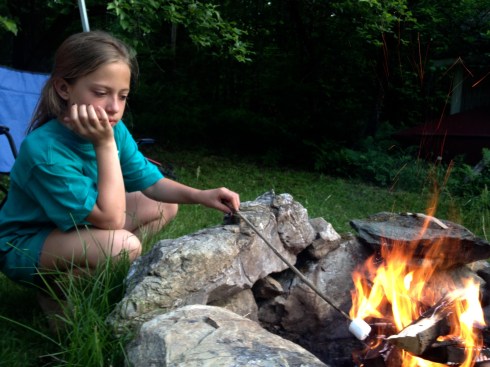
The first piece of writing I ever published that I made any kind of money from was titled “Maple,” and it was about the intense labor of cutting wood. As a family of sugar makers, for years we cut and split wood at far greater amounts than almost anyone else we knew. Particularly through my older daughter’s life, cutting, stacking, and hauling wood, has been a constant.

In that autobiographical essay, I wrote: “Perhaps it’s that Puritan streak driven so deeply in my soul, but I believe that living demands its toll: that creation is lockstep with destruction. As such, wood forms the crux of our life, the cycle of our turning days, months, years. And yet this rural life has also bequeathed my girl her wild wood.”

Today, undergoing yet more repair of a tooth broken twenty years ago when a piece of firewood fell from a pile stacked too high, I realized, again, our souls may be fierce, but we live and die by the body. It’s a marvel to realize something as small as tooth may do in a body. In the chair today, with my eyes closed, I smelled an antiseptic that reeked of bleach, and then…. cloves. Cloves? Exotically rich, sensual, nourishing. Could there be a greater juxtaposition?

The young endodontist showed me the film of my tooth, its root illuminated like a miniature splinter of lightning. In his pleasant, southern accent, he advised me to think good thoughts. I intend to. But I will also never stack wood higher than my shoulders again.

…When I was ten
we lived in a bungalow in Indianapolis…
Once I got up and went outside.
The trees-of-heaven along the track swam in white mist.
The sky arched with sickle pears.
Lilacs had just opened.
I pulled the heavy clusters to my face
and breathed them in,
suffused with a strange excitement
that I think, when looking back, was happiness.

Ruth Stone, from “What We Have”

IMG_1542

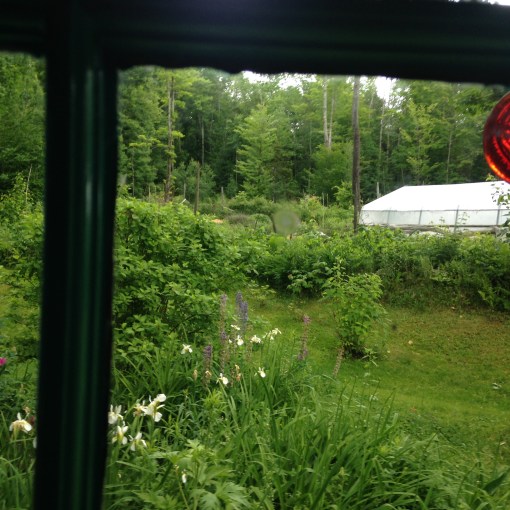
the kitchen window


Last night, I heard the poet Sydney Lea read at the Galaxy Bookshop in Hardwick, and he mentioned being in his seventies is a great time of life. In my forties, myself, I’m in that age justly called rugged – or is it ragged? The age of Dante’s dark woods, I tell myself: a territory to pass through. What’s the best age, anyway? The question begs, perhaps, how rooted we delve into the days we live. Maybe the best answer is Lea’s own, in this love poem.

“My Wife’s Back”

All naked but for a strap, it traps my gaze
As we paddle: the dear familiar nubs
Of spine-bone punctuating that sun-warmed swath…

…Phoebe, osprey, heron, hawk:

Marvels under Black Mountain, but I am fixed
On your back, indifferent to other wonders:
Bright minnows that flared in the shallows,

The gleam off that poor mink’s coat,
Even the fleas in its fur, the various birds
–The lust of creatures just to survive.

But I watch your back. Never have I wished more not to die.

– Sydney Lea

FullSizeRender

Woodbury, Vermont


Dear David Budbill

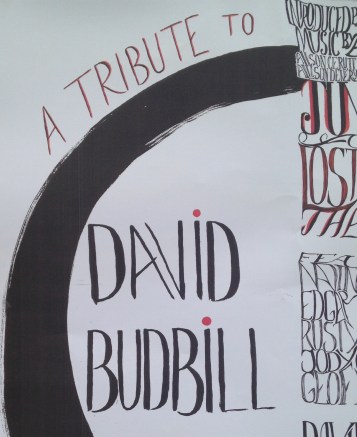
I laughed out loud and cried at David’s tribute, held by a ring of poets and actors on the stage where his work has been performed so many times. In the front row of the balcony, my friend and I talked about our children, and how our lives had shaken down. Later, driving home in the dark, up familiar route 12 I’ve driven so many times – with children, with friends, with family – now alone, not passing another car all those miles, save for an old Volvo station wagon that followed me out of Montpelier before turning off at a house with two lit windows.

Following the narrow sweep of my headlights, I thought of the final speaker’s words: from human suffering rises song. Thinking of David’s own kindnesses to me, and the great wealth of this man’s work and life, I followed those headlights like a unwinding stream of moonlight all the way home.

My children lay in their beds, sleeping. For the longest while, I stood on the balcony in the dark, listening to the frog’s steady chorus, rain falling lightly on my face, and then I, too, went inside and slept.

…These are not the rare and delicate lemon yellow day lilies
or the other kinds people have around their places. This one
is coarse and ordinary, almost harsh in its weathered beauty…

…A plant gone wild and therefore become
rugged, indestructible, indomitable, in short: tough, resilient,
like anyone or thing has to be in order to survive.

From “The Ubiquitous Day Lily of July” by David Budbill

FullSizeRender

Onamonapia

This afternoon, my 11-year-old daughter walked around the house saying 0namonapia,  over and over, desperately trying to drive her sister nuts, by repeating this beautiful word, richly rolling off her tongue.

Years ago I used to nurse this child at the farmers market where my then-husband and I sold maple syrup. One afternoon, I nursed my baby on the grass behind our tent, leaning up against a pole. A couple sat down somewhat near me, in the shade beneath a poplar tree. Eating, they casually spoke in a slavic language I didn’t recognize. I generally knew they were talking about the day, but I couldn’t really piece together much more than that.

My baby fell sleep, and I pulled a blanket over her soft little limbs, then leaned my head back against the pole and closed my eyes. While the couple kept eating and talking, I listened to their words, this beautiful language I couldn’t precisely understand, but I knew the language tied them together.

Surely, 0namonapia relays much more than cluck or moo. This is a word whose meaning can stretch to entire languages: an audible beauty that makes us human.


The Bells

Hear the sledges with the bells—
Silver bells!
What a world of merriment their melody foretells!
How they tinkle, tinkle, tinkle,
In the icy air of night!

– Edgar Allen Poe

FullSizeRender

sweater weather in June Vermont


Tools of the Trade

I stumble spelling the same handful of words, stupidly over and over. Fuchsia. Schedule. Traveling.  As good, serviceable words, I use them repeatedly, and yet I always catch myself just for an instant. How do those consonants line up in schedule, anyway?

I imagine a surgeon has terminology, methodologies, sterilized silver, to utilize in her trade. Writers weld words with the subtlest shades of meaning: fuchsia in a hanging plant, profusely blossomed; or fuchsia I wrote about this morning, the color of a woman’s silk blouse and hazily diffuse through an unwashed convenience store window, filtered through a storm of twisting snowflakes.

Roseate. Coral. Magenta. Cerise. Bloodshot. Ruby.

Red is the color of blood, and I will seek it:
I have sought it in the grass.
It is the color of steep sun seen through eyelids….

– Conrad Aiken

IMG_1333.JPG

Hardwick, Vermont

In my weekly commute to Burlington, some mornings I hit traffic, and some mornings I don’t. Today, waiting in a long line, I listened to Garrison Keillor read poetry.

“Despair” by Billy Collins

So much gloom and doubt in our poetry—
flowers wilting on the table,
the self regarding itself in a watery mirror….

Today, with the sun blazing in the trees,
my thoughts turn to the great
tenth-century celebrator of experience,

Wa-Hoo, whose delight in the smallest things
could hardly be restrained…..

Sitting alone in my little Toyota, I laughed out loud.

It’s the fragrant apple blossom season in Vermont. Dandelions are rampantly blooming. My teenager daughter texts me at work of her misery, the stark unfairness of the world. Of course, I text back, but go for a run. The ten-year-old skips on our evening walk. I’m just so happy, and I don’t know why.

How many decades has it taken me to relearn what I knew when I was ten? And to laugh about it? The black flies are out and biting fiercely, but the sparrows are singing mightily.

FullSizeRender.jpg