Onamonapia

This afternoon, my 11-year-old daughter walked around the house saying 0namonapia,  over and over, desperately trying to drive her sister nuts, by repeating this beautiful word, richly rolling off her tongue.

Years ago I used to nurse this child at the farmers market where my then-husband and I sold maple syrup. One afternoon, I nursed my baby on the grass behind our tent, leaning up against a pole. A couple sat down somewhat near me, in the shade beneath a poplar tree. Eating, they casually spoke in a slavic language I didn’t recognize. I generally knew they were talking about the day, but I couldn’t really piece together much more than that.

My baby fell sleep, and I pulled a blanket over her soft little limbs, then leaned my head back against the pole and closed my eyes. While the couple kept eating and talking, I listened to their words, this beautiful language I couldn’t precisely understand, but I knew the language tied them together.

Surely, 0namonapia relays much more than cluck or moo. This is a word whose meaning can stretch to entire languages: an audible beauty that makes us human.


The Bells

Hear the sledges with the bells—
Silver bells!
What a world of merriment their melody foretells!
How they tinkle, tinkle, tinkle,
In the icy air of night!

– Edgar Allen Poe

FullSizeRender

sweater weather in June Vermont


Tools of the Trade

I stumble spelling the same handful of words, stupidly over and over. Fuchsia. Schedule. Traveling.  As good, serviceable words, I use them repeatedly, and yet I always catch myself just for an instant. How do those consonants line up in schedule, anyway?

I imagine a surgeon has terminology, methodologies, sterilized silver, to utilize in her trade. Writers weld words with the subtlest shades of meaning: fuchsia in a hanging plant, profusely blossomed; or fuchsia I wrote about this morning, the color of a woman’s silk blouse and hazily diffuse through an unwashed convenience store window, filtered through a storm of twisting snowflakes.

Roseate. Coral. Magenta. Cerise. Bloodshot. Ruby.

Red is the color of blood, and I will seek it:
I have sought it in the grass.
It is the color of steep sun seen through eyelids….

– Conrad Aiken

IMG_1333.JPG

Hardwick, Vermont

In my weekly commute to Burlington, some mornings I hit traffic, and some mornings I don’t. Today, waiting in a long line, I listened to Garrison Keillor read poetry.

“Despair” by Billy Collins

So much gloom and doubt in our poetry—
flowers wilting on the table,
the self regarding itself in a watery mirror….

Today, with the sun blazing in the trees,
my thoughts turn to the great
tenth-century celebrator of experience,

Wa-Hoo, whose delight in the smallest things
could hardly be restrained…..

Sitting alone in my little Toyota, I laughed out loud.

It’s the fragrant apple blossom season in Vermont. Dandelions are rampantly blooming. My teenager daughter texts me at work of her misery, the stark unfairness of the world. Of course, I text back, but go for a run. The ten-year-old skips on our evening walk. I’m just so happy, and I don’t know why.

How many decades has it taken me to relearn what I knew when I was ten? And to laugh about it? The black flies are out and biting fiercely, but the sparrows are singing mightily.

FullSizeRender.jpg

Now, Stop & Admire the Scenery, for a Change

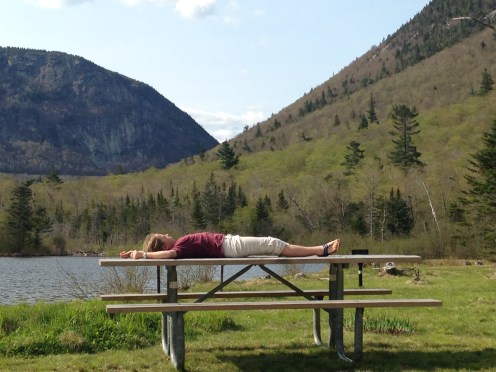
Yesterday, my daughters and I drove from Vermont and crossed over the White Mountains,  in a route I love and have travelled for years. This time, though, with a daughter’s friend, we stopped at a place in the mountains I’ve always rushed by, at fifty or sixty miles per hour. The point is near enough to the end (or, backtracking, to the beginning) of the trip that I’ve never wanted to pause.

In a meadow along the Sacco River, with enormous granite mountains steeply rising on either side, the area was exquisitely beautiful. The river flowed clear, clumps of bluets bloomed in the emerald grass, and the mountains held us like a pair of immense hands. In the bitter depths of winter, hail, snow, fiercely unrelenting winds pummel these slopes, but  this spring May afternoon, I remembered my childhood infatuation with Johanna Spyri’s little orphan Heidi.

As a mother, years later, when I read the book to my first daughter, I was appalled I had missed the heavy-handed Christian urging in this novel; this book was radically different from the book I had read over and over as a ten or eleven-year-old child. But was the book really different? What sang to me in the story was an orphaned child who loved her grandfather, a bed of fresh hay, the shimmering constellations, toasted cheese sandwiches and mountain meadows of wildflowers. Through her life’s circumstances, she experiences loneliness, cruelty, abject misery, and yet love of the mountains draws her beyond her own particular unhappiness: love of beauty and the inherent goodness in people is the staff of her strength.

Sanctimonious? Need not be.


But she had to go to bed first, and all night she slept soundly on her bed of hay, dreaming of nothing but of shining mountains with red roses all over them, among which happy little Snowflake went leaping in and out.

– Johanna Spyri, Heidi


IMG_1234

White Mountain National Forest, New Hampshire

Reading, Now and Then

Back when I was in high school, I copied Salinger’s Seymour Glass and wrote quotations on index cards and thumb-tacked the cards all around my desk. Some days, it feels like veritable centuries have passed since my high school days, and I’ve long since abandoned that practice. But every now and then, reading, I come across some of those lines I favored, and I’m often struck by how much I still admire whatever I was reading then.

What’s changed is me. What’s changed is that I no longer primarily understand with my head, but all the way down to the roots of my abscessed tooth, or twined around the scars of my caesarians, or in the pronounced veins on the backs of my hands.

Isn’t that one of the beauties of literature? Some places I’ve returned to from my childhood are far smaller and paler versions in my adult life than my memory held. But books? So many are infinitely better, this time around…..

We shall not cease from exploration, and the end of all our exploring will be to arrive where we started and know the place for the first time.

– T.S. Eliot

IMG_1224

Lake Elmore, Vermont


New Growth

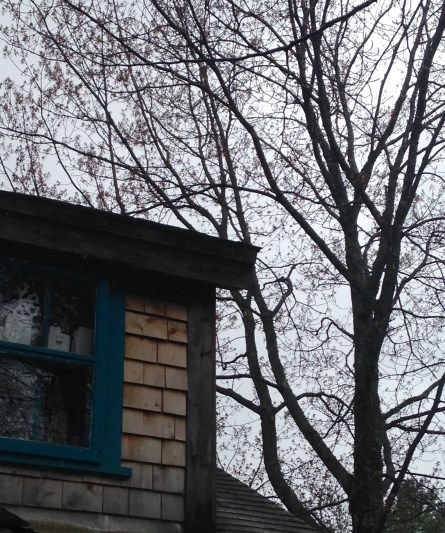
The maple tree before my house was seeded in this ragged lawn before I lived here, and it has grown steadily over these years. This beauty is likely much older than I’ve ever given her credit for. And yet here again, this May, her gnarled, lichen-covered branches are sprouting green again, with the tenderest of leaves.

I love that mystery; I love that rebirth; I love that change. One of my most favorite endings in a novel is Akhil Sharma’s Family Life, at once simple and exquisite, while throwing the reader back into the depths of the novel, the infinitely deep, living sea.

That was when I knew I had a problem.

– Akhil Sharma

FullSizeRender.jpg