Art? Why?

Yesterday, while the 12-year-old girls swam in Greensboro’s perfectly clear Lake Caspian, I read on the beach, just me and a few gulls, a pair of kayakers pushing off. An older woman wandered down and waded into the water and said only kids could swim in that water, and then left, too. The girls had swam out and were experimenting with laughing underwater.

Later, we went to Bread and Puppet’s outdoor theater, sprawled in the hot sun. Coming home, the girls swam again, while I eavesdropped on a pleasant conversation between our former pediatrician, his wife, and friends.

I kept thinking, What does art matter, anyway?, all this barefoot and Blundstone-shod performance in the field? What does poetry, fiction, song, mean, anyway? The more I thought, I wondered if my question was wrong, if the answer lay in who was listening, like myself listening to those 12-year-old girls. Maybe art is like that a cappella hymn, voices raised in harmony and confidence, to the variated audience, the shape of the earth, the enormous pine trees, and all that sky, blue and shifting with clouds, over field and forest, highways and water, on and on, and on.

Maybe my question, like a koan, holds the answer.

A painter should begin every canvas with a wash of black, because all things in nature are dark except where exposed by the light.

– Leonardo da Vinci

IMG_1758

Crossing Open Water

My canoeing experience, while somewhat lengthy, has always been confined to summery, pleasurable afternoons, on Vermont’s still lakes and ponds, often with swimming and almost always with kids. Only once, on my honeymoon, did I worry our canoe might flip.

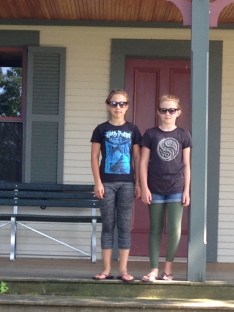
Oddly, I found myself on nearly those same waters in Lake Champlain this weekend, worrying again if I might roll the canoe. While the two cheerful and sunglasses-wearing 12-year-old girls waited for the ferry, I headed out to an island with a canoe loaded low with camping gear, not looking closely at the lake – a very large lake – rough with wind, torn up with the furled wakes of motorboats.

After I spun around, I gave myself a rapid crash course in reading the water washing near the low sides of my canoe, keeping my prow headed into the waves – those long curls might have delighted me swimming near the shore but frightened me with all this water around. The silver ferry passed by with my smiling girls, waving merrily in the sunlight.

On the return leg of the journey, after a few days of bicycling and card playing on an island magical with fiery sumac and twining vines, the water lay invitingly still, just me and the ducks and few gulls cavorting overhead.

It was then, on that crossing, that I remembered the children’s father and I had paddled in a rainstorm to this same stretch of beach, from an island further out, in a canoe we had borrowed from his parents that had no lifejackets. In a different version of my life story, I would have taken the ferry with the girls and he would have rowed the canoe – much stronger than myself and far savvier at reading wind. He would not have gotten stuck on the far side of the island as I did, and struggled against the current to round the rocky edge.

As I rowed, the lake lifted against my old red fiberglass boat, all that deep blue water, stretching far further than I could imagine, filled with darting fish and frond-waving plants, the shale-splintery islands, boats with white sparkling sails, sunlight profuse, with sunken ships and ancient fossils. I had been reading David Hinton’s The Wilds of Poetry, filled with narrative and a collection of stunning poems, from Rexroth to Robinson Jeffers, a stonemason apprentice who built his house at Carmel-by-the-Sea, all about motion and change. Kismet reading for sleeping on an island. I imagined how the gulls might see me, a small woman with a braid and a wooden oar with a broken handle, rowing home with a basket of dirty clothes, crumbles of crackers, softening cheese, a coffee pot and an unfinished sweater on knitting needles. I could not have wished to be anywhere else than there.

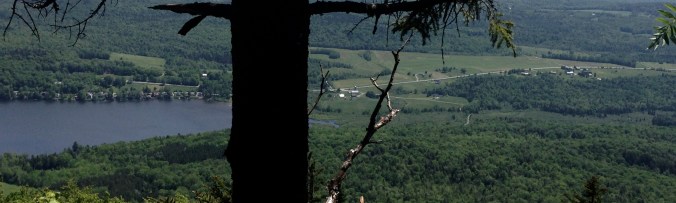
On the mainland again, I unloaded the canoe and walked along the high bluffs, waiting for the ferry. The wind was picking up then, and the day, the first of August, was bright with promise. The grass could not have been greener. I read the heartbreaking memorial marked for the boys who had died in the Second World War and then leaned against a bent cedar tree, one small woman in a landscape beyond time, myself just one living piece of its infinity.

When I met the ferry, its captain asked if the two girls alone were mine. Yes, indeed, I said and walked onto the rattling gangplank to greet them.

I have tried to write Paradise

Do not move
Let the wind speak
that is paradise.

Ezra Pound, from Cantos in Hinton’s The Wilds of Poetry: Adventures in Mind and Landscapes
IMG_1490

Memorable Days

27 years ago, my oldest nephew was born. I was visiting his great-grandparents on that day. I had recently entered that family, and I was on my very best, most sparkling, ready-to-please behavior. His great-grandfather walked me around his property, pointing with pride to the peach trees. Elderly and ill, a minister by trade, he remarked he wouldn’t be around long to savor that fruit, but someone else would.

I was 22 then, fresh out of college, naive and deeply in love. I’ve thought back often over these years to his comment about those peach trees, and how much those words summed up that man’s life. Even then, hardly beyond childhood myself, I wanted that equanimity.

A few years later, after his death, and his wife was moved to Vermont to live nearer her two daughters, someone else bought the house and cut down those fruit trees. That, I suppose, is a whole different philosophy. It’s not mine to suppose what he would have made of that action, but it’s a question I’ve pondered, whose answer I’ll never receive.

A little girl under a peach tree,
Whose blossoms fall into the entrails
Of the earth.

– Basho

FullSizeRender.jpg

Suddenly Summer!

One of the sarcastic and not-to-be-imitated jokes in our family is the phrase “Love Wins,” overused by a few people we know. Sitting on the stairs talking late last night, we mutter at each other Love wins.

What’s the battle anyway? And who are the footsoldiers?

Already passing the solstice, Vermont summer is cacophonious around us: the rhododendrons shed their petals as the iris beside them blaze up in violet splendor. Pulling into the driveway after work yesterday, the 12-year-olds leap on the trampoline, laughing, hair static-splayed.

Summer’s desire – love of summer – rampages. No winner and losers here, the season spreads on, with curling morning glory vines, Budbill’s ubiquitious day lily, robin’s eggs sucked dry by a predator. These dewy, sunny mornings.

…This (lily)
is coarse and ordinary, almost harsh in its weathered beauty,
like an older woman with a tough, worldly-wise and wrinkled
face….

David Budbill, The Ubiquitous Day Lily of July

FullSizeRender.jpg

And Even Heavier Lifting….

Not two white knights, but two women in Subarus showed up at my house last night to move cardboard boxes of books, wrap dishes, pull pictures from walls. My troops arrived, complete with olive bread and cheese, with enthusiasm and laughter, with encouragement for my daughter who is graduating today from high school.

No woman is an island. Could I remember this more frequently? I could not have moved in these handful of days without your help; I’d be moving boxes and beloved pieces of kid-made pottery for weeks, like a solitary ant toiling, moving sand grain by grain. Thank you, again, for reminding me of the steady earth behind my feet.

No man is an island,
Entire of itself,
Every man is a piece of the continent…

– John Dunne

FullSizeRender


Hefty Lifting

In my first pregnancy, I developed a fear of the transition phase of labor. Even without experiencing labor, I knew that would be my point of trial and terror. As it turned out, that so dreaded transition was but a moment or two. I had my single place of easy breathing. I looked at an analog clock, the time of 3:14 pm lodging in my memory. Sunlight streamed through an enormous window.

Moving, as Ben Hewitt once told me, sucks. As usual, Ben is succinct and dead-on right. Moving is the transition phase I dreaded in labor, the leaving one place and not-yet-in-another.

In days of acute stress, like the times my former husband was arrested, I wrote notes to guide myself through days – call this person or buy coffee, but also fragments of dialogue, or the state’s attorney’s ironed, lavender shirt – anchoring those moments in my notebook, hungry writer that I am, to return to that time later, when the miasma dissipated, and glean.

I want people who write to crash or dive below the surface, where life is so cold and confusing and hard to see.

Your anger and damage and grief are the way to the truth.

– Anne Lamott, Bird By Bird

FullSizeRender