“Everything blooming bows down in the rain…”

We make the trek again to Dartmouth for a surgical consult, the sign-off after surgery. I’ve met numerous members of this team, but not this kind NP, who’s read my history and says, What an ordeal. I’m not expecting these words, and I pause. Last November, when was I first admitted to Dartmouth, I had unplanned surgery. That snowy November night, the surgeon spent so much time with me. Then her Fellow returned and answered my endless questions. In May, I had surgery again. Two bookends – that November night and this sultry summer day. I’ll be treated here for years, but my hope – and none of know squat about the future – is that I’ll never need a surgeon again.

I thank her and the surgical team and student entourage who appeared in all those ER and hospital floor rooms where I stayed – me, the reluctant patient, who tried to negotiate some other outcome than surgery. To my surprise, she’s grateful for my words, too. We try our best but it’s hard to know how we come across to patients. The surgeons who operated on me are trauma surgeons. My surgery was routine, but routine surgeries go south. Mine did not.

Afterwards, my daughter and I stop at Dartmouth College’s Hood Museum. There’s a Georgia O’Keefe painting we want to see and two Monets. The current exhibit has mesmerizing photographs. This is a good day and a good visit. We eat sandwiches in King Arthur Flour’s patio, where so many families have pudgy babies tucked into a parent’s arm. We linger, talking about my mother who would have loved eating here.

So many of those drives on the interstate home, I slept, nodding in and out of conversation. My weak days are long passed, and we keep talking, the interstate edging near the Connecticut River and up on the ridge again. In June’s green, the drive no longer seems so desolate. Traffic here is always sparse. We pass a trailer of hay bales, a pickup with three wheelbarrows.

Enduring cancer turned my world (and my family’s world) inside out. In the first five-day continuous course of chemo, I forced myself to wash every morning. In those days, my hair had not yet fallen out. I was too weak to brush my hair, so I tied it at the nape of my neck. That month, my daughter cut what snarled hair remained. Those miserable uncertain November mornings, how grateful I was for hot water and soap, to have access to a brutal but hugely effective treatment, in a sterile hospital in one of the richest states in a phenomenally country. I made my choices, but I had choices.

In the inside-out world where I am now, I’m ticking through my list: profusely thank my oncologists and surgeons for saving my sometimes-surly life, tend my garden, figure out my youngest’s college bill, finish my book, accept the ravenous roaming woodchucks….. my domestic realm.

In our little end-of-the-road neighborhood, visitors come and go on my back deck, gardens on three sides, the wild pressing in on the fourth. My own nexus.

Everything blooming bows down in the rain:

white irises, red peonies; and the poppies

with their black and secret centers

lie shattered on the lawn.

~ Jane Kenyon

Dazzling light.

Here’s the weird thing about this March: cabin fever is not a thing. March has always marked the time of year when snow and cold has piled unrelentingly on us for veritable months. Not so, this warm year. But climate change does squat for the dearth of light, and certainly nothing for the dissatisfaction that’s creeping into our social consciousness. I am a woman who craves the planetary might of blooming crocuses, the radiant headiness of a forest strewn with spring beauties, the serene hover of a bee tucked into a downy apple blossom. Patience, patience.

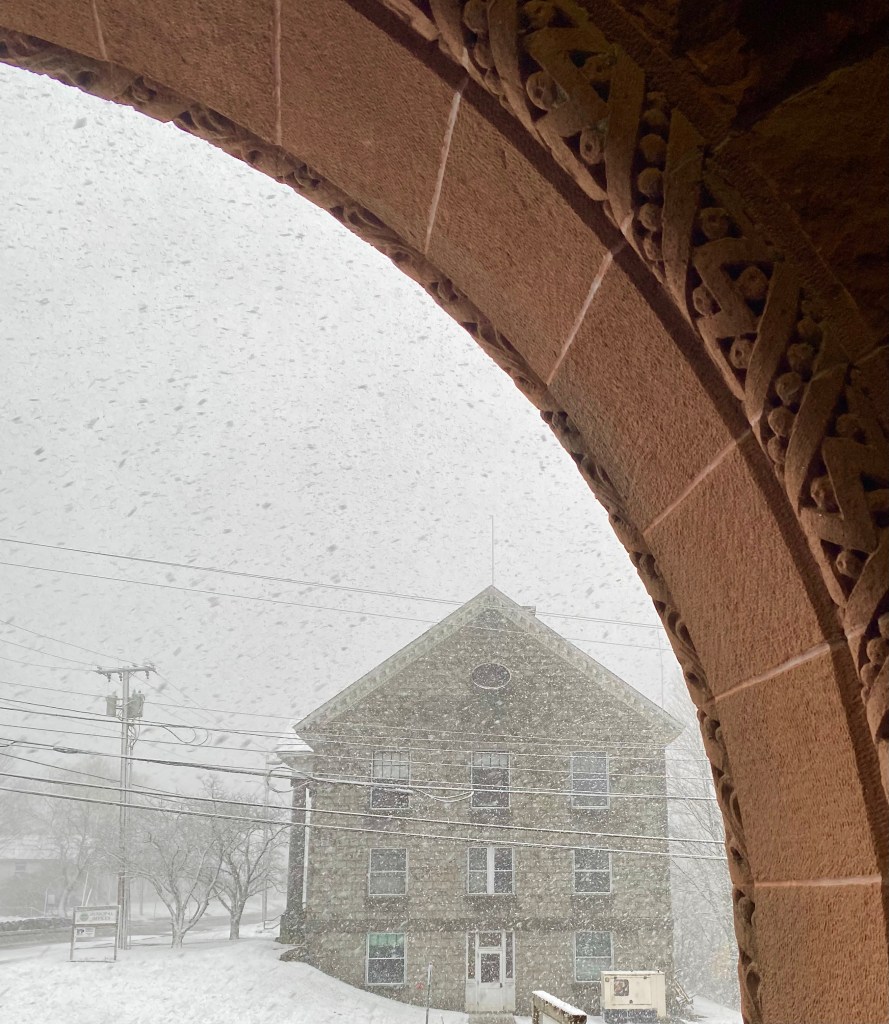
Walking home from the library, a sudden snowfall drenches my eyelashes.

On this early morning, poetry:

Strewn

It’d been a long winter, rags of snow hanging on; then, at the end

of April, an icy nor’easter, powerful as a hurricane. But now

I’ve landed on the coast of Maine, visiting a friend who lives

two blocks from the ocean, and I can’t believe my luck,

out this mild morning, race-walking along the strand.

Every dog within fifty miles is off-leash, running

for the sheer dopey joy of it. No one’s in the water,

but walkers and shellers leave their tracks on the hardpack.

The flat sand shines as if varnished in a painting. Underfoot,

strewn, are broken bits and pieces, deep indigo mussels, whorls

of whelk, chips of purple and white wampum, hinges of quahog,

fragments of sand dollars. Nothing whole, everything

broken, washed up here, stranded. The light pours down, a rinse

of lemon on a cold plate. All of us, broken, some way

or other. All of us dazzling in the brilliant slanting light.

— Barbara Crocker

Song against Reductionism.

A pretty wet snow covers our muddy world — temporarily, for sure, a grace of sugar snow in a long mud season. Early March, and I’m already hanging the laundry out to dry, the pale green nubs of perennial bulbs pushing up through matted debris of last year’s leaves, broken twigs.

On a warm afternoon, I put the snow shovel away — my usual blind enthusiasm about spring! I’m the woman who rails against reduction, that the world can be defined as this or that. This world is nothing but gray, an unending smear of thaw and freeze. And yet, I’m wrong about that, too. Daily, the bird chorus gains, the winged creatures flocking in the box elders in the ravine behind my house, feasting at the feeder in the mock orange.

A poem from the late David Budbill:

“What Issa Heard”

Two hundred years ago Issa heard the morning birds

singing sutras to this suffering world.

I heard them too, this morning, which must mean,

since we will always have a suffering world,

we must also always have a song.

Birthday Cake.

March 7 is my father’s 87th birthday. My daughter, the oldest grandchild, visited my parents a few days ago and asked what to do for my parents’ birthdays. Cake and flowers. And be sure to eat the whole cake.

At town meeting, on the fly, I had to add a few numbers, tally a total. Writing with my pencil, the 100 or so audience members looking at me, I thought of those childhood evenings when I handed my dad an algebra or calculus problem and asked for help. He always made me sharpen my pencil, align the numbers so the problem made sense, and exhibit some respect for mathematics, please. These three things have stuck with me my entire life.

Every year on my father’s birthday, I think of this Hayden Carruth poem. My father — a man who taught his kids about Arkhipov Day and Ancient Greek philosophy, and spent so many nights in the desert, playing cards with his kids at a picnic table lit by a battery lamp….

Birthday Cake

For breakfast I have eaten the last of your birthday cake that you
had left uneaten for five days
and would have left five more before throwing it away.
It is early March now. The winter of illness
is ending. Across the valley
patches of remaining snow make patterns among the hill farms,
among fields and knolls and woodlots,
like forms in a painting, as sure and significant as forms
in a painting. The cake was stale.
But I like stale cake, I even prefer it, which you don’t
understand, as I don’t understand how you can open
a new box of cereal when the old one is still unfinished.
So many differences. You a woman, I a man,
you still young at forty-two and I growing old at seventy.
Yet how much we love one another.
It seems a miracle. Not mystical, nothing occult,
just the ordinary improbability that occurs
over and over, the stupendousness
of life. Out on the highway on the pavement wet
with snow-melt, cars go whistling past. 
And our poetry, yours short-lined and sounding
beautifully vulgar and bluesy
in your woman’s bitterness, and mine almost 
anything, unpredictable, though people say
too ready a harkening back
to the useless expressiveness and ardor of another
era. But how lovely it was, that time
in my restless memory.
This is the season of mud and thrash, broken limbs and crushed briers
from the winter storms, wetness and rust,
the season of differences, articulable differences that signify
deeper and inarticulable and almost paleolithic
perplexities in our lives, and still
we love one another. We love this house
and this hillside by the highway in upstate New York.
I am too old to write love songs now. I no longer
assert that I love you, but that you love me,
confident in my amazement. The spring
will come soon. We will have more birthdays
with cakes and wine. This valley
will be full of flowers and birds.

‘Soon it will be the sky of early spring…’

Wild February!

At noon, I stand talking to the road crew in a sparkling snowfall. I wax on about the prettiness of snow on the emerging earth. The crew, who’s endured the strange vagaries of mud season in December, the fickleness of Vermont’s winter weather made weirder by climate change, humor me with a nod.

Fifty degrees and rain forecasted for today, followed by more, followed by bitter cold, then rain and wind, the sun I lean towards…. Late winter, again, and I remember when I could distinguish the years: the spring we boiled sap from March 1 to the 31st. The year we made 540 hard-earned gallons, two of us and a five-year-old, and I wore through three pairs of gloves carrying in wood and feeding the arch.

Walking around my snow-scattered garden, I envision where I will plant the bare root Japanese lilac I’ve ordered, for me or someone else to admire and love. The path down to my compost is both icy and soft mud, the conundrum of winter reluctantly losing its teeth to spring. The true joy is the inevitability, the earth’s order to proceed from twinkling snowflake to downy crocus, the planet’s sheer opinionlessness regarding skunks and black flies.

The road crew and I kick around a few more pithy remarks about government corruption, and then we head along….

From my one of my favorite Louise Glück poems, March:

The sea doesn’t change as the earth changes;
it doesn’t lie.
You ask the sea, what can you promise me
and it speaks the truth; it says erasure.

Finally the dog goes in.
We watch the crescent moon,
very faint at first, then clearer and clearer
as the night grows dark.
Soon it will be the sky of early spring, stretching above the stubborn ferns and
violets.

The true religion, the religion of snow…

I stand at my kitchen’s glass door devouring blood oranges and watching the sifting snow. Blood oranges — could I choose a less local delight? I open the door and cast out the peels for the birds.

The cat Acer sits on my feet, listening to the morning radio news, too. Just over the river, my home state New Hampshire revels in the Presidential primary. Meanwhile, Vermont prepares for its March Town Meeting Day, with the calculations and passion of budgets and petitions. Close an elementary school? Pledge to become a pollinator-friendly town? So much of January in my state is devoted to public meetings and discussion/debate, to a reckoning of the way forward, a jostling for who’s running for what seat — and what seats might remain empty.

Meanwhile, snowy winter has finally arrived, spare and elegant. Fearsome and enchanting. As the days deepen in cold, the light hours increase: no stasis in this world.

A fan of local chicken, bacon, milk, my cat stares at my orange-sticky fingers with disdain. I crunch the orange seeds, too, devouring this sunlight sweet.

Here’s Billy Collins’ poem about shoveling snow with the Buddha:

[Shoveling snow] is so much better than a sermon in church,
I say out loud, but Buddha keeps on shoveling.
This is the true religion, the religion of snow,
and sunlight and winter geese barking in the sky,
I say, but he is too busy to hear me.