Home/Place

My our tiny place on the planet is reveling in summeresque weather; I write this, knowing days are not far off when our collective Vermont shoulders will brace against the polar vortex. Meanwhile, the sweet warm air brims with dragonflies and fluttering insect life galore.

If there’s one theme – for what that word may be worth – that might struggle up to the surface of my writing life, it’s likely interconnectedness. So many of the bad decisions I’ve made have stemmed from my own blind ignorance – not understanding how this led to that and why this other thing was a factor, too. Years ago, when I first started college, a professor very simply pointed out that some things we can see with our eyes, and some things we can’t, but that doesn’t make those unseen things any less real.

When my daughters and I talk about the hurricane season roaring in, far from us, or Trump’s public words about Charlottesville, I find myself saying I don’t know, surrounded by the vastness of these things. Begin with questions, I keep reminding my girls and myself. Questions are a real place, too.

Here’s one of the ending paragraphs from this fine book:

I wanted to try to write a book about poverty that didn’t focus exclusively on poor people or poor places. Poverty was a relationship, I thought, involving poor and rich people alike. To understand poverty, I needed to understand that relationship. This sent me searching for a process that bound poor and rich people together in mutual dependence and struggle. Eviction was such a process.

– Matthew Desmond, Evicted: Poverty and Profit in the American City

FullSizeRender.jpg

Where We Live, Hardwick, VT


In a Darkened Theater

This week, I interviewed an author who had written what seemed to me the odd choice of a childhood memoir-in-verse, but she explained she chose that form because memory comes and goes in bits, not separated into blocky and linear chapters and paragraphs.

I kept thinking of her words yesterday, separated from a sunlight-sparkling autumn day in a second-floor opera house theater, as I listened to trains whistling through town. The warning calls punctuated a very adult conference about children’s literature, and my attention kept straying to those mournful sounds as the trains chugged their slowed way through town. Like a fishing hook, the notes pulled up my memories, reminding me that the last time I had been in White River Junction was three years ago, myself and my family riding through on Amtrak, looking through the windows at this brick-building Main Street and wondering who lived here.

At the conference’s end, impatient to leave and return to my own life, to hurry home along the interstate flanked by maples turning red, a woman read aloud a children’s book I had heard as very young child. I put down the sweater I was knitting and just listened to the words, familiar from long ago. The train whistles kept calling: a collage of memory.

You think your pain and your heartbreak are unprecedented in the history of the world, but then you read. It was books that taught me that the things that tormented me most were the very things that connected me with all the people who were alive, who had ever been alive.

– James Baldwin

Dinner Prep

Just before the twin towers were destroyed in New York City, we moved into a new kitchen we had built on one side of our house. Our old kitchen had a single window. The new kitchen was its own ell, with three walls of windows, the true gem of that house.

I remember washing Red Russian kale leaves in a white enamel sink we had scavenged from somewhere, mesmerized by the sunlight over my hands, and how the kale spines flashed silvery like minnows under the water. I was listening to NPR and staring at my garden’s kale as if I had never seen it before.

Soil in that garden later became contaminated with clubfoot, and I ceased planting brassica. Transplanted healthy plants miserably withered and died within a few weeks, and none of my remedies worked. Now, miles away in this new garden patch, snipping my first kale leaves, I thought of that afternoon so many years ago, with my toddler daughter tricycling around the kitchen, surrounded by sunlight streaming over freshly stained pine, the only adult in the house listening to the radio, wondering what would happen.

The thief left it behind:
the moon
at my window.

– Ryokan

IMG_1920.JPG

This.

There’s a place in Maughm’s Of Human Bondage where the main character, Philip Carey, sits down and eats dinner with a family in a London tenement. Although I haven’t read this section in years, it stuck with me, because Carey eats happily with the family, no longer squeamish about accepting food cooked in less than pristine conditions. Not so many years ago, I might have written what Carey learned was “humility.” Perhaps. But maybe he had been hungry often enough in his life to appreciate company and shared food, and had no fear about poverty’s uncleanliness.

I first read this novel when I was 22. I was living in a downtown Brattleboro apartment where a running box fan fell out of our second-floor window to the sidewalk below, and, by fate’s luck, missed pedestrians on that busy Friday sidewalk. Paired up with Walden, these two dissimilar books have become the books of my adult life.

Sitting in the Washington County Courthouse, where I have become a known woman, I thought of clubfooted Philip Carey, knocking around poor and rainy London, homeless at times, desperate to become a doctor. It was fitting to think of him, in that enormous and ugly building, filled with an apparently ceaseless flow of human misery. What would be the point of all this, really, if you didn’t pass through, and, on the other side, cherish pulling up a chair and eating with others, no matter what the circumstance?

He was always seeking for a meaning in life… He seemed to see that a man need not leave his life to chance, but that his will was powerful; he seemed to see that self-control might be as passionate and as active as the surrender to passion; he seemed to see that the inward life might be as manifold, as varied, as rich with experience, as the life of one who conquered realms and explored unknown lands.

– W. Somerset Maugham

FullSizeRender.jpg

Depths of Domesticity

In a cold rain, my teenager heads out to the barn in search of a saw and a just-right piece of wood, then disappears upstairs with her wood-burning tool. The younger girl spreads between the kitchen table and oven, baking mini-eclairs.

Not so long ago, the girls were toddlers, with me trailing behind, frazzled and tired.  While I believed they were so needy as little girls, I was likely wrong, caught up in our society’s crazy ideas of overparenting. Even then, my girls were writing their own stories, learning the ways of the world – beginning with nursing (and more nursing and yet more nursing), with skinned knees and bruised shins, with making friends, once sharing stories about a beloved stuffed Piglet and now trading their own girl secrets.

While I’m in the dining room, in my own writing world, my daughters are writing and rewriting their own lives. Toddlerhood is darling, but this is cool, too.

How do you begin to tell your own story?

Jacqueline Woodson, Another Brooklyn

FullSizeRender


Sunday Evening

Every year at at this point in the summer – just about at the end – I have an almost insatiable desire to lie down and take a nap. Between work, kids home from school, and trying to cram in as much warm weather happiness as possible (like an evening swim), the days arc all the way through dusk, and the nights, so long in winter, are still brief.

I’m not complaining; black winter nights will press in soon enough, and we’re still in the rowdy cricket circus.

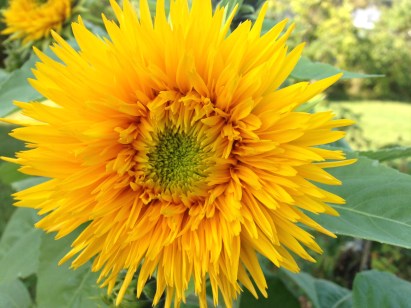
Today, visiting High Mowing Seeds, my daughter and I walked through fields of all-sized sunflowers, happy marigolds, delicately fragrant sweet peas in shades from pale pink to nearly black. This is Vermont’s summer apex: parents worn out, surrounded by unsurpassable beauty.

You got to understand: here
Winter stays six months a year—
Mean, mean winters and too long.
Ninety days is what we get, just

Ninety days of frost free weather….

From David Budbill’s “Summer Blues”
FullSizeRender.jpg