There is No Such Thing as Atheism.

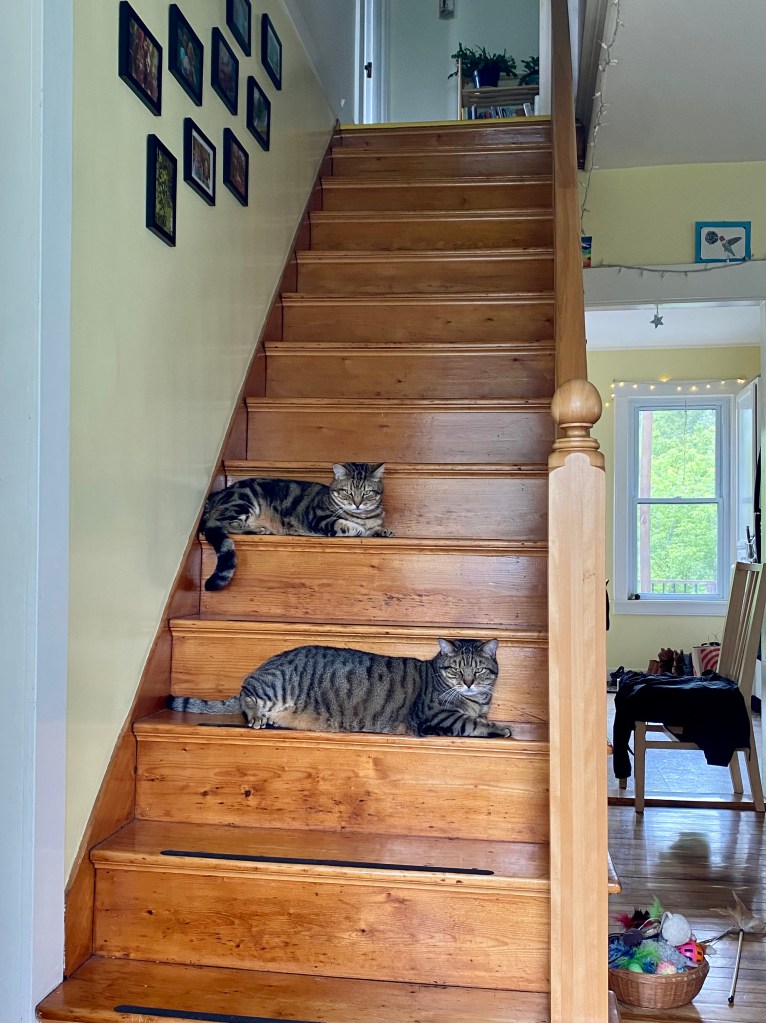
One of my favorite parts of our house is the small glassed-in porch at the bottom of the stairs, just large enough for two small loveseats. In this high school graduation weekend, we’ve spent a lot of time hanging out, talking, talking, the weather alternately switching from cold rain to sparkling sun. The cats sequestered themselves on the stairs while my daughter’s dog lingers around her feet. The dog wants to play. The cats cherish their dignity. The humans hover around this heartfelt drama.

Graduation and its platitudes… and yet the moment is such a pivot point, a marker between childhood and what will (god willing) be a very long haul of adulthood. Unplanned, the day spans the present, old friends I haven’t seen in years, and ends with a chess game with my brother at the kitchen table. Graduation isn’t weekend to solve anything, fix out the phone bill or shore up the back deck.

On this graduation weekend… the best commencement speech I’ve ever read is David Foster Wallace’s “This is Water,” gritty, savvy, and full of heart….

Because here’s something else that’s weird but true: in the day-to day trenches of adult life, there is actually no such thing as atheism. There is no such thing as not worshipping. Everybody worships. The only choice we get is what to worship. And the compelling reason for maybe choosing some sort of god or spiritual-type thing to worship—be it JC or Allah, be it YHWH or the Wiccan Mother Goddess, or the Four Noble Truths, or some inviolable set of ethical principles—is that pretty much anything else you worship will eat you alive….

— David Foster Wallace

Fox Running Down the Road…

Midday, driving from here to there, a fox runs across a field towards me, its jaws clamped around what appears to be a yearling groundhog. I immediately slow my Subaru. The fox runs quickly, darting across the road. I pull over and jump out, watching the fox run along the shoulder. It’s backwoods Vermont, and no one’s around but me and this fox intent on carrying home its slain prey.

Surely the fox knows the road is empty of humans but for me, and I am no threat. Running, running, the fox disappears into the hayfield. In no great rush, I admire the lake through the trees. It may rain, or not. The hazy swimming weather has been usurped by cold, by the strange smoke from the Canadian wildfires so far from us. Here, this midday, it’s just me and the fox and the groundhog turning doubtlessly into fox kits.

Eventually, a pickup appears and stops. The driver’s an acquaintance, and he rolls down the window and asks what’s up. I lean against the door. He and I grouse for a bit about town business and human chaos. When he’s gone, I linger just a little longer, remembering the rushing fox, those moments of human and wild.

“It would have been better to come back at the same hour,” said the fox. “If, for example, you come at four o’clock in the afternoon, then at three o’clock I shall begin to be happy. I shall feel happier and happier as the hour advances. At four o’clock, I shall already be worrying and jumping about. I shall show you how happy I am! But if you come at just any time, I shall never know at what hour my heart is to be ready to greet you…” 

— Antoine de Saint-Exupéry, The Little Prince

Myself, the Householder.

Furious, long before four this morning I’m at my desk with coffee and manuscript and my needy cat who must have his nose rubbed. A few months ago I asked a neighbor to knock off his cash carpentry payments to my ex-husband, a father who’s never made a child support payment. The neighbor brusquely told me I didn’t understand the complexity of the situation and walked out.

Now, he’s sent word that I made him and his wife feel unsafe. Oh Lord…. me and my 4’9″ stature and my insistence that I do know the complexity of my story and my uncomfortable female rage. I’ve doubtlessly repeated this, but his is a Kafka-esque flip of the word unsafe. And since when are other people’s children negligible?

I’ve been here before — like too many others, as this is hardly my unique problem — and I do what seems sensible to me. I tell no one where I’m headed and hike through the forest and up along a ridgeline. The hike cools my head. I discover white trilliums and wash my face in a low-running stream. The woods are hurting for rain, thirsty, thirsty.

I left with a question — what will I do? — and returned with my answer. Out of chaos, always, springs the pulsing might of creativity. At home, I hole up with Joanna Biggs’ A Life of One’s Own: Nine Women Writers Begin Again, and Biggs points me to Toni Morrison. In the evening, I pull a few weeds from the lily-of-the-valley that guard my house’s foundation. Such a delicate, pure, tiny flower.

 Q. You don’t feel that these girls (of teenage mothers) will never know whether they could have been teachers, or whatever?

A: They can be teachers. They can be brain surgeons. We have to help them become brain surgeons. That’s my job. I want to take them all in my arms and say, “Your baby is beautiful and so are you and, honey, you can do it. And when you want to be a brain surgeon, call me — I will take care of your baby.” That’s the attitude you have to have about human life.

— Toni Morrison, Time Magazine

‘In sorrow, pretend to be fearless.’

In Praise of Coldness

“If you wish to move your reader,”
Chekhov said, “you must write more coldly.”

Herakleitos recommended, “A dry soul is best.”

And so at the center of many great works
is found a preserving dispassion,
like the vanishing point of quattrocentro perspective,
or tiny packets of desiccant enclosed
in a box of new shoes or seeds.

But still the vanishing point
is not the painting,
the silica is not the blossoming plant.

Chekhov, dying, read the timetables of trains.
To what more earthly thing could he have been faithful?—
Scent of rocking distances,
smoke of blue trees out the window,
hampers of bread, pickled cabbage, boiled meat.

Scent of a knowable journey.

Neither a person entirely broken
nor one entirely whole can speak.

In sorrow, pretend to be fearless. In happiness, tremble.

— Jane Hirshfield

Last Moments.

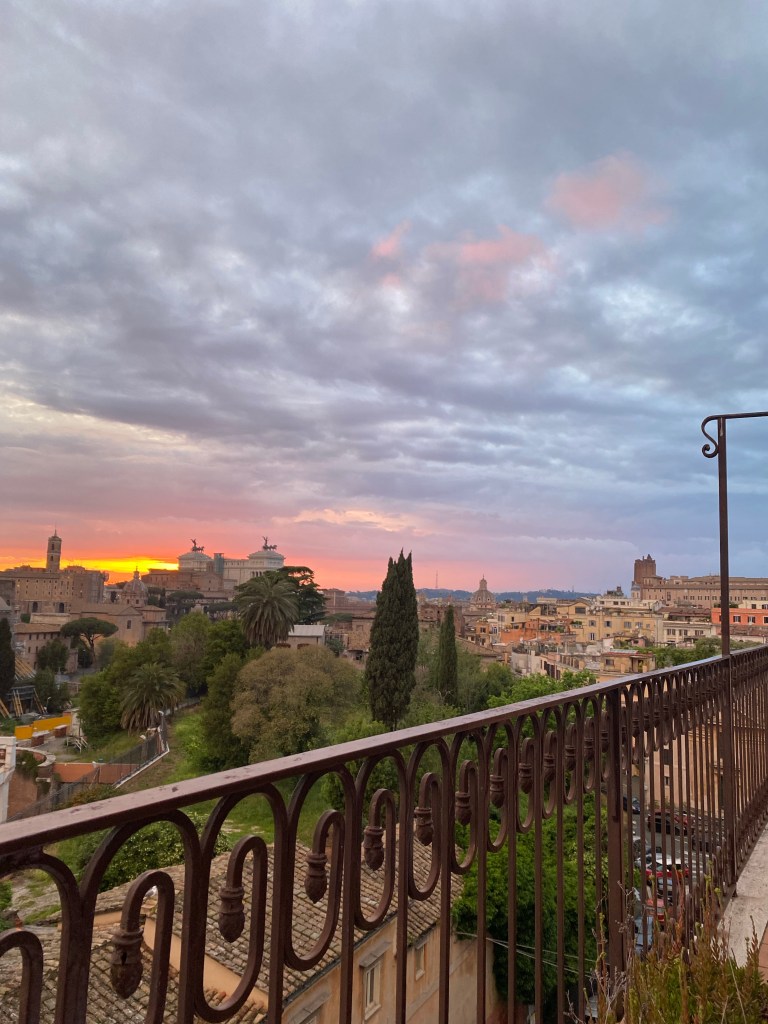
4 a.m., I’m drinking espresso on a balcony in Rome. Our tickets home have been cancelled. (Hello, strikers.) After a scramble, I’m hoping my patch-up fix will hold.

The morning is cool with a promise of sultry heat. Birds serenade in treetops and fly among ruins from an ancient world.

At the metro, my daughter and I are separated on opposite sides of a turnstile. I throw her my wallet over the gate. Her ticket won’t work, nor the second. A man appears, opens the gate on my end, and speaks to me in Italian. My daughter hurries through. I say thank you, thank you, thank you, to the stranger disappearing into the crowd.

Talking.

Old friends/neighbors appear on the other side of the cemetery fence. She’s wearing shoes with a hole in one heel and steps carefully through the patchy snow that remains. In the thin late afternoon sunlight, I’m in the brown garden, searching for nubs of green, an elbow of garlic, a toe of daffodil. It’s been so long since I’ve seen these people, in that long ago time known forever now to us as pre-pandemic, that I need a moment to determine, yes, yes.

We are all three of us worse for wear, but they dive right in, talking about my house and the wood piles, the forsythia I planted that’s sprung crazy, the picnic table beside the apple tree. Things have happened here. Life has gone on.

He leans on the fence where my youngest tied a pink strip of old t-shirt years ago, marking where she and a friend planted a time capsule. What’s in there I can no longer recall, and likely she can’t, either.

Six years ago, in April, I decided to move into this house. No one was living here then. I leaped over the fence and tore a hole in the back of my leggings. I headed to work afterwards, and the kids teased me. What have you been doing? That April was a warm one, too. I leaned against the house and studied the declination of sunlight as I guessed it would rise.

As we talk, the wind picks up. The robins are ecstatic in the neighbors’ maples, really belting out their songs. Overhead, the turkey vultures float, eyeing us. We keep talking, tossing at each other, “remember this? remember this?” Oh laughter….

The bud
stands for all things,
even for those things that don’t flower,
for everything flowers, from within, of self-blessing…
— Galway Kinnell