Small Reckonings.

I’m sitting in the back of the school library on the wall heater when a friend I haven’t seen for years walks in. A large school board meeting has started, and we whisper to each other until I suggest we leave and talk. Early evening, the school is empty, and turn on the lights in a room where my daughters both had classes. I pull out two chairs from the student tables.

Almost immediately, we start in on what should be a simple math problem — March 2023 to March 2020 — which yields an unbelievable three. Before the pandemic we worked together and spent hours talking about literacy and kids, about schools and families, but we also talked about canning tomatoes, about parenting, and being women. We ask how this or that turned out for each other — some decisions, some simply a bend in circumstance.

By the time we leave, the school has completely emptied out for the night. The weather has turned mild, and we walk slowly under the dim lamplight to our cars. A mist rises over the soccer field. I get in my car and drive down the hill and across the river and up the hill to my house. The village lights sparkle in the mist. The moon edges around a break in the clouds. In the darkness I stand there, thinking about the numbers we put together, marking places in our lives, then adding and subtracting our lives—people and jobs and books and houses. The numbers all mesh together, consumed in our shared stories.

Potato Pie Antidote

My oldest daughter texts me early this morning — she’s driven through slush to get to work. And so it begins, the snowy season. The days already burn low, dim by late afternoon. It’s Not the Swimming Season.

To counteract, I contemplate potatoes. Sausage and potato pie? I ask my youngest. Cook together?

Having lived in New England for most of my life, this side of the stick season is familiar to me, intimately so. During Saturday’s sunny afternoon, I coil up the garden hose, pull weeds from the garden, play soccer with my girl, then lie on the grass while she samples bitter apples.

My father sends good news — it’s Arkhipov Day — a celebration of a man who served humanity and not the nation-state. Read details here.

IMG_6702

Little Bits of Beauty

Taking out the trash from the library today, I stopped by the crabapple tree planted at the back school entrance no one uses anymore. My goodness! An utter profusion of beauty by the stinking compost!

On this warm day, in sleepy, quiet Woodbury, the first and second graders walked over for their final visit to the library this school year. I read only one book to them — Jim LaMarche’s The Raft — and remembered the summer I was 10, and my family camped for weeks in the west. I brought the book I discovered with great glee in my father’s very grownup shelves of Hume and Kant and Heidegger. What else but Huckleberry Finn, still one of my most favorite novels.

The children listened quietly this afternoon, checked out their books, and I walked back to the school with a girl who wouldn’t return next year, her arm around my waist.

It’s lovely to live on a raft. We had the sky, up there, all speckled with stars, and we used to lay on our backs and look up at them, and discuss about whether they was made, or only just happened…

IMG_5763

A Gift of Sticks, Maybe

Here’s a fantastic use of Facebook: a friend and colleague offers hydrangeas — come thin my patch, dig and carry.

I’ve known this woman longer than I’ve had children, so our conversation, while we dig, winds in and out of family and bits of gossip about the local library scene.

We pack the back of my little silver Toyota with boxes of sticks and fibrous roots, black crumbles of soil. I cradle a fat earthworm in one palm while we talk, then gently return this creature to damp earth. The early, misty morning is fragrant with the unmistakable scent of opened-up soil.

In the afternoon, at home, I plant two long rows of these hydrangeas,  separated by a path down to the woods.

My girls are skeptical of planting what they see as sticks. Really?

Act of faith. And not that extreme. These sticks will grow.

We are suspicious of grace. We are afraid of the very lavishness of the gift.

— Madeline L’Engle, Walking On Water

IMG_4385.jpg

Coltsfoot by Molly S.

Running Away

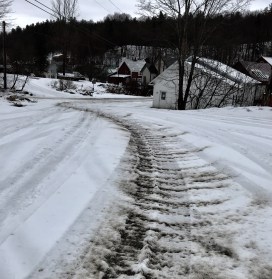
James Joyce’s “The Dead” is one of my favorite short stories, with that remarkable line about falling snow general all over Ireland. In my corner of Vermont, these days, the sentiment generally is enough with the snow for this year. April: season of rain, of snow and ice and, somewhere, beneath all that, struggling green.

I stopped in at the Woodbury school, leaning against the foyer wall while a man who grew up on a farm in the area told me the red-winged blackbirds reminded him of childhood. When he snuck away from farm chores, he headed down to the creek where those dark birds with their signature crimson mark sang.

Ridiculously visually inclined, I rely too heavily on my vision: really, as all my photos attest, the landscape here is yet the monochrome of winter. I’m wrong about this, of course, although I won’t point to any sign of spring at my friend’s request. Too cruel, she says, when sleet falls.

And yet — dumping coffee grounds around blueberry plants, fingering their branches and imagining small, perfect white blossoms, I then close my eyes and listen to the birdsong all around, their rising, sweet melodies.

I watched the first shoots
like wings tearing the soil…

— Louise Glück

IMG_1616.jpg

Woodbury, Vermont

Here.

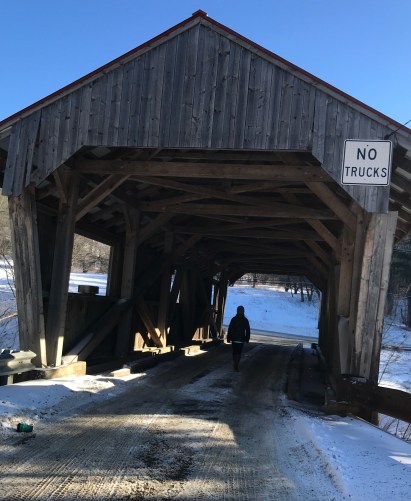
Here’s where I am, on this day buried deep in gray-and-white January: I’m in a tiny Vermont village — general store with a beer cooler and sandwiches made-to-order, post office open for its afternoon hours, volunteer fire department. It’s early afternoon, and I’m walking back to my library with an armful of mail, and no one’s around, the store empty of customers, no passing cars or granite trucks on Route 14 — no one but me and my library mail and a man on the steps of an unused church. He’s pressing his phone, and he doesn’t look at me.

I stand there, on the pavement, looking at him. I know who he is, as I’m sure he knows who I am, although we’ve never exchanged a single word between us. I know he’s been at my desk, illicitly after hours in the library, sitting with his hands on the worn wood, surrounded by stacks of books, my untidy bins of yarn and crochet hooks, the hastily piled colored scraps of paper. All around are small offerings from children — tiny notes to Miss Brett, a sketch of a piglet, an orange origami box holding a clay snowman. Miniature paper airplanes folded by 7-year-old hands.

On this January day, I keep thinking back to that sunny October afternoon, the leaves turning gold and russet. Had I known that man would be dead within months, I might have stood there a little longer and then walked over to him, said, Come in through the door and not the window.

As a writer, I’ve spent years training myself to look for junctures, to know actions matter far more than thoughts — and yet, that afternoon, I kept walking. Maybe I guessed I had all the time in the world, maybe I judged some things can slide without action and the world will work its own wonders. Maybe it was simply that the day was a fine autumn one, and I believed I had things to do.

I turned left, up the dirt road, and carried on with whatever I was thinking, and that particular day passed in the great finality of the past.

I believe that there is one story in the world, and only one. . . . Humans are caught—in their lives, in their thoughts, in their hungers and ambitions, in their avarice and cruelty, and in their kindness and generosity too—in a net of good and evil… There is no other story. A man, after he has brushed off the dust and chips of his life, will have left only the hard, clean questions: Was it good or was it evil? Have I done well—or ill?

— John Steinbeck, East of Eden

IMG_0917.jpg

Johnson, Vermont