Here.

Here’s where I am, on this day buried deep in gray-and-white January: I’m in a tiny Vermont village — general store with a beer cooler and sandwiches made-to-order, post office open for its afternoon hours, volunteer fire department. It’s early afternoon, and I’m walking back to my library with an armful of mail, and no one’s around, the store empty of customers, no passing cars or granite trucks on Route 14 — no one but me and my library mail and a man on the steps of an unused church. He’s pressing his phone, and he doesn’t look at me.

I stand there, on the pavement, looking at him. I know who he is, as I’m sure he knows who I am, although we’ve never exchanged a single word between us. I know he’s been at my desk, illicitly after hours in the library, sitting with his hands on the worn wood, surrounded by stacks of books, my untidy bins of yarn and crochet hooks, the hastily piled colored scraps of paper. All around are small offerings from children — tiny notes to Miss Brett, a sketch of a piglet, an orange origami box holding a clay snowman. Miniature paper airplanes folded by 7-year-old hands.

On this January day, I keep thinking back to that sunny October afternoon, the leaves turning gold and russet. Had I known that man would be dead within months, I might have stood there a little longer and then walked over to him, said, Come in through the door and not the window.

As a writer, I’ve spent years training myself to look for junctures, to know actions matter far more than thoughts — and yet, that afternoon, I kept walking. Maybe I guessed I had all the time in the world, maybe I judged some things can slide without action and the world will work its own wonders. Maybe it was simply that the day was a fine autumn one, and I believed I had things to do.

I turned left, up the dirt road, and carried on with whatever I was thinking, and that particular day passed in the great finality of the past.

I believe that there is one story in the world, and only one. . . . Humans are caught—in their lives, in their thoughts, in their hungers and ambitions, in their avarice and cruelty, and in their kindness and generosity too—in a net of good and evil… There is no other story. A man, after he has brushed off the dust and chips of his life, will have left only the hard, clean questions: Was it good or was it evil? Have I done well—or ill?

— John Steinbeck, East of Eden
IMG_0917.jpg

Johnson, Vermont


Cold Snap!

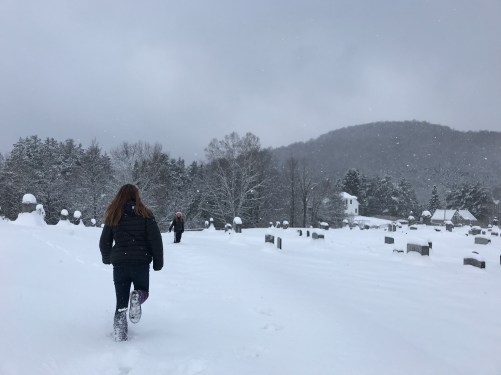
Our neighbors borrow my teenager’s hair dryer to thaw their pipes. It’s 14º below zero, and they’re confident their situation is minor. Gossip winds around town of whose pipes have frozen. This morning, I woke in the dark with a cat purring beside my shoulder. My daughter, 19, gets up with me in this predawn and says she doesn’t know what she should do with her life.

Aim to do something you’ll be proud of, I suggest.

Deeper than 20º below is when the bitter cold really sets in. The lowest I’ve seen the thermometer is 40º below, in farm fields along the Lamoille River. A ghostly mist ambled around, as if we were in an otherworldly dream.

This is the season of library books, board games, knitting — one year ebbing into the next.

Although there is the road,
The child walks
In the snow.

— Murakami Kijo

IMG_0654.jpg

Main Street, Hardwick, Vermont

Postcard #10: Uninvited Guest

This marks an even dozen of Hardwick posts, despite the #10, but all of these have skirted around the jagged edges of where I’m really aiming: that community, like family, is suffused with some of the best and some of the very worst, too, of human nature. The little, one-room library (nearby, but not the Hardwick library) where I reign as Chief Cataloguer and Window Washer is visited by kids who sprawl on the carpet between the shelves and read, who crawl behind the wing chair and create magical worlds with puppets and stuffed animals — toys I leave when I vacuum and then turn off the lights, for children I expect will return.

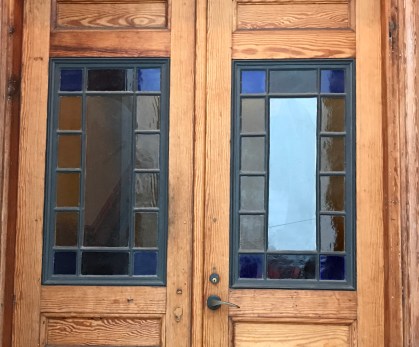
My library has also been visited through a window and burglarized. My desk, where I keep stickers and budget sheets and book orders has been touched by hands not mine.

There’s a story behind this that’s not a nice story, about this visitor I didn’t invite in, but whom I would have, had he used the door like anyone else. My face, writing this, must reflect my anger and my fear. I’m no tabula rasa, and this entry into a place I’ve considered a kind of personal sanctuary cuts me.

And yet — and this is a very, very big and yet — I’m familiar with that ghastly howl of addiction, and my guess is that this intruder seeks the intrinsic human need of coming in out of the cold.

Yet, he didn’t come through the open door.

Driving home with my daughters over snowy roads in the dark last night, listening to their music, we drove around Lake Willoughby with no one else on the roads, and the waxing moon pushed through a scrim of clouds. Cold, cold: nearly zero. Enchantingly beautiful. A terrain known and yet unknowable.

I don’t have answers to why some children are well-tended and dressed, while others have drawn a short stick of basic things like food and clothing. I’m not naive enough to think the uninvited guest will ever use the library door, nor do I ever intend to welcome him through a window. But in this Christmas season of redemption and giving, I keep returning to that reality that doors and windows open, and the world is wider than I’m often inclined to credit.

I wanted to try to write a book about poverty that didn’t focus exclusively on poor people or poor places. Poverty was a relationship, I thought, involving poor and rich people alike. To understand poverty, I needed to understand that relationship. This sent me searching for a process that bound poor and rich people together in mutual dependence and struggle. Eviction was such a process.

— Matthew Desmond, Evicted: Poverty and Profit in the American City

IMG_0699

Hardwick, Vermont