Understanding Ice.

Caspian Lake, Greensboro, Vermont

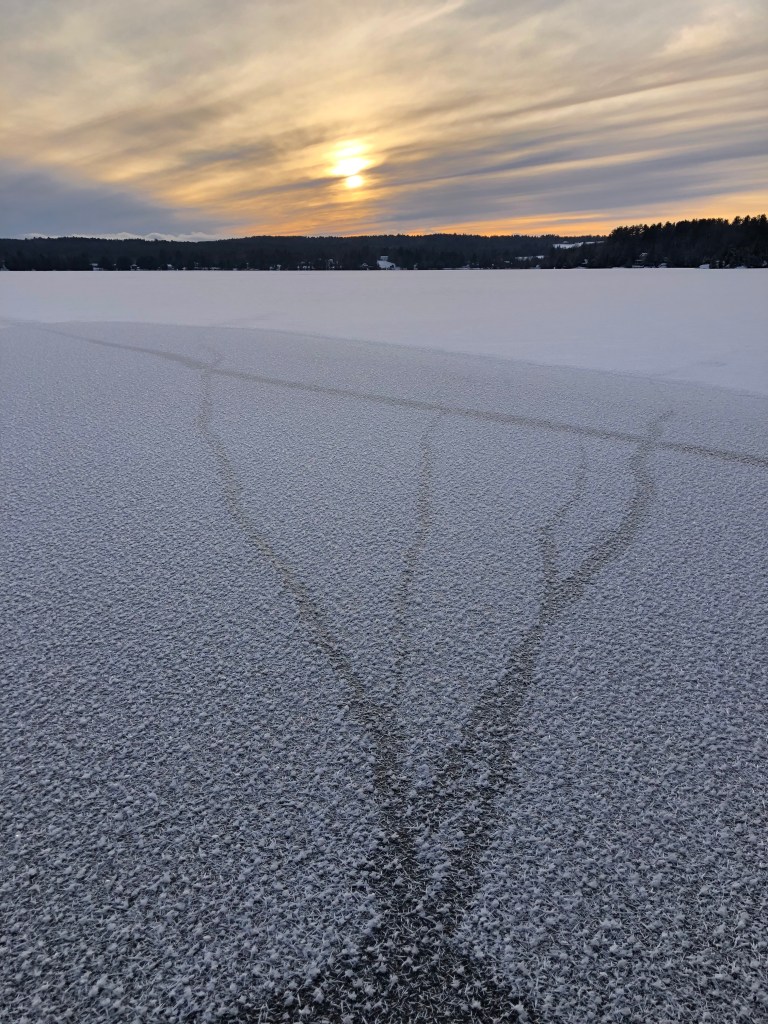
In the late afternoon, on a day just a little above zero, I walk through the woods down to edge of the lake. I come out of the woods where Porter Brook feeds into the lake, and the ice there, despite the cold, looks thinnish. There’s no one around at all. In the summer, that stretch of beach is noisy with vacationers. But now, even not a crow appears.

The post-holiday surge of Covid rages around us. These are not the cheeriest of days. My father, sister, nephew, and I — triangulated around the United States — decide to read and virtually converse about Benjamin Labatut’s When We Cease To Understand the World — in essence, the perfect title for our times.

Live in New England long enough, and you crave the return of ice, the experience of cold and clean winter, the turning around of seasons. The ice will pass, too. Cold, I crouch at the ice’s edge. A squirrel skitters out of the hemlocks and chitters at me before scampering off. Then it’s just me for a moment, and all that sky and the mysteries of the frozen lake. In January, the days give cold and a few extra minutes of sunlight….

Here’s the opening lines of Labatut’s book:

In a medical examination on the eve of the Nuremburg Trials, the doctors found the nails of Hermann Göring’s fingers and toes stained a furious red, the consequence of his addiction to dihydrocodeine, an analgesic of which he took more than one hundred pills a day. William Burroughs described it as similar to heroin, twice as strong as codeine, but with a wired coke-like edge, so the North American doctors felt obliged to cure Göring of his dependency before allowing him to stand before the court. This was not easy. When the Allied forces caught him, the Nazi leader was dragging a suitcase with more than twenty thousand doses, practically all that remained of Germany’s production of the drug at the end of the Second World War. His addiction was far from exceptional, for virtually everyone in the Wehrmacht received Pervitin as part of their rations, methamphetamine tablets that the troopers used to stay awake for weeks on end, fighting in a deranged state, alternating between manic furore and nightmarish stupor, with overexertion leading many to suffer attacks of irrepressible euphoria.
Stacked Deck.

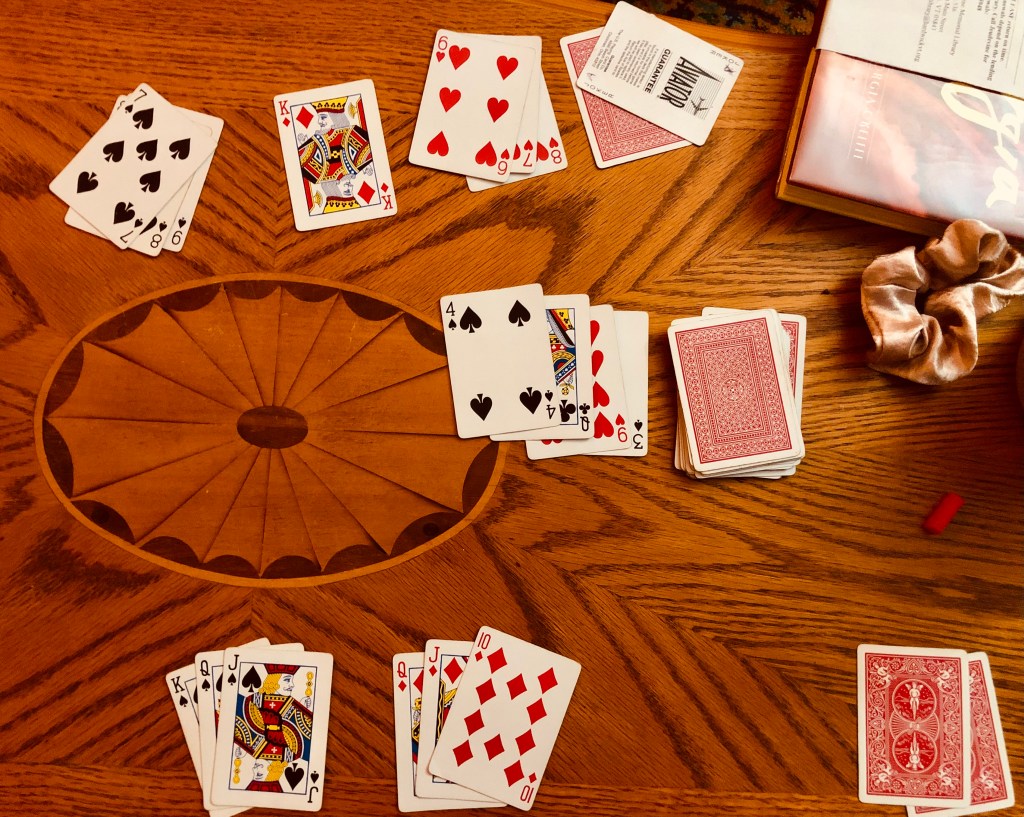
In the evening, we play cards. For years, I had this inner narrative unspooling, about living on the edge of the wilderness, the cold a near constant companion for a good portion of the year. Now, returning from work to a chilly but not cold house, I remember keenly how that narrative began when I was a young woman, living in an uninsulated apartment, reading about polar expeditions.

The cold, indeed, makes us more alive. Too much cold, however, deadens us, too.

Our deck of cards has a few duplicates — additional sixes and eights and two Jacks of Diamonds. We have another, unpadded deck, but I have a particular fondness for this one that bends the rules and mixes our games in funny ways.

January. My inner narratives keep unwinding. Cold. Kids. Cats. Writing that nourishes my soul.

William Carlos Williams’ lines about this winter month:

Again I reply to the triple winds
running chromatic fifths of derision
outside my window:
                                  Play louder.
You will not succeed.

Mud. Snow. Ice. What Next?

I met a friend yesterday, and we took a walk we’ve journeyed in various seasons — in bright green spring, in the summer when we admired flower gardens along houses. Yesterday, we walked through frozen mud ruts and sprinkles of rain, the jumbled up season and time of where we are.

On this New Year’s Day, I’m passing along a VTDigger story written by Kevin O’Connor about a Vermont couple’s 4,000 World War II letters. A history lesson and a love story — isn’t that what we need right now?

Kent’s Corners, Calais, Vermont

Math Matters.

Photo by Molly S.

My daughter gets her car inspected, but the mechanic has no inspection stickers. The stickers aren’t here yet, he explains. She texts me this, asking, What am I supposed to do?

Nothing, I answer. The stickers will come in when they come.

That sums up a strand of 2021 — there’s plenty more to this year, oh, boy, is there plenty more — but doing nada is definitely a 2021 strand. I’m not much for new year’s resolutions. I’m a compulsive list writer, and I tend to get a chunk of the stuff right before my eyes done. But there’s rain forecast for New Year’s Day when a deep freeze generally sets in. The world around us is unraveling.

This afternoon, I drove to the high school to pick up a rapid test for my daughter. The health department had taken over the parking lot with orange cones and bright vests. The tests were gone, of course. I talked with the health department employee for a few moments. He raised his hands, palms up, to the twilight settling in.

We commiserated about the strangeness of March weather in late December. Then I drove around him and headed home.

Small stuff. Big stuff. Proportion matters.

Walking with Skis.

Greensboro, Vermont

Someday, maybe I’ll look back at this photo of my daughter on the Christmas she was sixteen…. goodness, what will I be thinking then?

In the late afternoon, I ski up through the woods to where the farm fields meet the forest in two strands of electric fence. The fence is off now, and the fields are empty of grazers, save for the odd crow that picks in a bare spot. The day, although not sunny, has warmed, and snow clumps on my skis. The skis need waxing, which I haven’t done. Instead, I take the skis off and shoulder them, and walk down the trail through the few inches of snow.

These days, I’m working hard, the outside world coming at me in a fury. In the evening, we play cards. I’ve picked up a copy of a Mark Sundeen book that reminds me of my idealistic youth and a happy summer we spent in a tipi. The circumstances have changed; the world has changed, indeed, since my wild twenties; but the questions are the same.

I take the long trail back home through the woods, despite carrying my skis. At a stream, I stop. The ice hasn’t yet completely skimmed over the rocks. I pull off my mitten and dip my fingers in, the water so clear and cold.

How can a man hope to promote peace in the world if he has not made it possible in his own life and his own household?” 

― Mark Sundeen, The Unsettlers: In Search of the Good Life in Today’s America

Happenstance. Here.

Greensboro, Vermont

Christmas Day, in a light, almost-a-cold-mist rain over a few inches of old snow, we took one of our favorite walks in Greensboro, on Nature Conservancy Land at Barr Hill. Flanked by old sugar maples, the path goes through former farm fields and among 19th century stone walls. So this walk feeds my desire for history and also for the cold rawness of today in our faces. We meet not a single soul, not even a crow.

At the top, the view is obscured by clouds, the lake with its summer pleasures of kayaking and swimming occluded by winter.

We may be at the edge of the world, but what does that mean anymore? In our family, we’ve had both wonderful and terrible Christmases. As we drive, we say, remember the time…?

On Christmas evening, we drive, my teenager at the wheel, in search of colored lights. I keep my own entirely adult cynicism to myself, my snarky thoughts about the crumbling American Empire and how long will the boondoggle of electricity keep flowing for us. Instead, I tease my oldest daughter about her headlights. Are the headlights even on? I ask.

In my book interviews, this fall and winter, I’ve repeated over and over, that, by happenstance, each of us arrive in a time and place. The few us walk a downtown street, beneath glowing lights. We pass a gleaming white BMW, its engine running, no sign of a driver. A little further, I stop and read a sign at a creche, acknowledging the small figurines are on unceded Abenaki land.

The rain keeps falling in little bits. The youngest navigates us home, through mist and darkness, despite the poor headlights.

(And thank you, Barre Montpelier Times Argus, for the great interview.)

The night is so cold

even in bed it keeps me

wide awake.”

— Buson