Wood.

Friday, the fire in the wood stove gone cold, I shovel out the ash and discover two honeycomb boxes. I’ve been cleaning this stove for three years now, but I’ve never taken these pieces apart. The manual cautions me to be gentle. So I’m gentle.

The first essay I had published in a slick magazine, Taproot, was for their Wood issue. In those days, we burned countless cords of wood every year, for the few cords in our house to the many more to make maple syrup. Wood was far more verb than noun in our house; we did wood.

In my wooden house, whose floor joists in the basement still have ribbons of bark, on my maple floor, I empty ash and soot and creosote into a metal sap bucket. I kindle the fire with crumpled newsprint and ripped cardboard. The cats sprawl on the rug, satisfied as the heat suffuses our house again.

The late afternoon is raw and damp. So much snow has buried us in. I ski on a section of former railroad bed where I’ve never gone before, up a long slope fenced in by a cedar forest. There’s no one around, not a dog walker, not a snowmobiler, just me and the crows. At a crest, the valley below opens. I’m above a large dairy farm dug deeply by barns and fields and family generations into what had once been forest.

The sun has melted a section of trail to slush here. A cold wind blows down from the north. I stand here for a bit, stamping slush from a ski, then I turn, too, and head back through the forest.

Layers.

A week of sun ends in scattered raindrops and my hands dirtied with creosote from cleaning out my wood stove. The cats hunker against the wall, glaring at my labors, annoyed at the chill descending into their cat realm. My daughter, fluent in Cat Language, feeds the creatures small pieces of roast chicken. I brew more coffee.

Mid-March, the sudden season of reckoning: what is it I’m doing? This is the week of self-doubt and the week of the kindness of strangers, too. March has long meant the season of sweet maple and cold hands, of leaning hard into work, the season of faith that spring’s crocuses and snowdrops and ephemerals will return—that they always return—to remind myself that the wider world holds us inevitably, for good or ill and sometimes for both.

Cutting into with the ax,

I was surprised at the scent.

The winter trees.

— Buson

Stone House.

All night, wind howls around our house. I give up the charade of sleeping and pull out my library book. I’m in the final pages of Meredith Hall‘s memoir about growing up in New Hampshire, Without a Map, and I’m in no rush to end her story, close the cover, and return the book.

At my feet, my little cat lies awake, thinking cat thoughts, in a cat circadian rhythm of his own. The Ides of March howl in fiercely. All day, the wet snowstorm has swirled around us. My wet boots lie beneath the wood stove. Our house banked in by white and the ash bucket melting dirtily into the path where I’ve left to cool, its embers to burn out and die.

Somewhere in those hours before dawn, I shake flat the wood stove’s embers with the ash shovel and lay one, two, more pieces of wood on the flickering coals. In the dark house, the little cat follows me downstairs, curious about breakfast but not insistent.

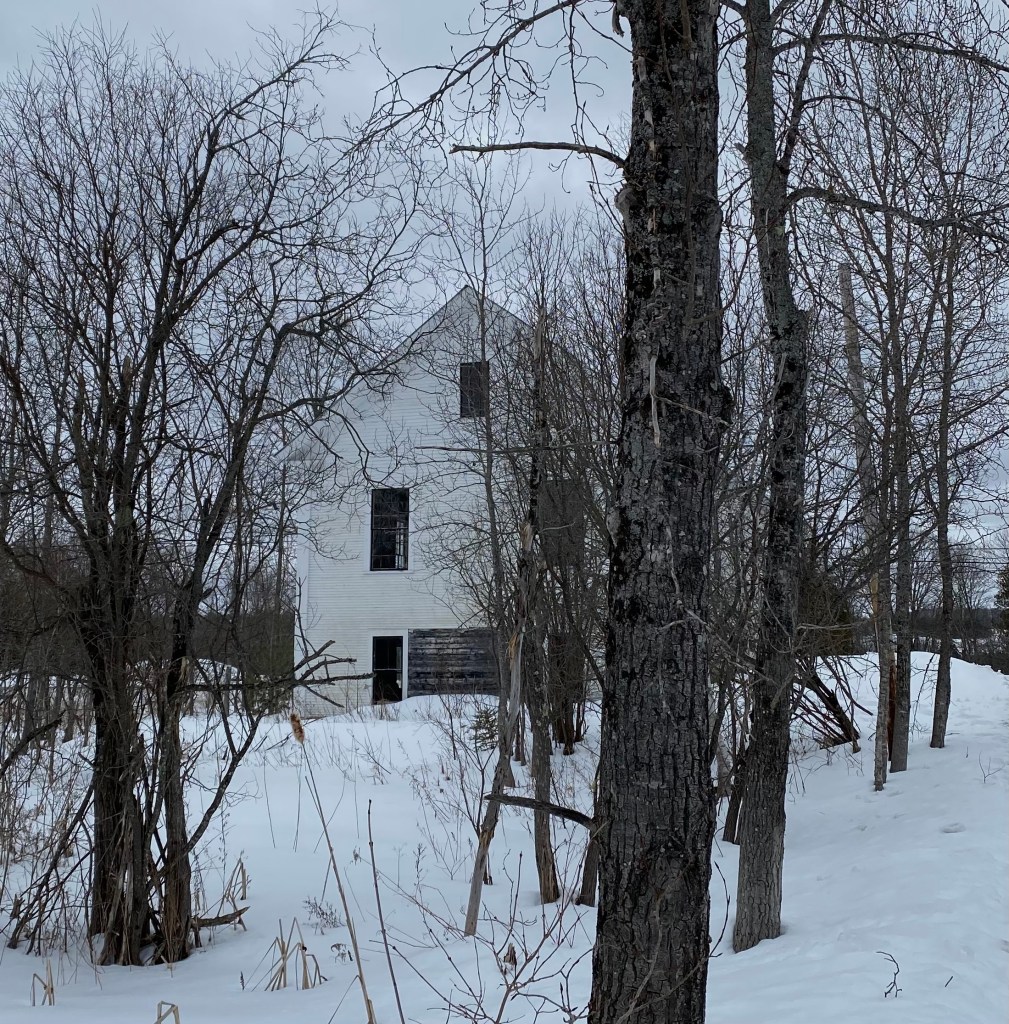
I think of what I’ve read that day, about a stone house built nearby in the 1800s from a single boulder. A curious endeavor. Take this stone, cut it into pieces, and make a home. In the darkness, the wind rakes over our house, hurls over my snow-submerged garden plot, and whirls over the town cemetery.

“The past lies beneath the surface, intransigent truth. Remembered or not, what we say and do remains, always.” 

— Meredith Hall

“Things Take the Time They Take…”

Walking this afternoon, I’m reminded of Sylvia Plath’s line, The winter landscape hangs in balance now… What a long balance it might be. Nonetheless…

A pileated woodpecker swoops down from a branch above my head and disappeared into the woods. I take this as an auspicious sign. Ides of March. More snow moving in. Nonetheless….

Things take the time they take. Don’t
worry.
How many roads did Saint Augustine follow
before he became Saint Augustine?

— Mary Oliver

Small Reckonings.

I’m sitting in the back of the school library on the wall heater when a friend I haven’t seen for years walks in. A large school board meeting has started, and we whisper to each other until I suggest we leave and talk. Early evening, the school is empty, and turn on the lights in a room where my daughters both had classes. I pull out two chairs from the student tables.

Almost immediately, we start in on what should be a simple math problem — March 2023 to March 2020 — which yields an unbelievable three. Before the pandemic we worked together and spent hours talking about literacy and kids, about schools and families, but we also talked about canning tomatoes, about parenting, and being women. We ask how this or that turned out for each other — some decisions, some simply a bend in circumstance.

By the time we leave, the school has completely emptied out for the night. The weather has turned mild, and we walk slowly under the dim lamplight to our cars. A mist rises over the soccer field. I get in my car and drive down the hill and across the river and up the hill to my house. The village lights sparkle in the mist. The moon edges around a break in the clouds. In the darkness I stand there, thinking about the numbers we put together, marking places in our lives, then adding and subtracting our lives—people and jobs and books and houses. The numbers all mesh together, consumed in our shared stories.

At 86.

I grew up in a family nearly devoid of grown men. No grandfathers, no uncles save one uncle by marriage I met once in California and never saw again. Like any kid, how I grew up seemed just the way of the world.

Every summer, we saw my grandmother and wacky and wonderful aunts and female cousins. In those weeks, the ordinary rules were suspended. We kids lived in our realm, quite happily, while the adults did their endless talking and laughing. In all this, my father headed our rambling crew, whether we were swimming in Maine’s icy Atlantic or visiting a Shaker village. My father taught his three kids to love E. B. White and Shakespeare, to fly a kite and cross country ski. The original YouTuber before YouTube was a thing, my father is a lifelong library aficionado. He taught himself — and so taught us — to paint a house and repair a leaking washing machine, to write a clear sentence, play Hearts, understand mathematics is exquisite, and lean into the happiness of lying on your back under the summer constellations. The list is eternal: use a sharp pencil to solve algebra; chop garlic fine; Plato is sublime; be polite to cashiers; work hard; pay your bills; hike.

If you couldn’t figure out an answer, keep thinking. My god, that’s useful.

I inherited his nose and his utterly irreverent sense of humor. He never indulged his children in the illusion that the world is easy or kind. The summer I was ten, we drove from New Hampshire to Wyoming to Colorado to New Mexico, living out of our green Comanche Jeep and careening back into New England two days before school started. By that time, my sister and I had read his copy of Huck Finn at least twice over and thoroughly kicked around Huck’s aversion to civilization. 86 today, my father is still modeling Thoreau’s behavior of sucking the life’s marrow, grit and all, while savoring espresso.

Sundays too my father got up early
and put his clothes on in the blueblack cold,
then with cracked hands that ached
from labor in the weekday weather made
banked fires blaze. No one ever thanked him.

I’d wake and hear the cold splintering, breaking.
When the rooms were warm, he’d call,
and slowly I would rise and dress,
fearing the chronic angers of that house,

Speaking indifferently to him,
who had driven out the cold
and polished my good shoes as well.
What did I know, what did I know
of love’s austere and lonely offices?

— Robert Hayden, “Those Winter Sundays”