Language of Loons.

Midwinter, I was working in the coffeeshop a few minutes’ walk from our house when a woman I once knew fairly well came in. We had started a preschool together, been in and out of each other’s houses, seen each of the other through a pregnancy.

While waiting for her coffee, she sat beside me and said my name, Brett, and that she wanted to mend the falling out between us.

I folded my notebook closed. I had a few more minutes before I needed to leave, and I could see I wasn’t going to put my pen to paper again that morning. We compared notes about a house fire. Our memories lined up with surprising accuracy, all the way down to slight and little things. And then our memories diverged, abruptly. We’ve both divorced, both moved, and yet the ashes of that fire lay deeply in each of our lives.

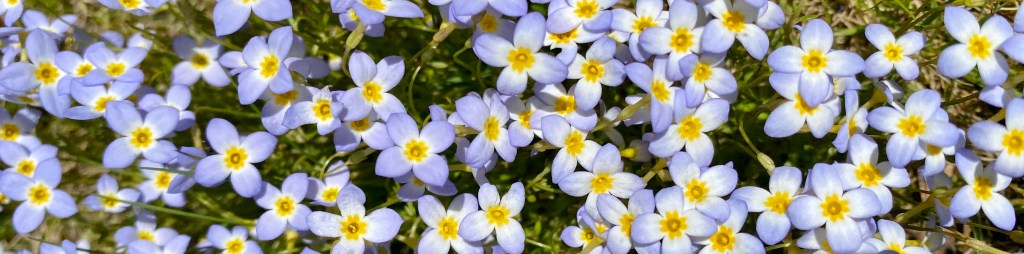
Midday today, I hurried along one of my favorite walks around the lake. Me and the bright daffodils, the cheery trout lilies, the striking bloodroot. As I walked through the woods, the loons called around the lake. Once upon a time, I would have heard their language as decorative sound, sweet ambiance. Today, I stopped, alone in these woods where the leaves haven’t yet spread out for the season and the sunlight dropped on my face. I understood the loons as much as I understood my old acquaintance, maybe as much as I understand myself, as they sang across the water, their voices echoing against the mountains.

I hear

outside, over the actual waves, the small,

perfect voice of the loon.

— Mary Oliver

Snapper.

On the way to my oldest daughter’s apartment for dinner, cars stop in the highway. A woman waves frantically for us to slow, slow. A few years back, on a Monday morning, I had pulled over at nearly this precise place. A car was flipped upside down in a roadside ditch. A passing motorcyclist stopped, too, and we walked around the car, then up and down the road.

This afternoon, a man walks behind a snapping turtle, guarding it safely across the pavement.

I’ve been in Woodbury all afternoon, back at the school and the library where I once spent so many hours, so much of my life for a few years. Seeing the turtle, my daughter laughs. So much has happened to us in these past few weeks, these past few years. For now, though, this return to May and spring and turtles on the move. Merry month of May…

History says, Don’t hope
On this side of the grave,
But then, once in a lifetime
The longed-for tidal wave
Of justice can rise up,
And hope and history rhyme…

— Seamus Heaney

Remember.

Not long after dawn, under circling pigeons, we get on a train to the Rome airport. I’m nearly certain our tickets aren’t valid. My phone’s app shows me a mixed message of a cheery You’re all set! and a stern Seats reservations required! I can’t figure out where the tacky-tacky box to check to shell out for reservations might hide. The train car is nearly empty. My daughter and I sprawl out with our suitcases and backpacks. In a luminous honeyed light, the train winds out of Rome. We pass immense apartment buildings with balconies crammed with tables and chairs, hanging plants, yesterday’s laundry.

A conductor walks by, returns and holds out his hand. He speaks to me in Italian. I answer in the one language I command and point to the cheery sentence on my phone. The train picks up speed.

“Remember,” he tells me and disappears into the next car.

Remembering has always been my strength and my weakness.

As a girl, my family used to take the train from New Hampshire to Boston for the day, excursions crammed with cobblestone streets, swans, pastries, history, the ocean’s salty breeze. On this Italian train, my daughter, 17-on-the-cusp-of-18, presses her suntanned face to the window. Crimson poppies bloom along the tracks. Before we left on this trip, a friend told me the adage about pedestrians in Rome — the quick and the dead. Quick we are this morning, on this train with our baggage of wrinkled clothes, a few gifts, those library books I finished reading. A man stands on a sidewalk, smoking a cigarette, studying the train as we sway along.

The next morning, not smoking a cigarette, I stand beside an apple tree in my yard, studying a woodchuck who’s set up housekeeping in a den, the creature returning my gaze, eyes glossy, inscrutable.

Last Moments.

4 a.m., I’m drinking espresso on a balcony in Rome. Our tickets home have been cancelled. (Hello, strikers.) After a scramble, I’m hoping my patch-up fix will hold.

The morning is cool with a promise of sultry heat. Birds serenade in treetops and fly among ruins from an ancient world.

At the metro, my daughter and I are separated on opposite sides of a turnstile. I throw her my wallet over the gate. Her ticket won’t work, nor the second. A man appears, opens the gate on my end, and speaks to me in Italian. My daughter hurries through. I say thank you, thank you, thank you, to the stranger disappearing into the crowd.

Espresso.

Florence is crammed with tourists. My daughter and I sit on a stone bench in the shade and watch pigeons and people. Midday, we climb stone stairs into the duomo while the organ plays. I’ve never been in a structure like this, such an awesome concert of art and size, art and music. My daughter whispers, You’re going to keep talking about the organ, aren’t you?

Later, we eat pizza. At our table, strangers strike up a conversation with us, give my daughter wine, offer shopping and college advice, and an espresso appears before me. I lift the tiny white cup and drink the brew.

Pigeons.

On the train to Florence, we strike up a conversation with a couple from Australia who are traveling with both their mothers. He’s interested in American universities and chats with my daughter about dorms and loans and degrees. He’s in banking. His wife works from home and hasn’t gone into the office in two and a half years. Sometimes, she says, she stands in the backyard and talks to the birds for company.

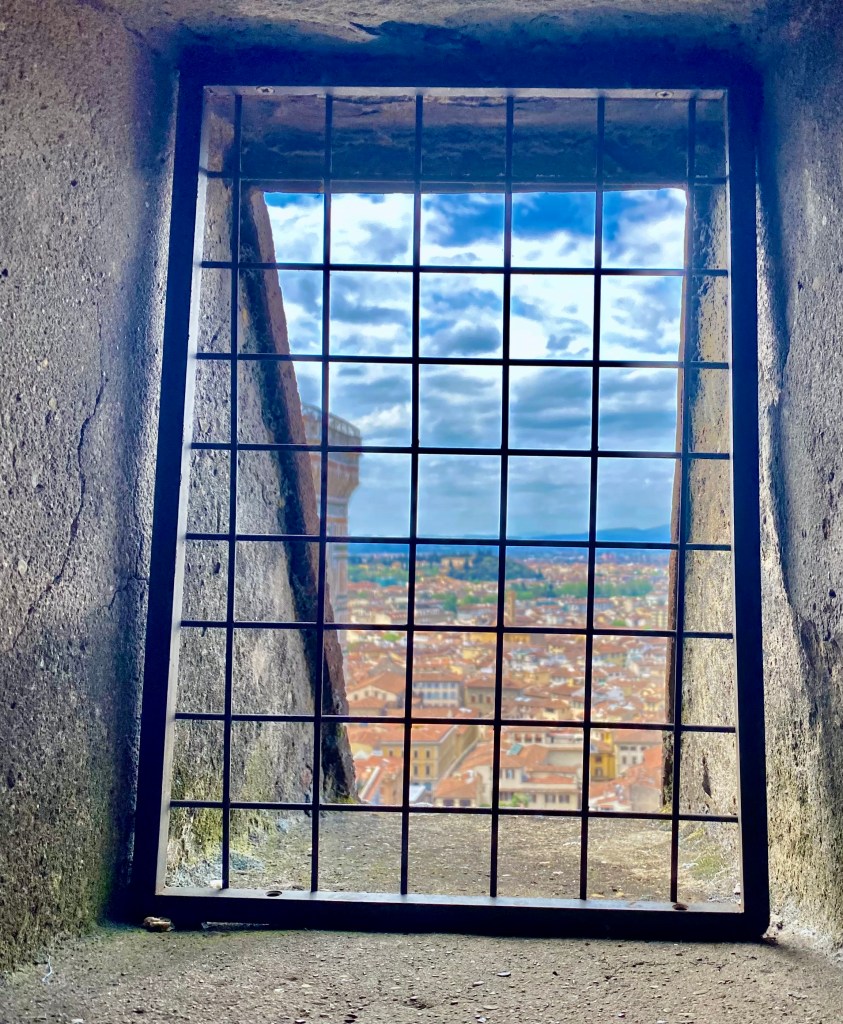
In Florence, our windows look over red roof tiles. Pigeons nestle in the ivy.