Myself, the Householder.

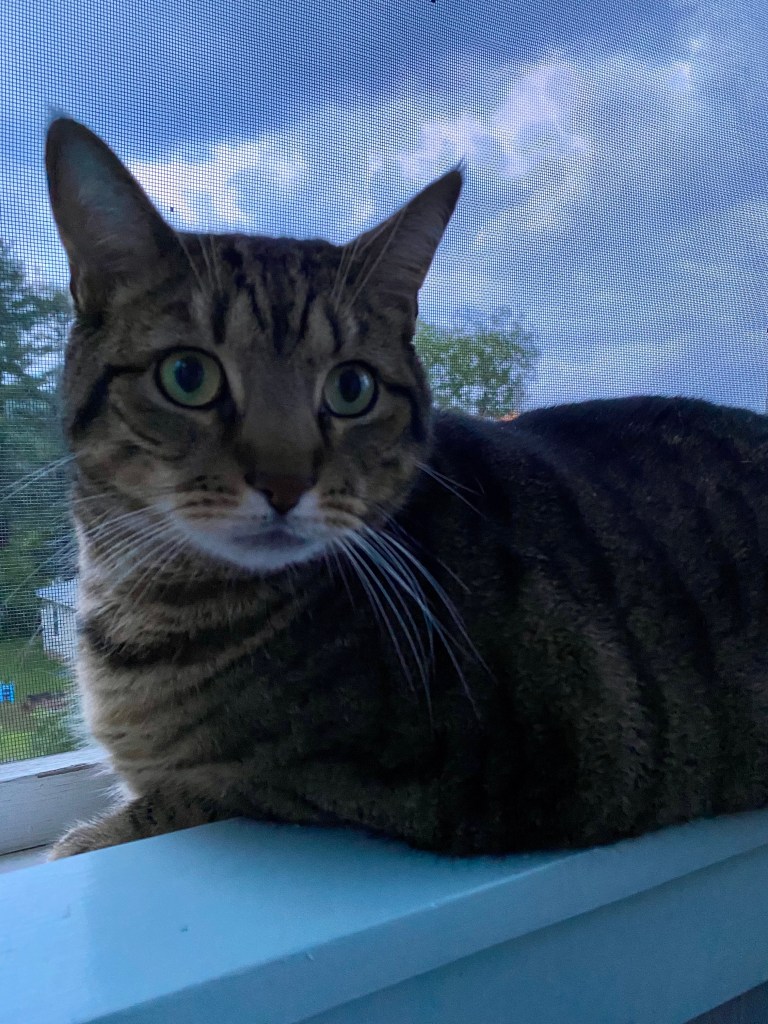
Furious, long before four this morning I’m at my desk with coffee and manuscript and my needy cat who must have his nose rubbed. A few months ago I asked a neighbor to knock off his cash carpentry payments to my ex-husband, a father who’s never made a child support payment. The neighbor brusquely told me I didn’t understand the complexity of the situation and walked out.

Now, he’s sent word that I made him and his wife feel unsafe. Oh Lord…. me and my 4’9″ stature and my insistence that I do know the complexity of my story and my uncomfortable female rage. I’ve doubtlessly repeated this, but his is a Kafka-esque flip of the word unsafe. And since when are other people’s children negligible?

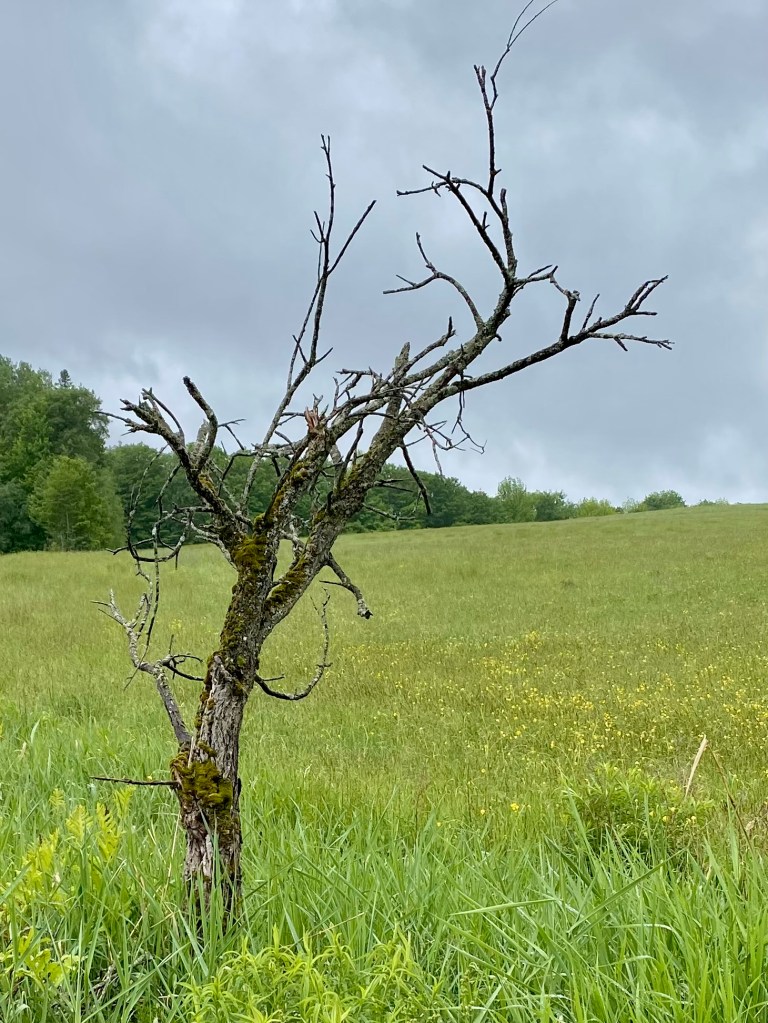
I’ve been here before — like too many others, as this is hardly my unique problem — and I do what seems sensible to me. I tell no one where I’m headed and hike through the forest and up along a ridgeline. The hike cools my head. I discover white trilliums and wash my face in a low-running stream. The woods are hurting for rain, thirsty, thirsty.

I left with a question — what will I do? — and returned with my answer. Out of chaos, always, springs the pulsing might of creativity. At home, I hole up with Joanna Biggs’ A Life of One’s Own: Nine Women Writers Begin Again, and Biggs points me to Toni Morrison. In the evening, I pull a few weeds from the lily-of-the-valley that guard my house’s foundation. Such a delicate, pure, tiny flower.

 Q. You don’t feel that these girls (of teenage mothers) will never know whether they could have been teachers, or whatever?

A: They can be teachers. They can be brain surgeons. We have to help them become brain surgeons. That’s my job. I want to take them all in my arms and say, “Your baby is beautiful and so are you and, honey, you can do it. And when you want to be a brain surgeon, call me — I will take care of your baby.” That’s the attitude you have to have about human life.

— Toni Morrison, Time Magazine

18th Birthday.

Here’s the thing: 18 years is a whole lot of parenting. 18 years is hardly a heartbeat.

My youngest was born by caesarian at 8:13 a.m. Leaving the hospital a few days later, corn nubs had emerged through the soil. As we drove by farm fields, I admired the new corn, marveling at its beauty. I had seen corn growing my whole life. And yet….

Perhaps that and yet sums up parenting. As a little girl, my youngest wore a green fairy tutu from her grandmother for about two years straight. These days, we are past the days of tiny teacups and Go, Dog, Go. Our family dynamics are now getting down to the hard questions: what does it mean to be a woman? what shall I do with my life? and how many times does sunscreen really need to be applied on a senior skip day at the beach? The questions go on….

blessing the boats

                                    (at St. Mary’s)

may the tide

that is entering even now

the lip of our understanding

carry you out

beyond the face of fear

may you kiss

the wind then turn from it

certain that it will

love your back     may you

open your eyes to water

water waving forever

and may you in your innocence

sail through this to that

— Lucille Clifton

‘In sorrow, pretend to be fearless.’

In Praise of Coldness

“If you wish to move your reader,”
Chekhov said, “you must write more coldly.”

Herakleitos recommended, “A dry soul is best.”

And so at the center of many great works
is found a preserving dispassion,
like the vanishing point of quattrocentro perspective,
or tiny packets of desiccant enclosed
in a box of new shoes or seeds.

But still the vanishing point
is not the painting,
the silica is not the blossoming plant.

Chekhov, dying, read the timetables of trains.
To what more earthly thing could he have been faithful?—
Scent of rocking distances,
smoke of blue trees out the window,
hampers of bread, pickled cabbage, boiled meat.

Scent of a knowable journey.

Neither a person entirely broken
nor one entirely whole can speak.

In sorrow, pretend to be fearless. In happiness, tremble.

— Jane Hirshfield

Conversation in the Moonlight.

At the open hatch of my car, I’m writing a mental grocery list, when something — what it is I don’t immediately know — happens. I’m fucked, I think. I’ve broken my hand.

A pneumatic hatch strut has broken, and is pinned between the hatch and taillight, the plastic light smashed. I turn my hand around and around. My hand suddenly seems very small, utterly familiar, a thing easily ruined.

People walk around me, going in and out of the co-op. Weirdly, I remember a car crash from my twenties when a Subaru Justy ran into my gold Rabbit. My Rabbit was knocked off the road. I got out and ran. The Justy had spun around and around and came to a stop, the wrong way in the middle of the road. No one was around. The Justy’s driver was crying, her window rolled down, saying, “I’ve killed you.” I begged her to get out of the car, leaning towards the Justy in the falling snow but not touching it, saying, “But I’m alive. I’m here.”

In a twist of great good fortune, my hand isn’t broken, only bruised. I go in the co-op and buy scallions and yogurt. The hatch and the strut are an irritation, another thing to sort out and solve, a fixable occurrence.

Later that week, after the dinner guests have left and it’s just me and my daughters and their friends, the five of us pull our chairs around the fire. The neighbors have taken their little kids into bed. The band in the village has quit by then, too, and the frogs are signing again, snippets of frog melodies.

In the darkness, we talk about relationships and marriage, what holds people together, what makes people endure. What makes people split. I toss another chunk of wood on the fire. A glistening half moon hangs over my house. Listening, I turn my hands around and around. So often, my hands are full and busy. Now, the moonlight falls in my open palms.

We keep talking and talking and talking. The moonlight is endless.

Birds are a Kind of Souls.

I’m sitting at the kitchen table talking with my daughter about past, present, future — one or all of those mixed in together; it’s late adolescent talk; the future hovers around us all the time, all day long — when I see a robin swoop up to our porch beam, its beak full of limp weed.

For the first time in the half dozen years we’ve lived here, robins are building a nest a few feet from our kitchen door.

In our other house, robins crafted fat nests in our sugarhouse and under our balcony. We witnessed baby beak feedings and collected blue ragged shells. Twice, a hawk ate fledglings — the course of nature, but sorrowful.

Rain has fallen all day. There’s an underlying promise of deepening green with the rain, but the hours have been cheerless and cold, filled not with any bad news but the accrual of petty things that drag at all our lives.

A robin stands on the porch railing, eyeing us through the glass door. Its mate flies in quickly, busy busy in the nest. Time is of the essence in bird movement. The robins are a little story come to stay with us for a short while.

Build and thrive, I think. Thrive.

“I was convinced that birds were kinds of souls. Not the souls of people but of previous birds whose mystery and beauty were so necessary on earth that God would not allow them to be anything in their second life but birds again.” 

— Howard Norman

Apple Blossom Petals Like Snow.

When my youngest was born, nearly 18 years ago, my brother had a new cell phone that had a camera. I didn’t own a cell phone then and didn’t predict I ever would. Who wanted to carry a phone around with them?

Turns out, my brother had forgotten his phone, anyway.

I could rhapsodize about how many phones and how many laptops have now passed through our house, the zillions of digital images and words, but really…

This is the most amazing blossom season. In the late afternoons, I read beneath an apple tree while petals fall, the pollinators hum, the spring crickets creak on. The first crop of dandelions has already morphed into gossamer globes of seed. How fast this passes. Sometimes, waking in the night, I get up and read. I am now beyond those baby waking nights, no longer so hungry to rest. Jays bicker over something I’ll never know. The day slips along.

The sea is calm tonight.

The tide is full, the moon lies fair…

— Matthew Arnold