Vermont Almanac.

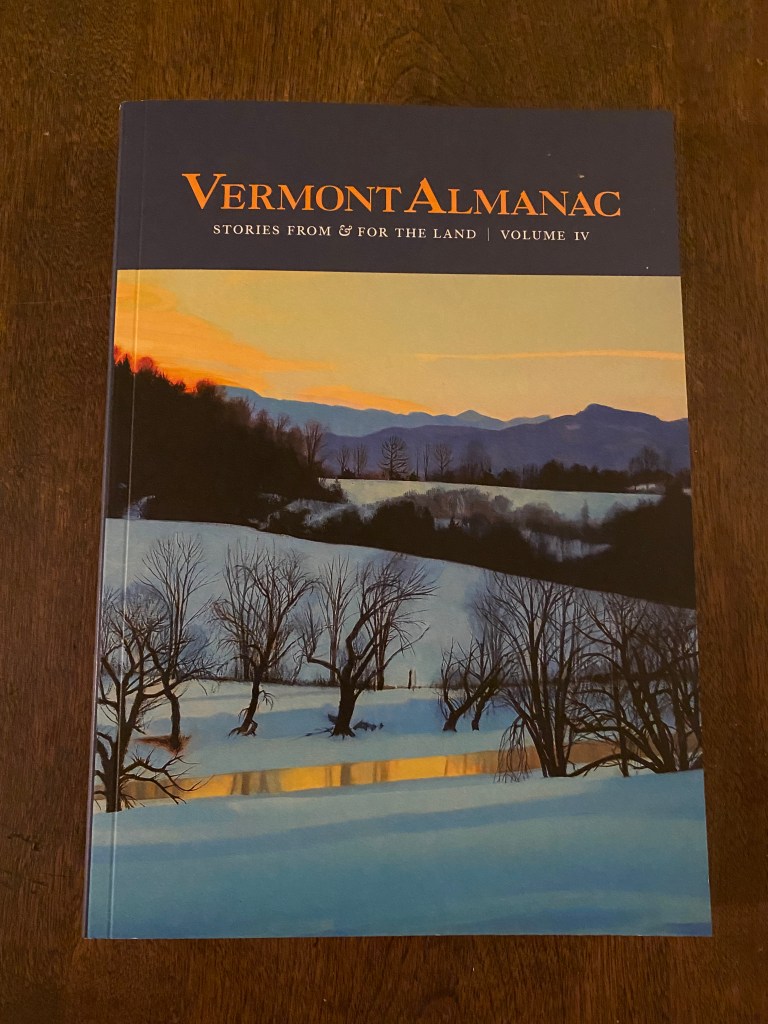
My copy of the fourth Vermont Almanac arrives in my mailbox. Remember real mail? I remember exchanging long letters with friends for years. Email is fine and dandy, but email has no smell. I open the book in my kitchen and breathe in the scent of ink and paper. I was fortunate to write and edit a bit for this issue.

These days, on my moonlit evening walks, living in Vermont is often on my mind. So much has happened in my own life and in this dear state: a summer of rain and wildfire smoke, a flood, beloved Montpelier drowned, a rise in violent crime. And yet, I’m tugged more deeply into this state I’ve called home nearly all my adult life. Reading this hefty book, I’m reminded, again, of how yankee ingenuity is so often yankee generosity, too. While our nation (and much of the globe) as a whole is navigating unsettled and often stormy waters, I’m heartened by Vermonters’ ruggedness, tenderness, and, so often, outright humor. Who could imagine a world without these fine things?

Hope is no mere aspiration that things will turn out well. Hope instead takes our hand, shines a light ahead, and pushes us onward into the messiness and uncertainties of life.

Bryan Pfeiffer, Vermont Almanac, Volume IV
Pocket Treasures.

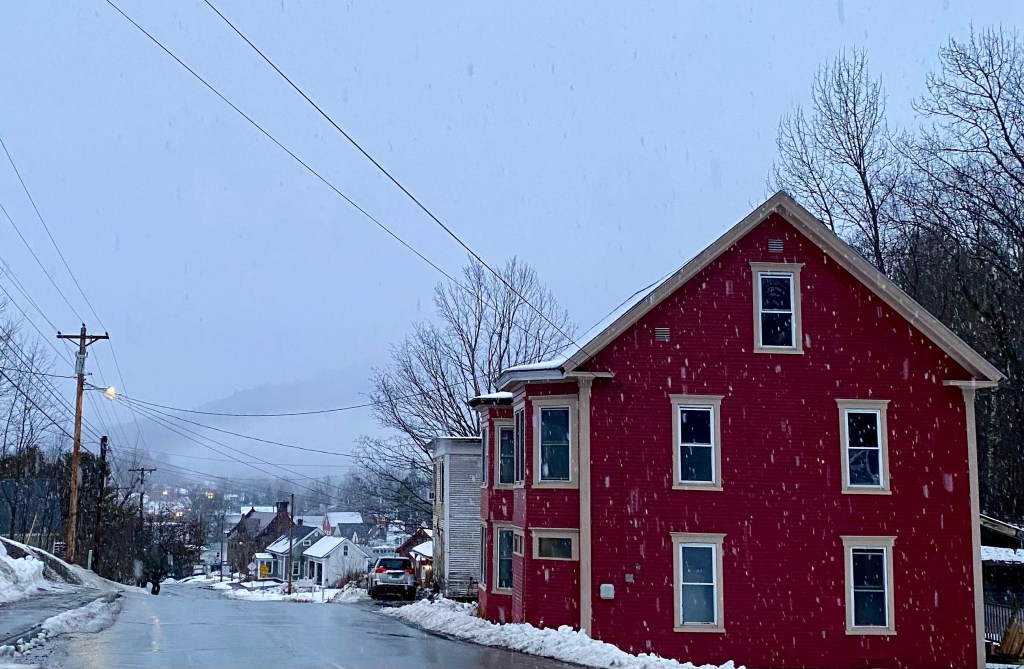
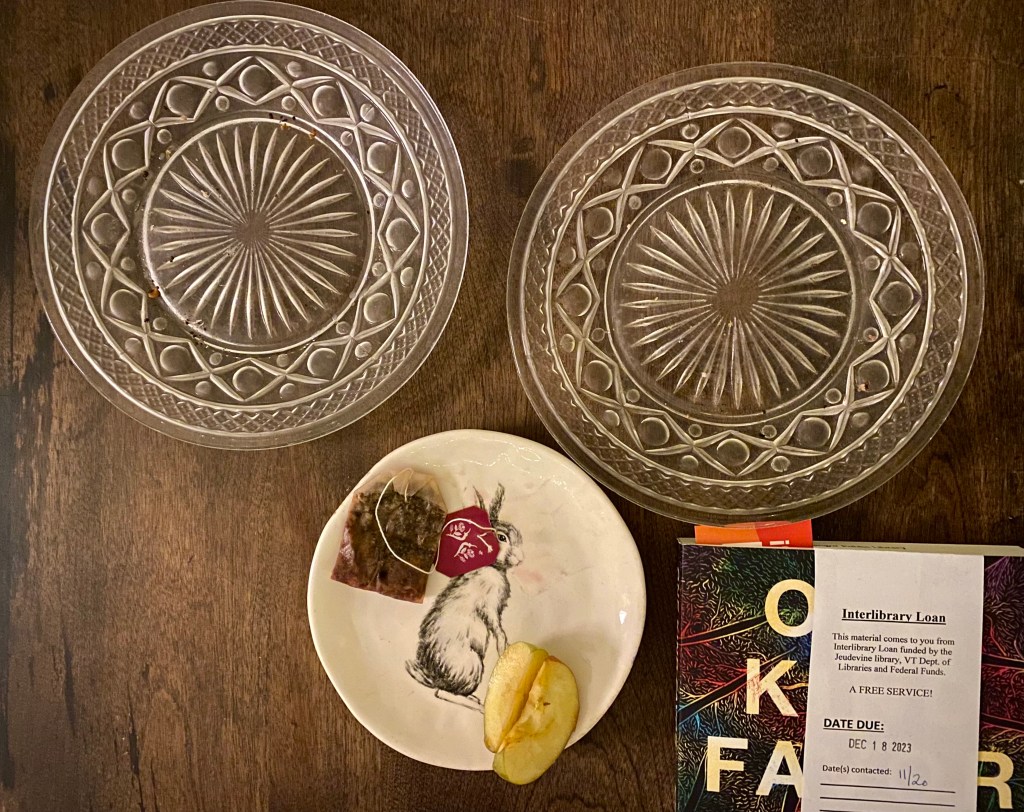
On this Sunday afternoon, my guest departs in the falling snow. When I head out for a walk, the cold has sunk in, deep enough that tendrils of snow cling to the grass and trees branches. The snow bends down last summer’s sunflowers in the garden. I leave my woodbox full, the cats sleeping, plates on the table. I intend only to return a handful of library books, but I head up the hill and around the high school and into the woods where the snow lies deeply and slows me down.

It’s December. Snow circles down, lovely and miraculous, this silent transformation.

Here’s a few lines for winter:

“Treasure what you find
already in your pocket, friend.”
― Ted Kooser

Stitching, in Friends & Wool.

December, and by five o’clock, the dark has hammered in for the night. A friend and I walk to the post office, talking about work and family, laughing as we avoid icy patches glowing beneath the streetlamps. We meet a neighbor walking home with her two children from the afterschool program. The boys have glowing strips wrapped around their wrists, red and green, that draw lines through the darkness as they pinwheel their arms.

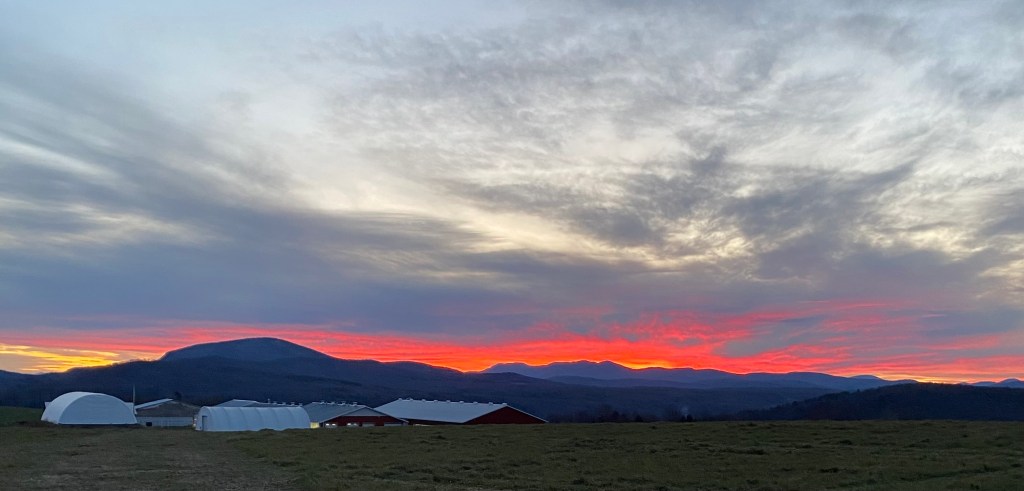
We return to my dead-end street where the light glows on my back porch. At the silhouette of mountains across the valley, an immense column of amber light illuminates the night sky. Moonrise. It’s not particularly cold. We linger and watch the stars and planets rub on against the darkness, one by one, and keep talking about those complicated stories of family, of how history bends back upon itself and what this might mean for our children who are in the time of their youth.

Above, stitches of a sweater I knitted for a faraway friend, something I created with pleasure and gratitude, that I’ll box up and mail away. Who knows when I’ll see these friends again. But it’s the only way forward that lends any illumination for me: stitch. When need be, unravel and begin again.

“The products of science and technology may be new, and some of them are quite horrid, but knitting? In knitting there are ancient possibilities; the earth is enriched with the dust of the millions of knitters who have held wool and needles since the beginning of sheep. Seamless sweaters and one-row buttonholes; knitted hems and phoney seams – it is unthinkable that these have, in mankind’s history, remained undiscovered and unknitted. One likes to believe that there is memory in the fingers; memory undeveloped, but still alive.”

Elizabeth Zimmermann

Vermont.

VTDigger‘s reporting about Burlington, Vermont.

Everything Is Made Of Labor 

The inchworm’s trajectory: 

pulse of impulse. The worm 

is tender. It won’t live 

long. Its green glows. 

It found a place to go. 

Arrange us with meaning,

the words plead. Find the thread 

through the dark.

Farnaz Fatemi

Two Bald Eagles.

After losing Yahtzee twice and then again to make a third, I’m in the passenger seat, heaing north for no particular reason at all. I’ve forgotten the library books I meant to return, and my bend of mind is that it makes no real difference at all.

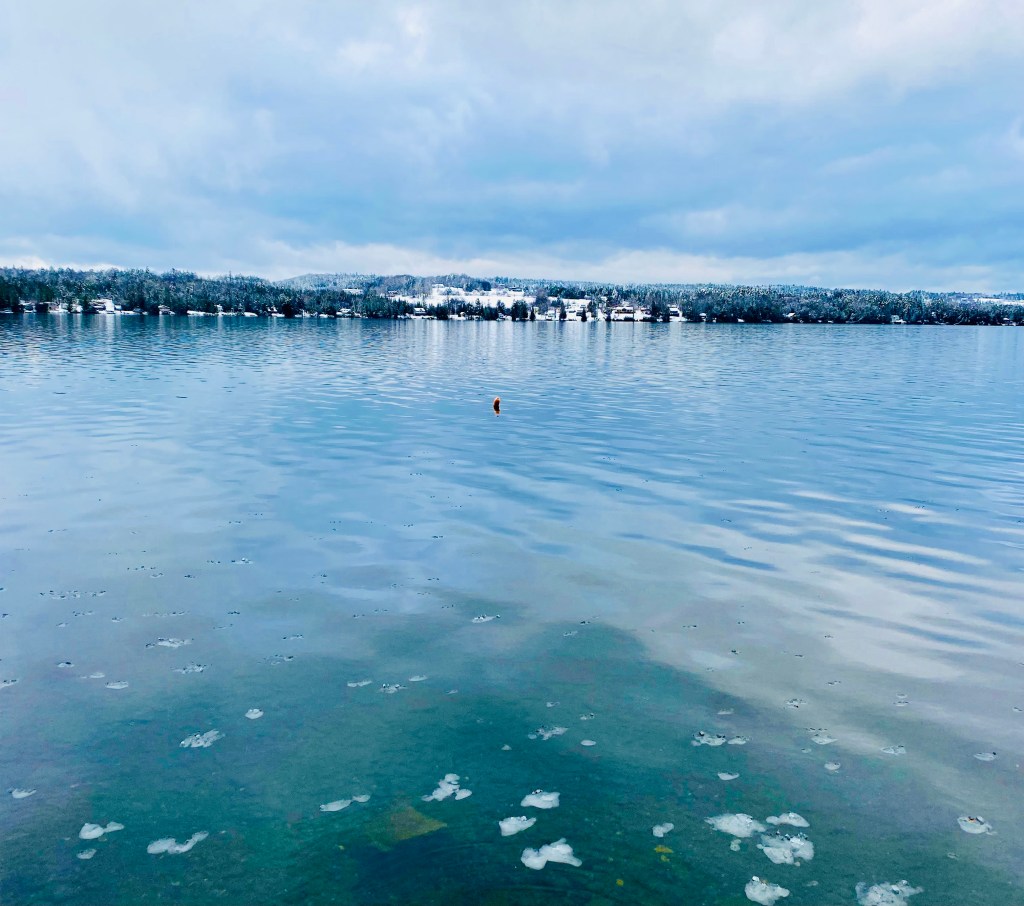
Just out of town, I spy two bald eagles on the reservoir, hunched on the beginnings of winter’s ice, unmistakable with their dark bodies, the white of their heads. We drive around a bend, disappearing up the road that’s so narrow and tight there’s no good place to stop. By the time the road widens, I know the way back is impassable through thickets. And so we go on. Talking, talking.

The eagles are perhaps the best of holiday metaphors, utterly outside the realm of any camera lens. (Please, my family might beg, could you lay off the insistence of seeing the world in metaphors?)

This, then: two mighty raptors, the season’s early ice, the rising moon. The evening now is cold enough that the moon sprinkles frostily. I dump the compost in the bin and crunch back over the scattered snow, hungry for the embers in my stove.

Yet once being born there is no turning back.

— Hayao Miyazaki

Thanksgiving Poem.

Don’t Hesitate

If you suddenly and unexpectedly feel joy,
don’t hesitate. Give in to it. There are plenty
of lives and whole towns destroyed or about
to be. We are not wise, and not very often
kind. And much can never be redeemed.
Still, life has some possibility left. Perhaps this
is its way of fighting back, that sometimes
something happens better than all the riches
or power in the world. It could be anything,
but very likely you notice it in the instant
when love begins. Anyway, that’s often the case.
Anyway, whatever it is, don’t be afraid
of its plenty. Joy is not made to be a crumb.

— Mary Oliver