Where’s the Calvary?

I stop by a friend’s house with some cookies, and we talk for a few moments on her back porch. Sunlight streams in through the windows, rare and cherished in December.

Driven more by the solstice than the calendar, this time of year is the time of reckoning: what’s happened, what’s lying fallow, what might emerge next year? 2023 was a year in my immediate world of wildfire smoke, of floods and more floods, of a social fabric thinning with half-truths and deception and irascibility. A year of people around me who suffered losses in ways that matter immeasurably.

The world we’ve created drives us to reduction, to categorizing our lives in an Instagram post, a hashtag. For anyone who’s even remotely following our personal or national stories, the facts align otherwise. History may likely prove that the precipice of 2024 was a still moment before a tsunami. A handful of years ago, on a sunny autumn afternoon, I faced a still point in my life when I realized the cavalry I’d relied upon to get me out of a marriage gone sour was not saddling up and heading my way. In what was really no joke, I sized up my assets, secured my perimeter, and penned myself a map to head out for new territory. I was, in fact, my own cavalry. Fresh horses arrived, thankfully, at key places. What surprised me the most was the generosity of strangers who, in passing, offered me small precious things like swallows of magic elixirs.

Here’s the thing: in my way of thinking, December is the holy month because of its deep darkness, utterly mysterious, profoundly unknowable, utterly unnegotiable, sometimes terrifying. It’s the season to open our hearts beyond that reduction. On her porch, the cold gnawed my hands holding those cookies. As we spoke, I thought of the songbirds that flock around this house in summer. We are the cavalry, in ways we often don’t rationalize or consider. Perhaps this is the dearest part of December: that in the darkness that transcends any human doing, our eyes are always searching for the moon and starlight, for luminosity. And the light is always there.
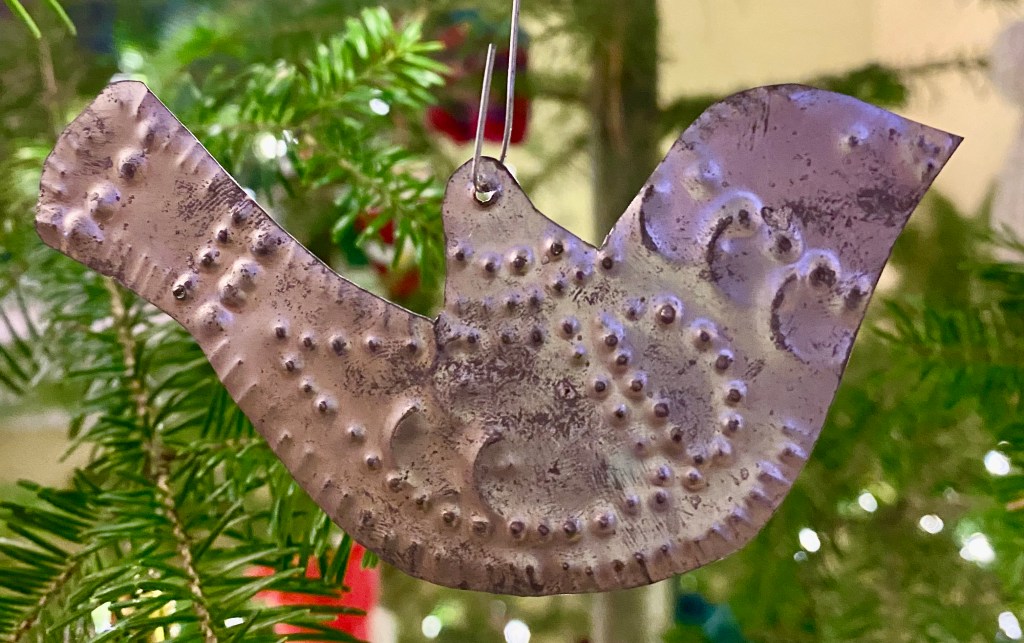
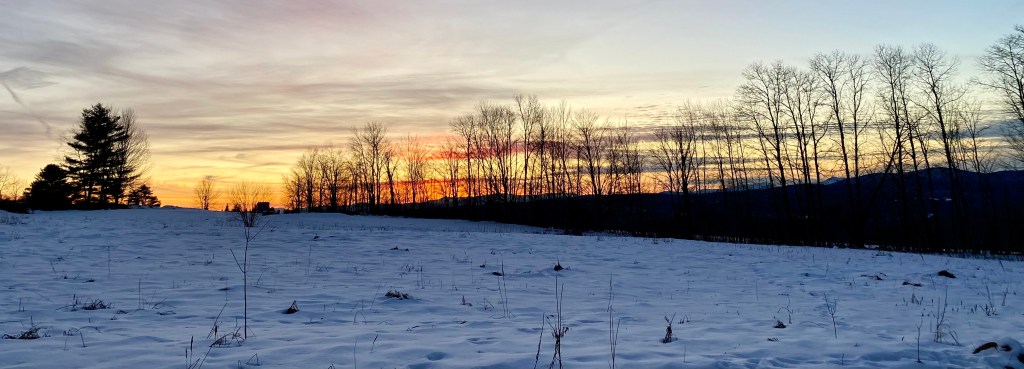
Solstice Dandelion.

I stopped into a candy shop in Montpelier to buy chocolate Santas for my daughters. We’ve been visiting this store since my daughters were so young I always held their hands downtown. The owner read my book, and we always talk about writing and family and Vermont small town life. Her store had reopened recently after July’s devastating flood. The rain and snowmelt in the forecast hovered around us as I filled a white paper bag with those bright foil-wrapped chocolates. As I listened, I added chocolate pastilles and more Santas, for her or my daughters or me, for the giving or taking, or maybe both.

This week’s rain likely spared this sweet shop, but towns around us were flooded again. In the town where I work, sections of roads carefully repaired after July’s flood broke again.

Yesterday, I spied a folded dandelion blossom in the town green. I squatted down and stared, not touching this brilliant gold in its emerald set. Overhead, those bunching clouds. A balmy breeze stirring over the lake that by day’s end will whet a bitter cold.

Solstice: hallelujah on this spinning planet.

Less and less surprises us as odd.

— Tracy K. Smith

Hello, Darkness, my old friend.

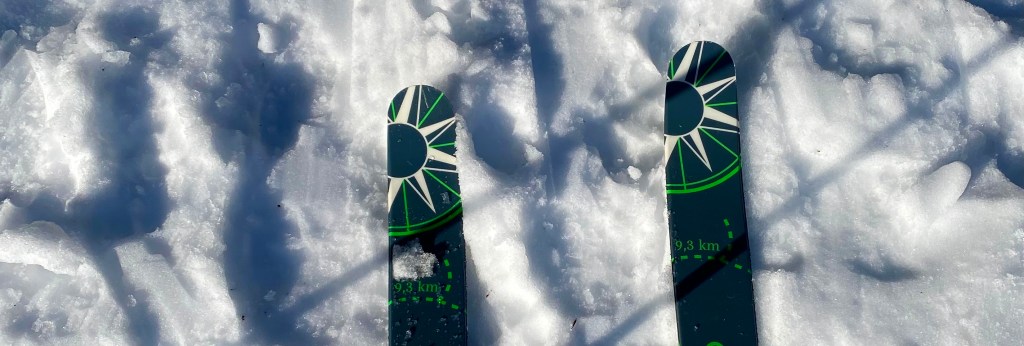
Heading towards the winter solstice, the days are cropped short. I ski in the woods. The next afternoon, after a spurt of warmth, I remove my skis to navigate around patches of tree roots, the exposed carpet of pine needles.

By 4:30, darkness envelopes us, velvety and broken only by our brief human endeavors of a line of twinkling holiday lights, streetlamps, parking lots lit up like precious jewels. Like a wild creature roused by these warm December nights, I prowl through the village and along the river.

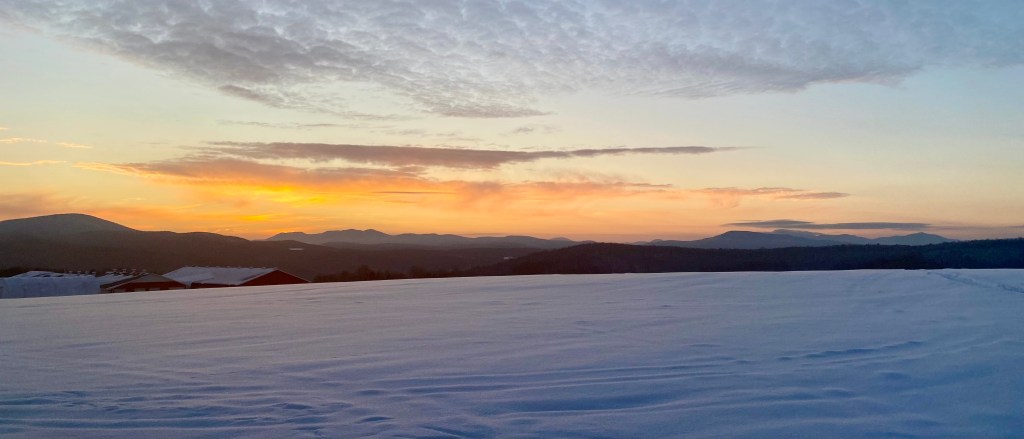
Returning home one late afternoon, I pause beside Woodbury Lake. A crescent moon illuminates the blue-black sky, the outline of its orb a faint round: a promise of January’s full wolf moon. Twilight’s but a few moments, molten gold rapidly consumed by the unstoppable night.

I remind myself that December is the time of descent, that the darkness I eyed so warily in October is now my mellifluous friend. I’ve been here before, in so many seasons of my life — dissatisfied and cracked, heart-full, my eyes attuned to starlight. Living into December and the solstice and the winter stretching ahead means stepping into the world’s great vessel, full of so much.

Here’s an article about the world’s first seed bank forwarded to me by a reader.

Your place in the world.

A rare mid-December day of sunlight, and the town seems festive, stirred by the truly false promise of spring. Not true, not true.

December’s a season of reckoning, of that inevitable look back across the months, to a year ago, to five, more. I’m old enough now that the seasons jumble into a Jacob’s Ladder of years: the Christmas of the hoar frost, the year a mouse drank from our Christmas tree stand, the 60 degree Christmas Eve my brother’s dog went swimming and gasped from the cold. The December snow fell every single day. That year, holed in the house with sick children, I wondered if I would go mad; I did not. All past, all somehow yet still with us. Heraclitus reminds us that the single constant in this life is change, and yet it’s still the same molecular stuff arranging and re-arranging, by the force of the universe and our sheer human will.

Oh December: you heartbreaker, you. Sleet and radiant sunlight in the span of a few days. Icicles drip. Chickadees whistle in the white pines. My wood chores finished, the compost bin dug out, I linger in the sun, leaning against the house, reading Paolo Cognetti:

You find your place in the world much less predictably than you’d imagine.

The sound of wind.

Seems a little early, pre-solstice and all, to be citing winter haiku, but the thing is, winter haiku is just so darn good. In so many ways, winter brings out the New Englander in each of us, as we ramble on about previous winters (the year back in the mid-90s when antifreeze froze, or the year school was cancelled was for three days straight). Or how to survive with savviness: long quilted coat, chop wood, frying pan on the sheets. When a few strands of sun tumbled out of the clouds this afternoon, I dashed outside to fill my eyes with light. Hope the weather’s keeping you more interested than inconvenienced…..

Winter solitude—

In a world of one color

The sound of wind.

— Bashō

I believe in good gloves.

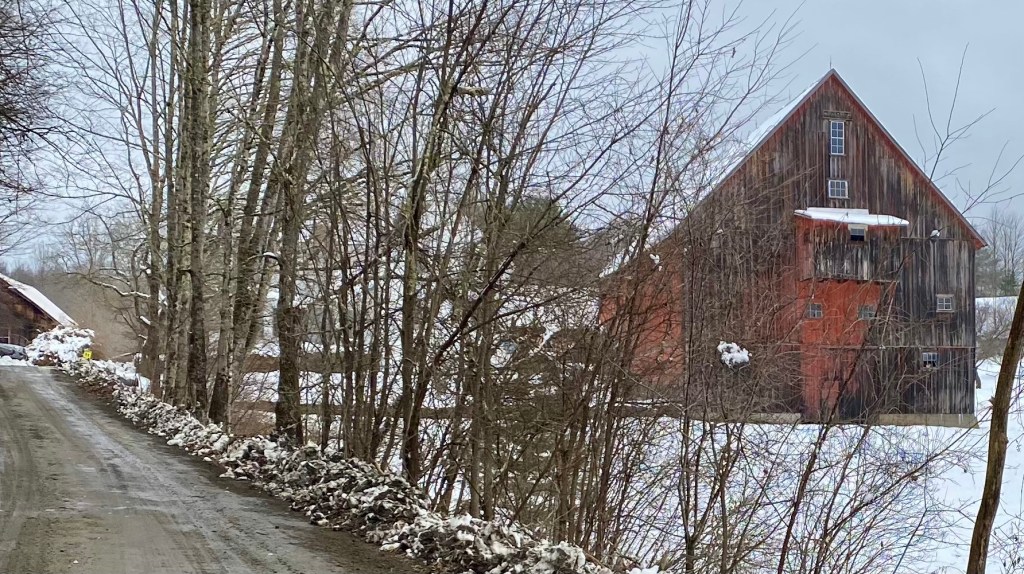
At the Vermont Almanac‘s celebration of volume four, I talk with people I haven’t seen in years — my daughter’s beloved elementary school teacher, a couple who bought a house down the road from where I once lived. As the staff from the center where the celebration was held clean up, ready to head home themselves, I walk out with my former neighbors. We stand for a few moments by a fire burning in a pit, talking about sugaring and our daughters and Vermont dirt roads. Through the wide windows, I watch people wrapping up the remains of cheese and dried sausage. In my house, I am still eating the remains of Thanksgiving’s cheese, the sharp cheddar I used in my friend’s birthday sandwich.

Overhead, stars strained again the clouds.

I’d been asked to read a poem, “Dear Day in Late September,” for poet Kerrin McCadden, who couldn’t attend. I consider this poem a love letter in the tenor of love letters I admire most — elegantly stripped down, mindful of life’s deep sadness and the beauty of our world fat with bees.

On my way home, I think of the line “I believe in good gloves.” As a former sugar maker, I’ve used up countless gloves. With my small hands, I’ve never had a pair of gloves that fit. At Thanksgiving, in a shop looking for boots, my daughter handed me a pair of petite gloves. I nearly laid them to the side (thrift, thrift), but I bought them. Yesterday, wearing these gloves to bring in wood, I realized the gloves fit me perfectly, downy on the inside. Warm, strong, practical. What do you know.

…. I want to tell you I am

thinking about closing up shop for the winter. I am settling

my accounts. Enclosed, please find a brace of birds,

which I hope you will accept as payment against last winter’s

oil bills. There is much to do. Up in the barn, I have spelled

out the name of the man I love with crabapples. It is one way

to know a man’s heart. I believe in his name, though,

like I believe in good gloves. Oh, how we fight the cold

with everything we have.

Kerrin McCadden