Ice and Woodchucks

The little girl, her grandfather, and I baited a borrowed trap for the woodchuck yesterday afternoon. This morning, I lay awake for a little, wondering if the woodchuck had tripped the trap, and what I would do with the animal if I had possession. When the bright-eyed little girl awoke, we ran up through the buckwheat and looked. The trap was still empty, the unpeeled banana beginning to rot.

Will the trap be empty tomorrow, or slammed shut with a furry and weighty creature within? I dread the thought of a crazed and wild animal thrashing in that narrow cage, but I’m also consumed with a curiosity, a sheer wonderment to meet this foe as near to me as possible, to see the sheen of its dark eyes, its lustrous pelt, its razor glinting teeth. For weeks now, this woodchuck has stalked my garden, devoured my chard in one meal, ransacked my tomatoes, tore off in a run whenever my steps approached. All around the edges of my world this creature has been at once elusive and visible.

To meet your nemesis face-to-face, not in combat, but to simply see, gaze upon the other’s face–what an experience that would be. Will a woodchuck be hunkered angrily in that cage tomorrow? Or a raccoon? An odoriferous skunk? Or perhaps merely the wind, whistling through, over decaying fruit.

I’m more and more aware that, as the ice recedes, this world we live in becomes more unlivable for humans. People need glaciers, just as glaciers now need us. Sudden crevasses in our lives can leave us helpless and alone, but we are never isolated for long. What makes up a glacier, I remember, is millions and millions of little snowflakes, reaching out to one another, grasping hands.

–– M Jackson, While Glaciers Slept
Photo by Molly S.
Photo by Molly S.

Oh, Mary Oliver…

How sweet can this job be? When I arrived at the Galaxy Bookshop today, my co-worker handed me an advance reading copy and said, This is the important thing for today. You need to read this.

Felicity by Mary Oliver.

My fellow bookseller said, Some of these poems she’s created just for me.

And then she promptly showed me a poem I knew was written solely for me. But maybe you, too?

NO, I’VE NEVER BEEN TO THIS COUNTRY

No I’d never been to this country
before. No, I didn’t know where the roads
would lead me. No, I didn’t intend to
turn back.

–– Mary Oliver

Photo by Molly S.

Photo by Molly S.

Summer: Sing Like the Sea

Day by day, this sweet August season winds down. Next week, I’ll walk with my girls down the driveway to the bus stop, where we’ll kick around the fallen apples from the wild trees along the road, looking through the misty fall mornings for the bright yellow bus. Our summer has been packed with all kinds of things: hiking and friends and art camps, not enough swimming, countless s’mores with the cousins.

We spent a lot of miles with my older daughter at the steering wheel, me with my knitting in the front seat, the three younger kids in the backseat, everyone talking sometimes all at the same time. Near the end of the cousins’ stay, late one afternoon we drove up the winding dirt road towards home, everyone hot and hungry, miserable and crabby all the way around. Without thinking, I put both my bare feet out the window and waved my soles at the passing trees. The children shouted, What are you doing? and because I started laughing, they all started laughing, even the teenager in the driver’s seat who does not approve of such undignified behavior, not at all, although she graciously tolerates my foolishness.

Silly? Completely. But in the face of things that are not humorous–words that none of us even want to say, like cancer for instance–why not occasionally throw your feet up and rally to the grubby children in the backseat? Say: I don’t want to hear bickering; just hang with me for a little bit in this golden summer, with all of you so near?

Driving to work today, I thought of these kids of mine and that afternoon, and the last stanza of one of my most beloved poems, “Fern Hill.” I’d always considered the final words tragically bittersweet, but I wonder perhaps now if I misunderstood these lines. Perhaps this poem is about acceptance of our mortality, and simultaneously an exhortation to sing like the sea, rage on against the dying light, laugh in the face of despair. Write beautifully in this good world.

Nothing I cared, in the lamb white days, that time would
take me
Up to the swallow thronged loft by the shadow of my hand,
In the moon that is always rising,
Nor that riding to sleep
I should hear him fly with the high fields
And wake to the farm forever fled from the childless land.
Oh as I was young and easy in the mercy of his means,
Time held me green and dying
Though I sang in my chains like the sea.

–– Dylan Thomas

IMG_7430

Photo by Molly S. Gabriela and Kaz, Sterling Pond

Weeping and Hovenweep, one year later

Just about a year ago, my daughters and I spent a long afternoon in Hovenweep National Monument, in Utah. Even now, the sound of that name – Hovenweep – makes me want to press my fingers over my face. We sat under a slatted aluminum covering over a picnic table, unable to stir out into the heat, unwilling even to walk a short distance to what I imagined was the edge of a canyon. By this point in the summer, we had traveled thousands of miles, slept in many different places, and trod the gamut of human emotion. Hovenweep become our literal edge of the world, the place where, when you get there, you can no longer admire the abyss of the canyon.

All afternoon, under a broiling sun, my daughters and I sat beneath that crude cheap covering, playing Hearts, playing Yahtzee, the girls eating Nutella so hot it dripped from a spoon. We were waiting for a particular person to either appear, or not. As we waited, I watched a storm cloud in the distance, so far away in that eternal Utah horizon. Would it mass over us and rain?

The drama of our little family unspun that afternoon in an immense landscape of dust and small pebble and a few sprigs of sage, a land of no rain. I believed I could walk all day long in that desert, and, at the end of the day, I could still look back and see where I had begun. Hovenweep is a territory of stunning high desert beauty, and yet inescapably saturated with the crumbling, inexplicable ruins of the past. All that afternoon, filled with trepidation, anger, grief, I sensed the vast watchfulness of that place; how many, many women must have lived in that dry land, with joy surely, and surely also with terror for themselves and their children, as their demise reared up, with neither cheap shade nor nutella.

How much I would have liked to have seen one of my sisters from long ago that afternoon, a woman who might have known how things break apart. Who might have understood how I look at my daughters with mine, mine in my eyes. Who might have offered me her hand, as I would have toward her.

This is what human beings have felt from the beginning of time. If you want to be a full, complete human being, if you want to be genuine and not pretend that everything is either one way or the other way you can hold the fullness of life in your heart….

–– Pema Chödrön, Fail Fail Again Fail Better
IMG_8406

Failure and Writing

One of the real assets to working in a bookstore is the Advance Reader Copies–those paperbacks that appear in a white box shortly before everyone else gets their hands on them. Early this morning I read a little book of Pema Chödrön’s, Fail Fail Again Fail Better but, heads up, the interview at the end is the better part of the book. An eighty-year-old nun now, Chodron is refreshingly honest about her mistakes as a young woman, her two failed marriages, her struggles with parenting.

In this book, she writes about how to live a life in the present–with mindfulness–and yet acknowledge the wrongs we’ve all committed in our lives. In other words, how to reconcile what we’ve screwed up–and we all screw up, badly, one way or another–with a creative and loving and productive life. Isn’t that a fine place to aim for? To hold the past, acknowledge it, hold it before you like the foulest and ugliest of your fears, and yet move on.

Canoeing with my daughters today is a wholly present moment–sunlight and dragonflies, the water almost too warm at the surface, then cooler the deeper down I dove–and yet I carried with me, secreted, as if beneath a middle rib, thoughts of the book I’m rewriting–taking apart and taking apart–and will begin to put back together, better. Finer. Smarter.

“Fail better” means you being to have the ability to hold… “the raw of vulnerability” in your heart, and see it as your connection with other human beings and as a part of your humanness. Failing better means when these things happen in your life, they become a source of growth, a source of forward… If it’s something like writing, just start–don’t not write the book.

–– Pema Chödrön

IMG_8448

Photo by Molly S. Number 10 Pond, Calais, Vermont

Writing Your Life

By this time of year in Vermont, much of what will come to fruition has been sowed and thrives. You’ve either had a crop of blueberries or not. The strawberries have long since gone by, only the verdant green remaining. Carrots, kale, squash, all should be well on their way.

What’s gone is gone. My chard, devoured by the woodchuck, will not grace my kitchen table this year. This digs at the question of poetry. I could turn my gaze and blind myself to how my garden lies at this time, weedy and gnawed in places, the peppers sweet and savory, the green ripening on the ear, the cucumbers proliferate. A metaphor for raising a child, acknowledging where wiser tending could have happened – or not. The elements of rain and cold and disease will thrust in.

But writing, perhaps, is a different endeavor than life. You get a rough draft; with diligence, you can rewrite and rework, burnishing your words. Easier, less risky, less dear.

Isn’t this all a matter of hunger, of desire in one raw form or another, a great maw of longing for satiation? The woodchuck to fill his belly. The carrots to thicken. A writer’s desire to reflect and hold the world’s mysterious complexity and beauty. A child’s yearning for growth and expansion.

A mountain can be a great teacher–not only because it manifests that cosmology of sincerity and restless hunger with such immediacy and drama, but also because it stands apart, at once elusive and magisterial…. (Walking up Hunger Mountain) reminds me yet again that things in and of themselves remain beyond us, even after… the most concise and penetrating poem.

–– David Hinton, HUNGER MOUNTAIN

DSCF0031 1

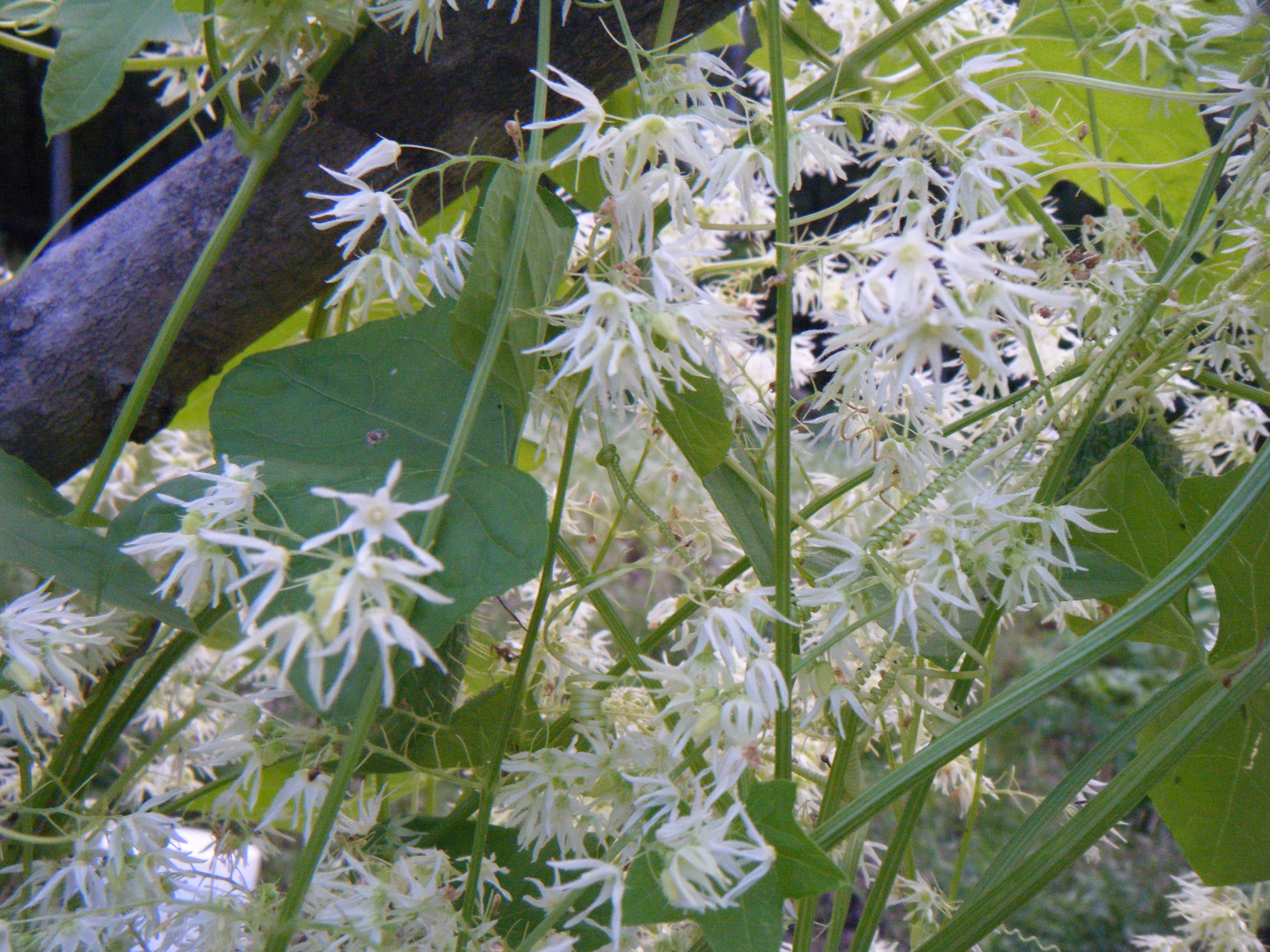
Wild cucumbers.