The Earth Herself

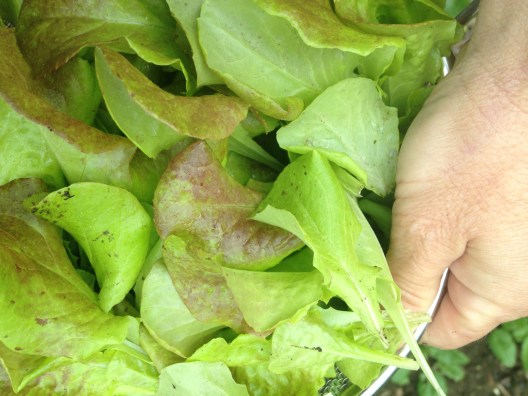
In the garden, on this chilly, almost autumn-esque day, I pulled lettuce from a fattening line, admiring the myriad green. So much of writing is spinning the stuff of language into this three-dimensional world we inhabit. Our world is so amazingly complex, jammed ceaselessly with variations of color and light, that language at times seems a poor descriptor.

I always remind myself, begin at the beginning, with the very first word. Setting aside my basket of lovely leaves, my fingers crumbled dirt into my palm. Dirt? Or the earth itself, but a few grains of this celestial, spinning orb? Or Thomas Wolfe’s “loamy soil”? Or is this broken sod? Tenacious clay?

I held the handful near my face: black earth, lavish enough to devour.

The voice of forest water in the night, a woman’s laughter in the dark, the clean, hard rattle of raked gravel, the cricketing stitch of midday in hot meadows, the delicate web of children’s voices in bright air–these things will never change.

– Thomas Wolfe, You Can’t Go Home Again
IMG_1435.JPG

Woodbury, Vermont

Vinegar & the Lupine Metaphor

My teenage daughter asked me if I knew Christ, dying on the cross, had been given vinegar to drink. Why? she asks, mystified.

Why is it that these profound questions so frequently appear when I am about bled out of energy? Could I not write a veritable book on this subject? Our kitchen holds five vinegars – apple cider, balsamic, white, rice wine, an herb infusion – and we use it for preserving, cooking, cleaning. But soak a spongeful and press it your lips? My daughters are horrified at the image.

I offer what my children consider an unsatisfactory answer: the antidote to drinking sour wine is wild lupines. I remind them of the children’s book they both loved so dearly, Miss Rumphius. Could this be the weekend’s challenge, in a realm beyond folding laundry? Amend that: could this be the existential challenge?

You must do something to make the world more beautiful.

 Barbara Cooney, Miss Rumphius

FullSizeRender

Where You Can Find Us

Late last night, cleaning up my desk for the morning’s work, I found a flip book my daughter had made, with scraps of white paper from my recycling box and stapled together. On its cover, she had written in pencil Where You Might Find Me.

The first page began with a band of rainbows stars drawn in colored pencil – the Milky Way – followed by the classic solar system with orbiting planets, and then the azure and emerald orb of Earth. Her maps decreased to graphite renditions of North American, the United States, New England, Vermont, Washington County, and finally the town of Woodbury.

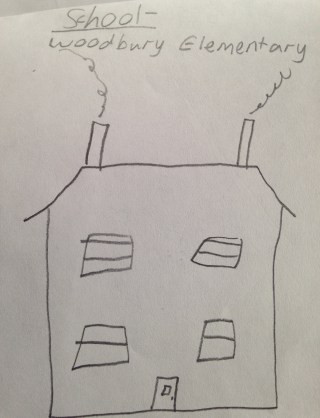
At the very end, I anticipated her typical drawing of our house, with a second floor balcony and the cupola that yet remains unfinished, the front door flanked by tiger lilies. Instead, she drew the Woodbury Schoolhouse, smoke cheerfully curling from its matching chimneys.

I love Vermont because of her hills and valleys, her scenery and invigorating climate, but most of all because of her indomitable people. They are a race of pioneers who have almost beggared themselves to serve others. If the spirit of liberty should vanish in other parts of the Union, and support of our institutions should languish, it could all be replenished from the generous store held by the people of this brave little state of Vermont.

– Calvin Coolidge

FullSizeRender

Yin Yang, or Giving Rise To Complements

Here’s a simple thing which took me a ridiculously long time to learn: that famous yin yang symbol isn’t particularly about a dot of white in a tear of black or vice versa. Instead, the black and white are all smeared together.

As an American woman, for years I perceived the world as opposites: you’re in the house or out, it’s light or dark, we’re dead or alive. Through gardening, I began to perceive growth demands decay, and then I carried that notion to writing: creation depends on destruction. The universe is intricately braided with myriad shades of being, color, sound….. There is no one single thing separate and opposed to the whole other rest of the world.

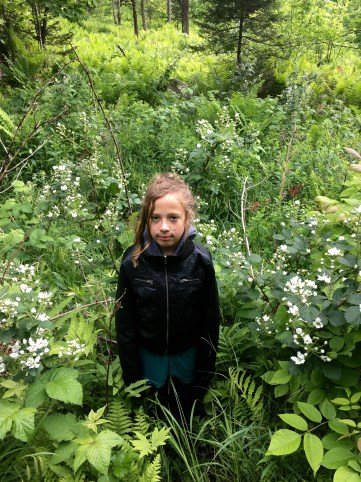
So when my daughter comes with me on a drizzly and rainy afternoon in the woods behind our house, I’m grateful this the childhood world she knows, the place she is rightfully at home in.

….These two emerge together but differ in name
The unity is said to be the mystery
Mystery of mysteries, the door to all wonders….

– Tao Te Ching

FullSizeRender.jpg

Photo by Molly S./Woodbury, Vermont


Onamonapia

This afternoon, my 11-year-old daughter walked around the house saying 0namonapia,  over and over, desperately trying to drive her sister nuts, by repeating this beautiful word, richly rolling off her tongue.

Years ago I used to nurse this child at the farmers market where my then-husband and I sold maple syrup. One afternoon, I nursed my baby on the grass behind our tent, leaning up against a pole. A couple sat down somewhat near me, in the shade beneath a poplar tree. Eating, they casually spoke in a slavic language I didn’t recognize. I generally knew they were talking about the day, but I couldn’t really piece together much more than that.

My baby fell sleep, and I pulled a blanket over her soft little limbs, then leaned my head back against the pole and closed my eyes. While the couple kept eating and talking, I listened to their words, this beautiful language I couldn’t precisely understand, but I knew the language tied them together.

Surely, 0namonapia relays much more than cluck or moo. This is a word whose meaning can stretch to entire languages: an audible beauty that makes us human.


The Bells

Hear the sledges with the bells—
Silver bells!
What a world of merriment their melody foretells!
How they tinkle, tinkle, tinkle,
In the icy air of night!

– Edgar Allen Poe

FullSizeRender

sweater weather in June Vermont


Butterfly Visitors

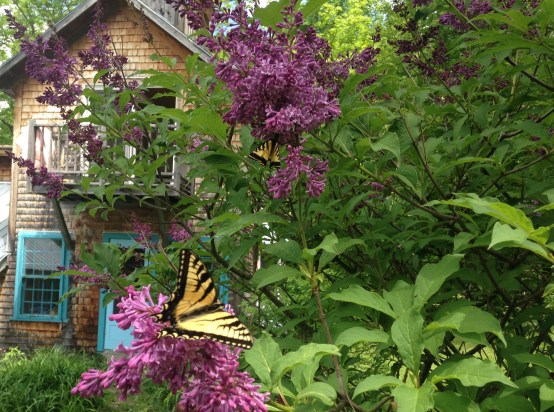
Finally bursting into growth this year, our lilac bush is covered with swallowtail butterflies. All around us, the pollinators steadily work: hummingbird, bee, wasp. The butterflies are uniquely magical, though, wholly silent, almost tame enough to touch my hand near the fragrant blossoms. Then, like a shimmering cloud of colored papers, they lift off one-by-one and disappear, upward, into the apple tree’s canopy.

My daughter’s favorite scene in My Neighbor Totoro is when little Mei lies sleeping on the Totoro in the forest, while butterflies flicker and rise. In that same spirit, the book I’m writing holds spring azures near its end, these exquisitely beautiful creatures who appear mistakenly fragile, yet are graced with flight and fertility, mightily powerful.

….Come often to us (butterflies), fear no wrong;
Sit near us on the bough!
We’ll talk of sunshine and of song,
And summer days, when we were young;
Sweet childish days, that were as long
As twenty days are now.

– William Wordsworth, “To a Butterfly”

FullSizeRender

Woodbury, Vermont