Morning March Music

I unlocked the elementary school yesterday morning when the day was yet in that black-turning-blue phase of dawn. I was there to get the coffee going for that venerable New England tradition, pie breakfast. Allow me to brag for a moment about my town. With a population of 902 (including newborns), nearly 200 pies appeared in the school kitchen, carefully wrapped, many warm from home ovens.

Pie Breakfast is a hustling sweet-and-savory morning, bursting with conversation, live music, laughter, lots of kids. The most welcome melody I heard, though, was the red-wing blackbirds in the white pines below the library. My booksale volunteers and I stood on the icy pavement in the brilliant March sunlight, surrounded by two feet of sparkling snow, listening to the first harbinger of migration’s return, the promise of spring, the full-throated song of mating.

Hope is the thing with feathers
That perches in the soul,
And sings the tune without the words,
And never stops at all…

– Emily Dickinson

FullSizeRender

A Condensed Parenting Manual

There’s an odd line from Lee in Steinbeck’s East of Eden that’s always stuck with me, since I first read the book when I was sixteen or so: I will not put my finger in any human pie. What a strange metaphor (as if we’re baked goods?).

Tomorrow is Woodbury Pie Breakfast, the community-wide sit down to pie and coffee, live music and cabin fever conversation. This afternoon is pie baking in my house, as I suspect it will be in many Woodbury kitchens. The question around town is, What kind of pie are you baking? Or, wishfully muttered, I hope I get some of Skip’s chocolate with raspberry swirl this year.

Pie is easy – crust and filling – but human pie? Human creation? A family member this winter drove to North Dakota and joined the Standing Rock Protests, then disappeared underground, in a variation of Five Easy Pieces, with not a word to family he had left behind. He must have profoundly believed he was called to that Jihadist path, leaving behind a grief like earth crudely harrowed up but untended, uncultivated.

Steinbeck is likely at the heart of my own raw parenting philosophy. As one daughter steps into adulthood, and the other teeters on adolescence, my mantra repeats Socratic self-examination: What the heck are you doing – and why? What an annoyance it must be to have a mother more concerned with keeping the darkness of Nihilism at bay, rather than building a really stellar college application.

March is always the season of entropy, cabin fever, quarreling. We’re surrounded by depths of snow: Currier and Ives picturesque, and a real complication, too. And that’s another metaphor.

I believe that there is one story in the world, and only one. . . . Humans are caught—in their lives, in their thoughts, in their hungers and ambitions, in their avarice and cruelty, and in their kindness and generosity too—in a net of good and evil. . . . There is no other story. A man, after he has brushed off the dust and chips of his life, will have left only the hard, clean questions: Was it good or was it evil? Have I done well—or ill?

– John Steinbeck, East of Eden

FullSizeRender

Snow Child

It’s an Ezra Jack Keats kind of snowy day (or days) in Vermont. If you’re not out foolishly driving around (and not many are), the snow is spiraling down exquisitely. After hours of tedious work inside, while the snow swirled against the windows, I walked along our unplowed road. Pausing on my way to meet my neighbor, I remembered those winters when my firstborn was a toddler, and winters really were one months-long housebound snowstorm.

Every day, I pulled my chattery child along the road on a runner sled. Always, at the same place she would beg me to lumber through the deep snow into the woods and pluck a few miniature hemlock pinecones from a low hanging branch.

Years later, unboxing this red snowsuit for her younger sister, I discovered tiny pinecones in every pocket.

It was so wonderful to be there, safe at home, sheltered from the winds and the cold. Laura thought that this must be a little like heaven, where the weary are at rest.

– Laura Ingalls Wilder, The Long Winter

FullSizeRender

Chipped Lives

It’s so darn cold here I woke up in the dark this morning with the cold scraping my cheeks. Leftover pork bubbles on the wood stove with red chili and beans: we need heat and bright color.

Despite the cold, the March light is sparklingly beautiful. My young neighbor and I slid around the ice surrounding the sugarhouse, covered with a few inches of sugary snow. I offer him salvaged doors and windows, piles of wood; he’s happy.

Less here; more down the road. This morning, while my wood stove slowly warmed our house, I remembered a Hemingway line about the surprise at the end of Ulysses. Finishing Finkel’s new book this morning, I discovered an incredible surprise in his ending. The line I snipped below is perhaps one of the few pieces of advice I could truly offer my 18-year-old daughter, this young woman who has already met the hole in her heart with burning rage.

The neighbor loads his Subaru. I’m relieved to have these potential pieces of home travel down the road. Build a greenhouse. Plant more seeds. Thrive.

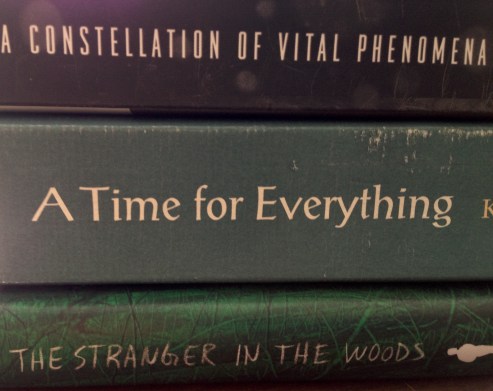
I think that most of us feel like something is missing from our lives, and I wondered then if Knight’s (the hermit) journey was to seek it. But life isn’t about searching endlessly to find what’s missing; it’s about learning to live with the missing parts.

– Michael Finkel, The Stranger in the Woods: the Extraordinary Story of the Last True Hermit

FullSizeRender

My Familiar

The past two mornings, a large fisher cat has slunk through my snow-covered garden, scoped out the compost, and wandered back into the woods, with that odd, weasel-esque serpentine back motion. The creature is dark as a rain-sodden forest floor.

My house is for sale now, and strangers have been wandering in and out. Do they admire the blue I’ve painted the windows? Are they as annoyed with the unfinished trim and stair treads as I am, or are they starry-eyed, as I would have been, years ago?

I’ve told none of them of this wild creature wandering in and out, my own particular secret, the wildness I’ll carry with me, no matter where we go.

The truth felt stranger than the myth.

Michael Finkel, The Stranger in the Woods: the Extraordinary Story of the Last True Hermit

FullSizeRender

fitting reading, these days

Mother

One rainy Saturday when I was a kid, my dad drove me and my siblings to the movie Watership Down in Manchester, New Hampshire, in an old green Commando Jeep he drove most of my childhood. On the way there, approaching an intersection, the brakes failed, and he slid through an intersection blaring his horn and flashing his lights. Under a benevolent star that day, we cruised through the red light unharmed, and my dad pulled over, doubtlessly nearly breathless with relief.

For a child, that memory remained as a flashy bit of drama. As a parent at the wheel with three kids, terrible misfortune averted. When I told my 18-year-old daughter to drive safety the other day, heading to high school or work or out with her friends to the movies, she rolled her eyes. I reiterated that I will always be your mother, so bear up, my beloved.

Today is my mother’s 80th birthday, two days after my father’s 80th birthday, both children of the Depression, with their own long lives which have touched so many people.

I think of parenting like the proverb from an old Tom Selleck movie: The ox is slow, but the earth is patient, plodding along with heavy-hooves, but overhead spreads the changing, infinite sky, the eternal constant comfort of the earth beneath our feet.

Best wishes on your birthday, mother.

…Let me congratulate you on
the birthday of your son…
You didn’t make him prosperous or famous,
and fearlessness is his only talent.
Open up his windows,
let in the twittering in the leafy branches…
Give him his notebook and his ink bottle,
give him a drink of milk and watch him go.

– Yevgeny Yevtushenko, from “Birthday”

FullSizeRender