Sunday

Growing up in southern New Hampshire, the summer sky often skimmed over with smeary white humidity, and I spent a lot of my childhood summers reading library books on the cool front porch behind the trumpet vine. Our box fan in a green metal cage was missing a screw and rattled until my mother jammed it somewhat quiet with a folded-over piece of cardboard.

These days, it’s often just the 12-year-old and me. Yesterday, I found her, hidden on the back porch, reading. While the summer to me seems to be soaring by in a few heartbeats, for a child I often forget a day is yet a day.

Good book? I asked.

Her eyes came to me slowly, returning from this fictional land with people I’ve never met. She nodded. Yeah.

Walked and walked
Here still to go—
Summer fields

– Buson

FullSizeRender.jpg

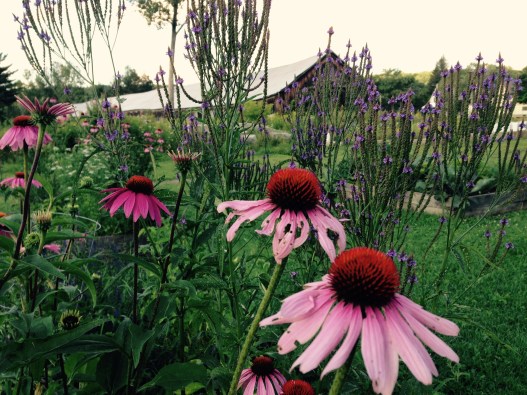
Hardwick, Vermont, community garden

August Fragrance

My car stunk of shit when I arrived in Vermont’s capital city Friday afternoon, the debris from an enormous manure spreader I’d passed on a dirt road in Calais jammed in the undercarriage. Add to that, the fat stalk of garlic I’d nabbed from the school’s garden. I’d tugged it out to see how near (or late) to picking it was, and the pearly head, beneath the crumbling dirt I’d thumbed off, smelled so fragrantly delicious I decided to bring it home for dinner. Manure, garlic, and someone’s running shoes left in the backseat.

This past month, fierce thunderstorms have deluged us, and our piece of Vermont fluctuates between sodden and freshly-dried, smelling of wild blackberry vines and the pine bark mulch I gleaned from the town garage. Yesterday afternoon, my weeding interrupted, I read Adam Gopnik’s line in his article about Buddhism in The New Yorker – “…the things we cherish inevitably change and rot…” – which is likely the entire, unvarnished sum of human suffering.

The kids complained about the co-mixture of odors in the car – naturally. And, inevitably, I laughed off those complaints. Even with this early morning rain, I think we’ll swim today.

IMG_1518.JPG


Navigating Sans I-Phone

Before I bought this house in June, I’d spent a number of winter and spring evenings wandering around its exterior. The house was uninhabited then, and I very much wanted to know where the moon rose on this piece of land. Would the moon be concealed by trees or streetlights, or would Lady Moon sail up in her luminescent beauty?

Nearly twenty years ago, I became a sugarmaker about the same time I became a new mother – the work of both often accomplished in the wee night hours. In those years, I began to know Lady Moon in all her phases – round and crescent, gibbous, waxing and lessening. This house I began to love, in part, because of the rising moon view.

Last night, late, the moon was my companion as I read a book I’d found in the library stacks, Juliane Koepcke’s story of surviving a plane crash in the Amazon when she was 17. Her parents, an ornithologist and biologist, had taught her to know and love the jungle – and Koepcke credits both knowledge and love with her ten-day trek out of the jungle and into survival.

In the moonlight, I lay awake thinking of Koepcke, and how her story, in an odd way, mirrors that of the poor woodcutter who gave his children bread. Hansel and Gretel crumbled the bread behind them, in a vain attempt to find their way out of the forest and away from the wicked witch. Metaphorically, there it is again: the jungle or forest all around us. So many times, I’ve wondered what I’m giving my children to find their way home, when my daughters will be lost. I’m too much of a pragmatist to know they won’t be mired in thickets, in their time. (Just not too thorny, please. Just not too darkly.)

Foolishly, I’d never considered love a navigation tool.

I open my eyes, and it’s immediately clear to me what has happened: I was in a plane crash and am now in the middle of the jungle. I will never forget the image I saw when I opened my eyes: the crowns of the jungle giants suffused with golden light, which makes everything glow green in many shades…. This sight will remain burned into my memory for all time, like a painting…. I don’t feel fear, but a boundless feeling abandonment.

– Juliane Kopecke, When I Fell From the Sky 

IMG_1499.JPG

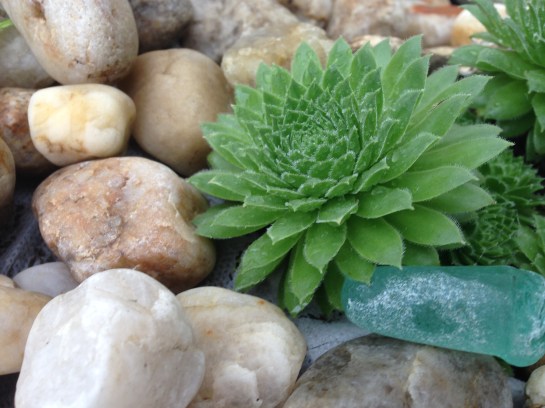
Gabriela’s rock garden, created on a summery day


Myriad Things

These summer days, I often work at home, awake and drinking coffee while the girls slumber, and the sun rises and slowly steams off the dew from our croquet patch, the garden, and the town’s rusted metal fence and cemetery beyond.

Yesterday afternoon, my daughter and I walked into the sultry town for another of my meetings at the town library. Some rouge patron had plugged up the basement plumbing, so I shopvacc’ed the cement floor while librarian lifted boxes from the spreading flood. Then we sat outside in the sunlight, nodding to patrons, while she answered my questions about the little library I manage. One patron returned three books, including the novel I’ve written. I restrained myself from quizzing, What did you think?

At home again, in the late afternoon, my daughter picked handfuls of cucumbers from our small garden. While we talked, I made a savory dinner the girls love – peppers, onions, herbs, sausage, tomatoes, rolled into bread dough, coarse-salted and rubbed with olive oil. While the bread baked, we worked in the garden, the half moon rising through crimson clouds over the peak of our house. She was chattery and happy. I love the evenings best, she said.

Poem (As the Cat)

As the cat
climbed over
the top of

the jamcloset
first the right
forefoot

carefully
then the hind
stepped down

into the pit of
the empty
flowerpot

– Williams Carlos Williams

FullSizeRender


Crossing Open Water

My canoeing experience, while somewhat lengthy, has always been confined to summery, pleasurable afternoons, on Vermont’s still lakes and ponds, often with swimming and almost always with kids. Only once, on my honeymoon, did I worry our canoe might flip.

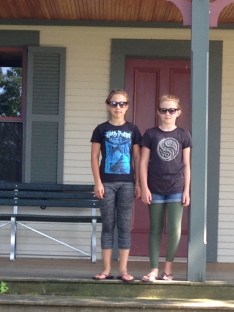
Oddly, I found myself on nearly those same waters in Lake Champlain this weekend, worrying again if I might roll the canoe. While the two cheerful and sunglasses-wearing 12-year-old girls waited for the ferry, I headed out to an island with a canoe loaded low with camping gear, not looking closely at the lake – a very large lake – rough with wind, torn up with the furled wakes of motorboats.

After I spun around, I gave myself a rapid crash course in reading the water washing near the low sides of my canoe, keeping my prow headed into the waves – those long curls might have delighted me swimming near the shore but frightened me with all this water around. The silver ferry passed by with my smiling girls, waving merrily in the sunlight.

On the return leg of the journey, after a few days of bicycling and card playing on an island magical with fiery sumac and twining vines, the water lay invitingly still, just me and the ducks and few gulls cavorting overhead.

It was then, on that crossing, that I remembered the children’s father and I had paddled in a rainstorm to this same stretch of beach, from an island further out, in a canoe we had borrowed from his parents that had no lifejackets. In a different version of my life story, I would have taken the ferry with the girls and he would have rowed the canoe – much stronger than myself and far savvier at reading wind. He would not have gotten stuck on the far side of the island as I did, and struggled against the current to round the rocky edge.

As I rowed, the lake lifted against my old red fiberglass boat, all that deep blue water, stretching far further than I could imagine, filled with darting fish and frond-waving plants, the shale-splintery islands, boats with white sparkling sails, sunlight profuse, with sunken ships and ancient fossils. I had been reading David Hinton’s The Wilds of Poetry, filled with narrative and a collection of stunning poems, from Rexroth to Robinson Jeffers, a stonemason apprentice who built his house at Carmel-by-the-Sea, all about motion and change. Kismet reading for sleeping on an island. I imagined how the gulls might see me, a small woman with a braid and a wooden oar with a broken handle, rowing home with a basket of dirty clothes, crumbles of crackers, softening cheese, a coffee pot and an unfinished sweater on knitting needles. I could not have wished to be anywhere else than there.

On the mainland again, I unloaded the canoe and walked along the high bluffs, waiting for the ferry. The wind was picking up then, and the day, the first of August, was bright with promise. The grass could not have been greener. I read the heartbreaking memorial marked for the boys who had died in the Second World War and then leaned against a bent cedar tree, one small woman in a landscape beyond time, myself just one living piece of its infinity.

When I met the ferry, its captain asked if the two girls alone were mine. Yes, indeed, I said and walked onto the rattling gangplank to greet them.

I have tried to write Paradise

Do not move
Let the wind speak
that is paradise.

Ezra Pound, from Cantos in Hinton’s The Wilds of Poetry: Adventures in Mind and Landscapes
IMG_1490

Repeating Patterns

A few years ago, my daughter bent all the paper clips in our house into necklaces, a project involving pliers and colored beads, with incredibly cool results. One necklace still hangs from the windowsill in my room, crooked over the sill.

At the time, I was running a business out of our house that involved frequent and complicated mailings. One morning, I fumed around the house, muttering about the lack of paper clips, before I realized all those boxes of small metal pieces had been transformed into kid art.

There’s one pattern in my life: my intent adult life knocked up against the busyness of childhood.

In the end that day, I mailed out those so important papers sans paper clips, and here I am, years later, having forgotten what was on those papers while the necklace still hangs over my desk.

In the penetrating damp
I sleep under the bamboos….
One by one the stars go out.
Only the fireflies are left.
Birds cry over the water.
War breeds its consequences.
It is useless to worry,
Wakeful while the long night goes.

– Tu Fu, from “A Restless Night in Camp,” in David Hinton’s The Wilds of Poetry: Adventures in Mind and Landscape
FullSizeRender